
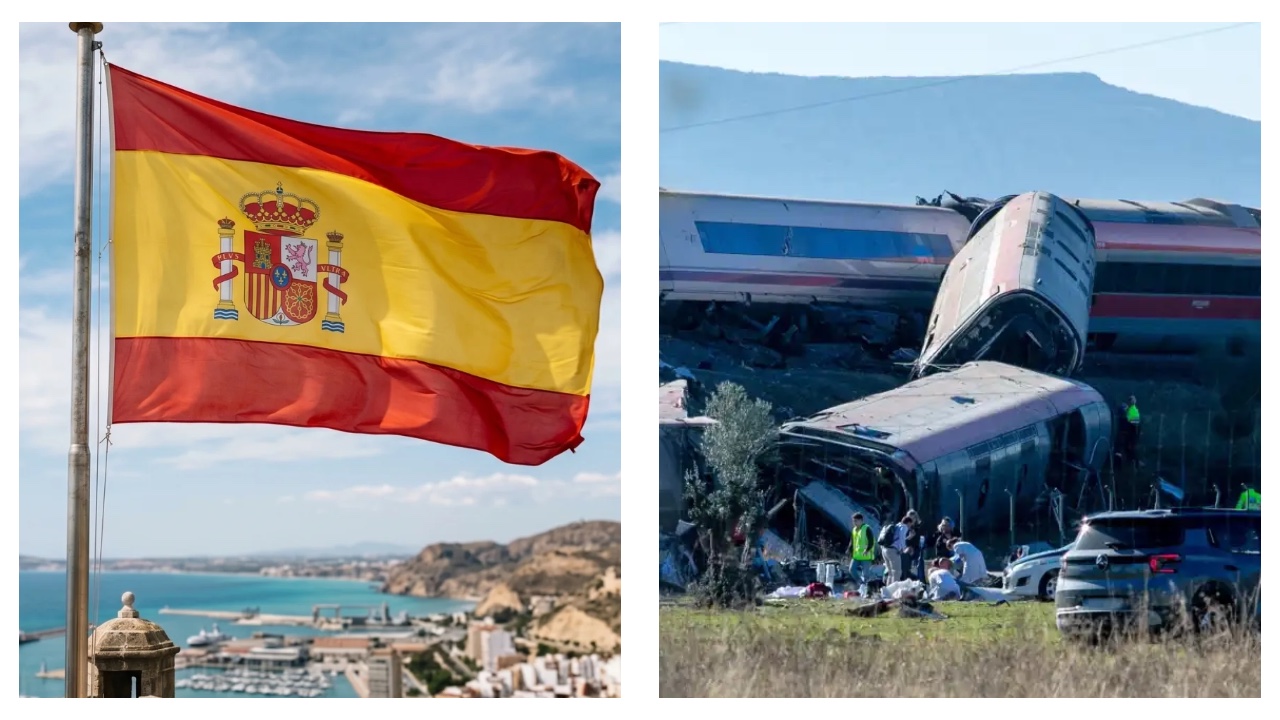
The chance of winning the 29 November general election has gotten slimmer for Spain’s governing Socialists now that their transport minister has decided to step down following a fatal high-speed rail crash, according to observers.
Óscar Puente confirmed to Congress his official resignation on Tuesday evening, six days after the incident claimed 69 lives and injured dozens near the town of Urda, south of Madrid.
Before his announcement, a lengthy session was recently held to discuss his proposed safety measures and respond to the opposition’s questioning.
“A transport minister in a country like Spain cannot remain in office after two accidents of this seriousness in less than a year,” he said, a reference to January’s crash on the same line that resulted in 46 casualties.
He also said, “I am not only stepping down from my position as minister of transport, but… I am also withdrawing my name from the lists for the early legislative elections.”
A dilemma for the government
Many were in disbelief at Puente’s decision, especially since he had stated just days earlier that leaving was not an option.
But for the conservative People’s Party, the far-right Vox and several government allies, it was a move that needed to be done.
They argued that he should be held accountable for a rail system that has now brought fear to many local commuters, whose credibility Prime Minister Pedro Sánchez admitted was “broken”.
Puente is also being accused of putting the heavier blame on human error.
Resigning risked looking like an admission of fault, while staying risked looking insensitive.
Puente said that “political dignity” was the driving force of his resignation.
His move was hailed by Sánchez, saying, “Out of dignity. Of his own accord. Out of respect for the victims.”
READ MORE: EU hints at leniency on harnessing oil, gas in the Arctic region
Questions over the control centre
The crash involved a Renfe train carrying 397 passengers and a stationary Iryo train with 147.
A reported computer failure in the automatic signalling system had forced all trains on the stretch to halt.
Leaked recordings published in Spanish media suggest that the Renfe train was cleared to move even though the Iryo train was stopped about 25 kilometres ahead.
A controller told the Renfe driver, “Continue your journey and then proceed under [Lateral Signalling Block], at normal speed with normal operation.”
The driver asked: “At normal speed?”
“Yes,” the controller responded.
The Iryo driver separately reported being “stationary in front of the entry signal at Urda” and later said, “The train won’t allow me to control the [security] system. That’s why I am still stopped in front of the entry signal.”
Iryo said its carriages were “struck from behind”.
With one of Europe’s worst modern rail disasters now central to the campaign, Puente’s successor faces the task of restoring public trust.
READ NEXT: Singapore steps up Indonesian haze probe, summons companies involved
 Liam McLaughlan
 Carmela Calling
 Jheruleene Anne Ramos