
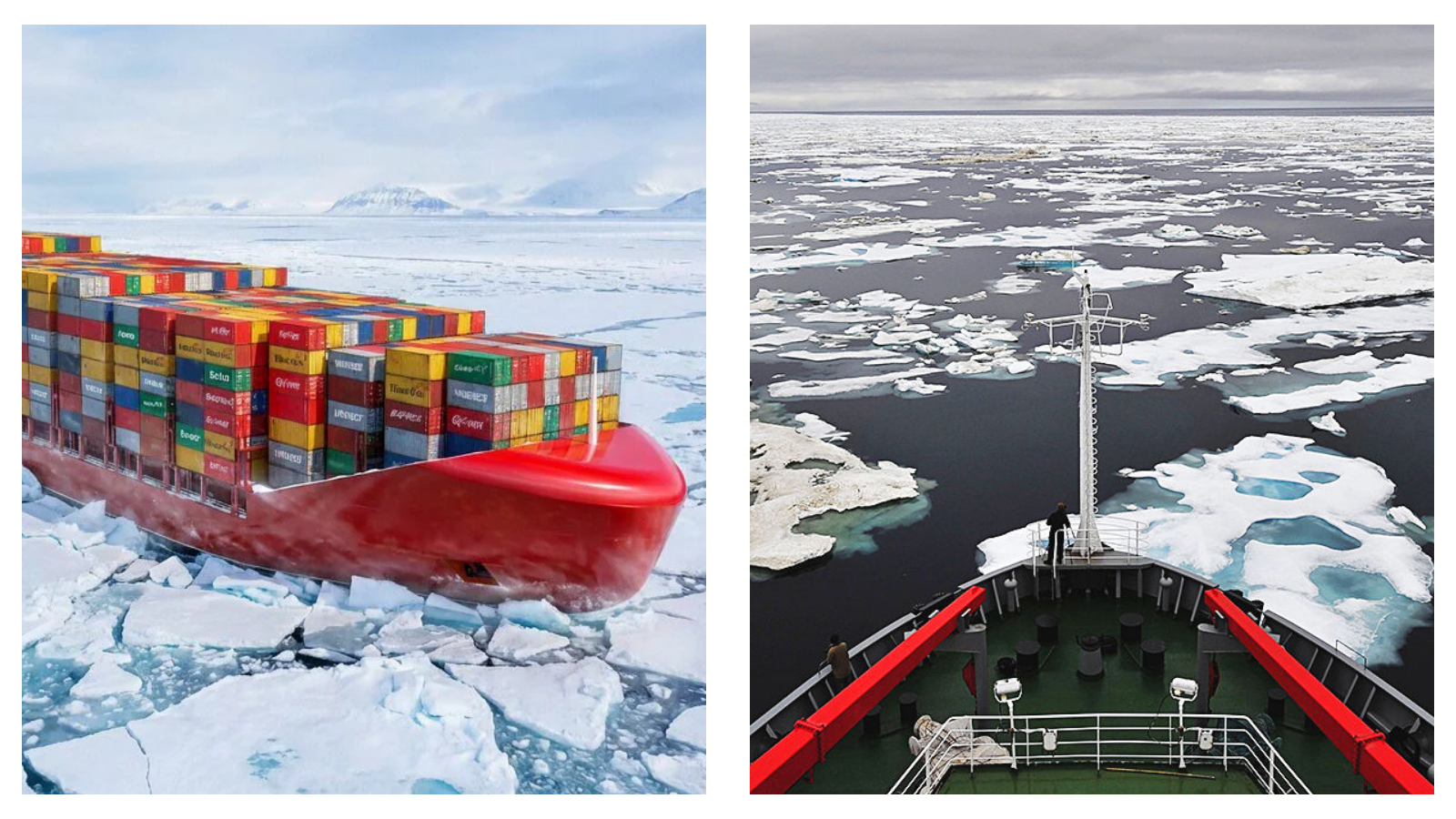
A new design to build a ship capable of traversing, and potentially opening, a new shipping route into the Arctic region was revealed by a partnership of Chinese and Russian shipbuilding companies in a bid to create a new shipping route in the said ice region.
The Rosatom Arctic program, co-spearheaded by Chinese-based NewNew Shipping Line and Russian state nuclear corporation Rosatom, has reached a new milestone after dropping the new designs for five large ice-class container ships that would be designed by United Shipbuilding Corp., also based in Russia.
Vladimir Panov, representative of Rosatom Arctic, said during the Eastern Economic Forum that the ships are expected to be over 4,800 twenty-foot equivalent units, measuring 255 meters and boasting a 35m beam capable of crossing level first-year ice of up to 1.7m thick.
He said that vessels would also have sustainable features thanks to their 46-megawatt diesel-electric power plant, while two 15-MW electric propulsion motors would power their fixed-pitch propellers.
China’s and Russia’s plans in the Arctic remain vague
China and Russia have been among the most aggressive nations vying to establish a shipping route in the Arctic region. So much so that the allied nations have signed a landmark joint venture called the Northern Sea Route Shipping Line program, signed in late 2024.
China has dreamed of pursuing a “polar silk road” that would stretch across the Arctic region and would act as an extension of its Belt and Road Initiative.
Russia, on the other hand, has placed the Arctic region among its long-term priorities that would grant the country vast access to seas and oceans as its current icy coastlines begin to melt from the impacts of increasing global temperatures.
Russian President Vladimir Putin pitched the development of the $400 billion Trans-Arctic Transport Corridor to pave the way for at least 270 projects to build key infrastructure in the country’s region in the Arctic zone until 2035.
Despite announcing major plans to potentially exert early influence in the Northern Sea territories, the plans of China and Russia have yet to push through, as interests and investments have only trickled in over the past years due to huge risks and sanctions from the West.
ALSO ON NJN: India bolsters AI deployment for maritime surveillance
Race to dominate the icy region
Apart from China and Russia, European nations and the United States have also begun to make their moves to lay claim to the growing opportunities in the Northern Sea region.
The European Union (EU) has acknowledged that the Arctic region has always been an integral part of its security environment and a potential leverage for Europe’s economic stability in the future.
A summit led by EU leaders is set to be held in Finland to tackle the EU’s plans for its Arctic region and push for a sustainable and strategic direction.
Meanwhile, the US has been aggressive in exerting its presence in the Arctic, even threatening to take over Greenland as part of its national security.
Washington has also struck a shipbuilding deal with Finland to bring its icebreaker fleet closer to the Arctic region as part of its efforts to stay in the race in the icy territory.
 Rosemarie Zamora
  Andre Alfonso R. Gutierrez
  Bobbie Matias