
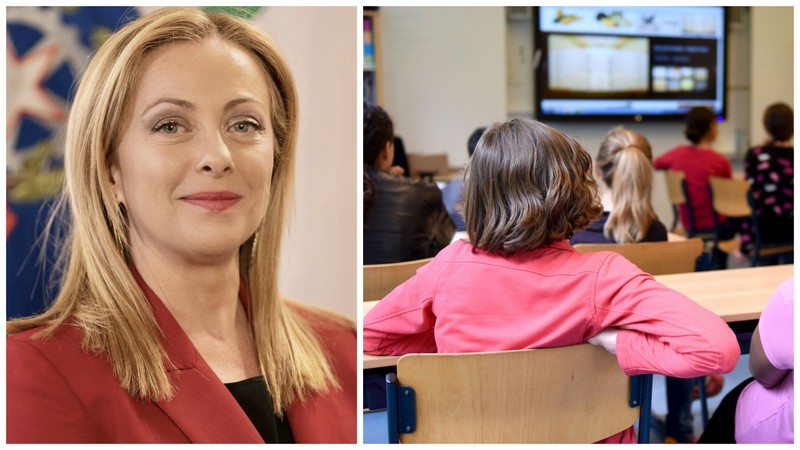
Prime Minister Giorgia Meloni faced sharp criticism as Italy approved a decree on September 24, 2026, aimed at limiting the number of foreign students in classrooms and prohibiting face coverings such as the burqa and niqab in schools, which the opposition described as a “witch hunt.”
Under the decree, there would be a 30 per cent cap on the number of foreign students with limited Italian-language proficiency in the first year of primary, middle and high school, Euronews reported.
However, the limit is flexible and could be adjusted in certain cases, including when foreign students have proficient Italian-language skills or when schools face specific circumstances.
The law also requires parents with “limited” Italian proficiency to enrol in free Italian-language courses and reach A2, or pre-intermediate, level.
Failure to comply with the measures could result in fines of up to EUR1,000 ($1,620) and may lead to children being transferred to nearby educational institutions.
YOU MAY ALSO LIKE: Advocates slam Indonesia’s anti-LGBTQ+ education efforts
Italy bans burqa, niqab in schools
The new legislation also prohibits students from participating in school activities with their faces covered or in any way that prevents identification. Violators could face fines of up to EUR1,000.
Although the decree does not explicitly mention the Islamic burqa or niqab, Meloni indicated that the measure targets such face coverings when announcing the new policies.
The move comes even though burqa and niqab use remains uncommon in Italy, with only about 500 to 600 women estimated to wear them nationwide.
The measure is expected to take effect immediately as a decree law, but it must be ratified by parliament within 60 days.
Govt hails new measures
Meloni said the move to limit foreign students in classrooms reflects Italy’s desire for immigrants who wish to “build a future in Italy” to learn the country’s language and culture.
She also said the face-covering ban aims to ensure students’ safety in classrooms and strengthen gender equality.
“When a woman – or worse, a young girl – is forced to cover her face, she is being denied fundamental rights and the very integration that is so often loudly championed,” she said, as quoted by Inquirer.net.
Meanwhile, Education Minister Giuseppe Valditara said that the cap on foreign students is “purely linguistic,” saying that it only aims to avoid “ghetto classes” or classrooms with high concentrations of non-Italian speakers.
Opposition accuses govt of ‘witch hunt’
However, the new measures drew criticism from the opposition and advocacy groups, with Democratic Party leader Elly Schlein describing the move as a “new witch hunt at the expense of children.”
“Faced with all this, the government’s response is to kick foreign children out of the classroom…After four years of cuts and no serious investment in school buildings, they’re inventing a witch hunt that targets the youngest children,” she said, as quoted by The Guardian.
Schlein further called the new decree “shameful” and accused the Meloni-led government of placing additional burdens on Italian parents amid poor school infrastructure, high textbook costs and low teacher salaries.
Human rights groups such as Save the Children also denounced the measures, warning that excluding individuals based on nationality and limited language proficiency would create “first class” and “second class” students.
‘Political propaganda’
Other critics also accused Meloni of using the decree as a political or symbolic gesture aimed at appealing to right-wing voters ahead of next year’s general election.
Daniela Ionita from the group Italians Without Citizenship accused Meloni of “creating emergency” as part of efforts to intensify divisive rhetoric, court right-wing voters and counter emerging political rivals.
Such accusations came as the Roberto Vannacci-led Futuro Nazionale (FN) has gained popularity since February, with polls suggesting it could secure around eight per cent of the vote in the elections.
Political scientist Marco Tarchi noted that many of FN’s potential voters are former supporters of Meloni’s Brothers of Italy party who have expressed disappointment over the premier’s softened stance on key issues.
Limited impact expected
Nevertheless, Costanzo Ranci, head of the Social Policy Lab at Milan Polytechnic, told Reuters that capping the number of foreign students would likely have little “real impact” in the long run.
He noted that the new policy would likely affect only around 300 children nationwide, potentially fewer than 1,000 and possibly none, suggesting its practical impact could be limited.
The expectations come as Meloni and her party face growing competition from political rivals ahead of next year’s elections.
Meloni became Italy’s longest-serving prime minister since World War II after spending 1,413 days in office by early September, surpassing the previous record set by Silvio Berlusconi by one day.
READ NEXT: Crime case divides Italy, Elon Musk steps in
 Kamille Q. Cabreza
  Geoffrey H. Latayan
  Carmela Calling