
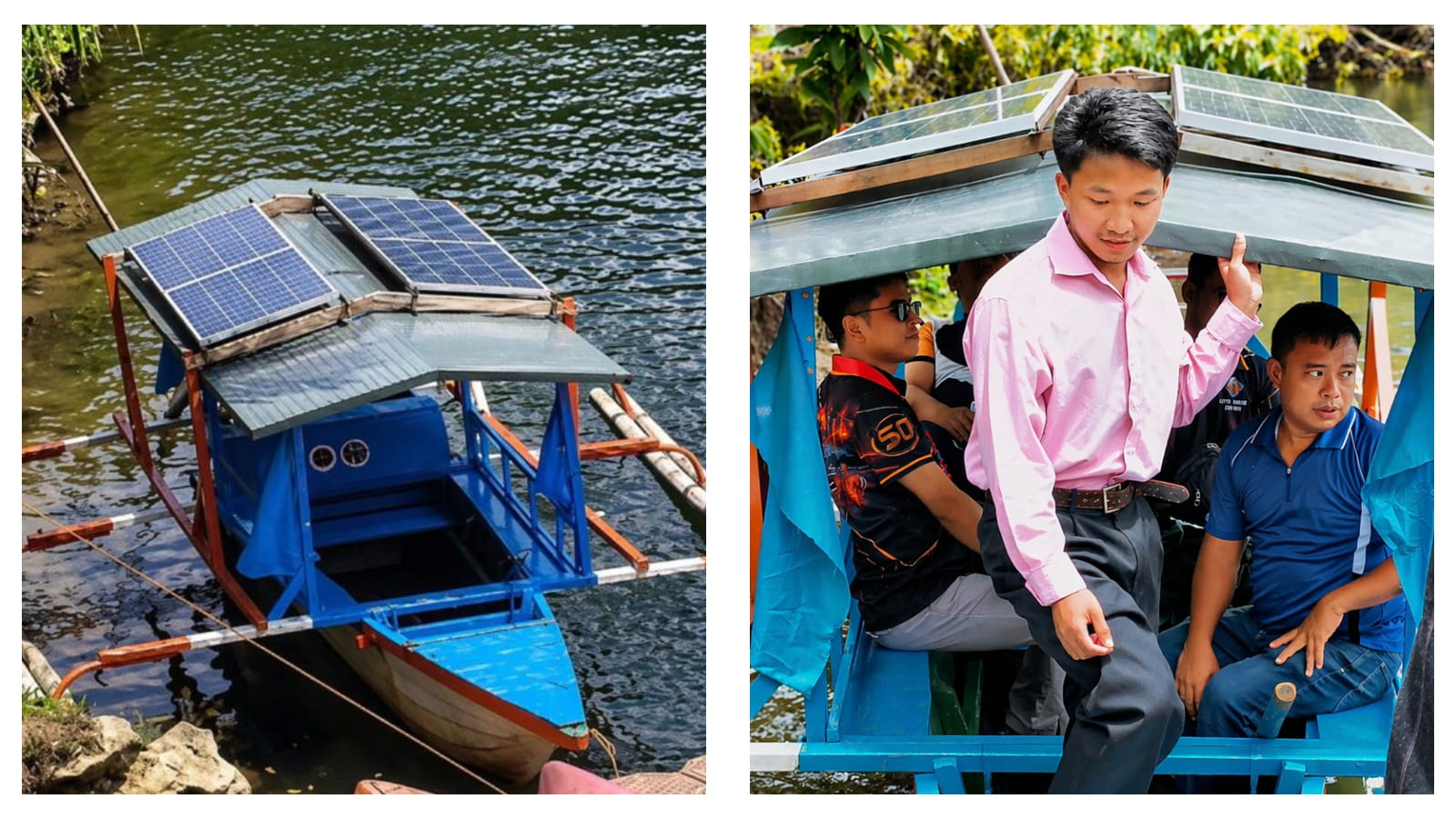
A student-built solar-powered pump boat is being trialled in one of the Philippines’ most visited eco-tourism sites.
It’s highlighting how local engineering projects are beginning to intersect with transport needs in remote tourism areas where fuel costs remain volatile.
The vessel was developed by four graduating electrical engineering students from Eastern Visayas State University (EVSU) in Tacloban City.
It was then turned over to a community-based organisation operating in Sohoton, Basey – an area that sits within the wider Samar Island Natural Park.
The area is a protected landscape known for its caves, rivers, limestone formations, and forest ecosystems.
Titled, “Design and Implementation of a Solar Electric Pump Boat for Tourist Transportation in Sohoton, Basey, Samar,” the project was designed to explore alternatives to fuel-dependent transport in a destination where boats are essential for moving visitors through river and cave routes.
Addressing fuel costs
Sohoton’s tourism operations rely heavily on pump boats, a mode of transport commonly powered by gasoline or diesel.
Rising fuel prices have increased operational costs, prompting interest in alternatives to reduce dependence on conventional energy sources.
The student developers, Antonio Adorza Jr., Mac Jandy Guintadcan, Brian Jeffrey Reyno and Richard Reynada, designed the boat to run primarily on solar power.
The system removes the need for fossil fuels in its operation, which they said was a response to both cost pressures and environmental concerns affecting local tourism services.
The prototype has been integrated into community operations managed by the Sohoton Services Cooperative, which oversees tourist transport within the area.
Beatriz Boleche, a representative of the cooperative, said fuel costs had been a continuing challenge for operators.
“This is a big help to us, especially now that fuel prices are high,” she said in an interview with the Philippine Information Agency.
“The integration of solar into our service motorboat reduces our dependence on gas.”
READ MORE: Solar power reshapes small bakery operations in the Philippines
Engineering design
The boat is powered by four 100-watt solar panels connected to a 48-volt battery system, which in turn drives a 1,500-watt electric motor.
According to its developers, the configuration was intended to support steady and quiet navigation along designated tourist routes.
Unlike conventional pump boats, the solar-powered version produces no direct carbon emissions during operation and generates significantly less noise.
These factors that are relevant in a protected environment where tourism activities take place alongside sensitive ecosystems.
Furthermore, Reyno said the team spent around PHP40,000 on the prototype.
He described the system as an attempt to demonstrate an alternative approach to small-scale marine transport.
“One of its biggest advantages is that it doesn’t rely on fuel. It’s quiet, clean, and environmentally friendly,” he said.
The project was developed over a period of about six months, during which the students refined its design before completing a working version capable of operating on local routes.
EVSU School of Engineering Dean Vinyl Oquiño said the university plans to seek wider engagement for the project, including possible presentations at research conferences and discussions with government agencies and partners.
“We aim to present this in research conferences and exhibits, and seek support from agencies like the Department of Science and Technology and the Department of Tourism, as well as public and private partners,” he said.
As fuel prices continue to fluctuate, the project has drawn attention as an example of how local engineering initiatives are being tested in real-world settings.
Whether it can be scaled beyond its pilot use in Sohoton remains to be seen, but for now, it represents an incremental shift in how small tourism economies are exploring energy alternatives.
READ NEXT: Philippines rights body to probe deadly military clash that killed student activist, 18 others
 Angelica N. Hall
  Geoffrey H. Latayan
  Diana Mae Y. Cleto