
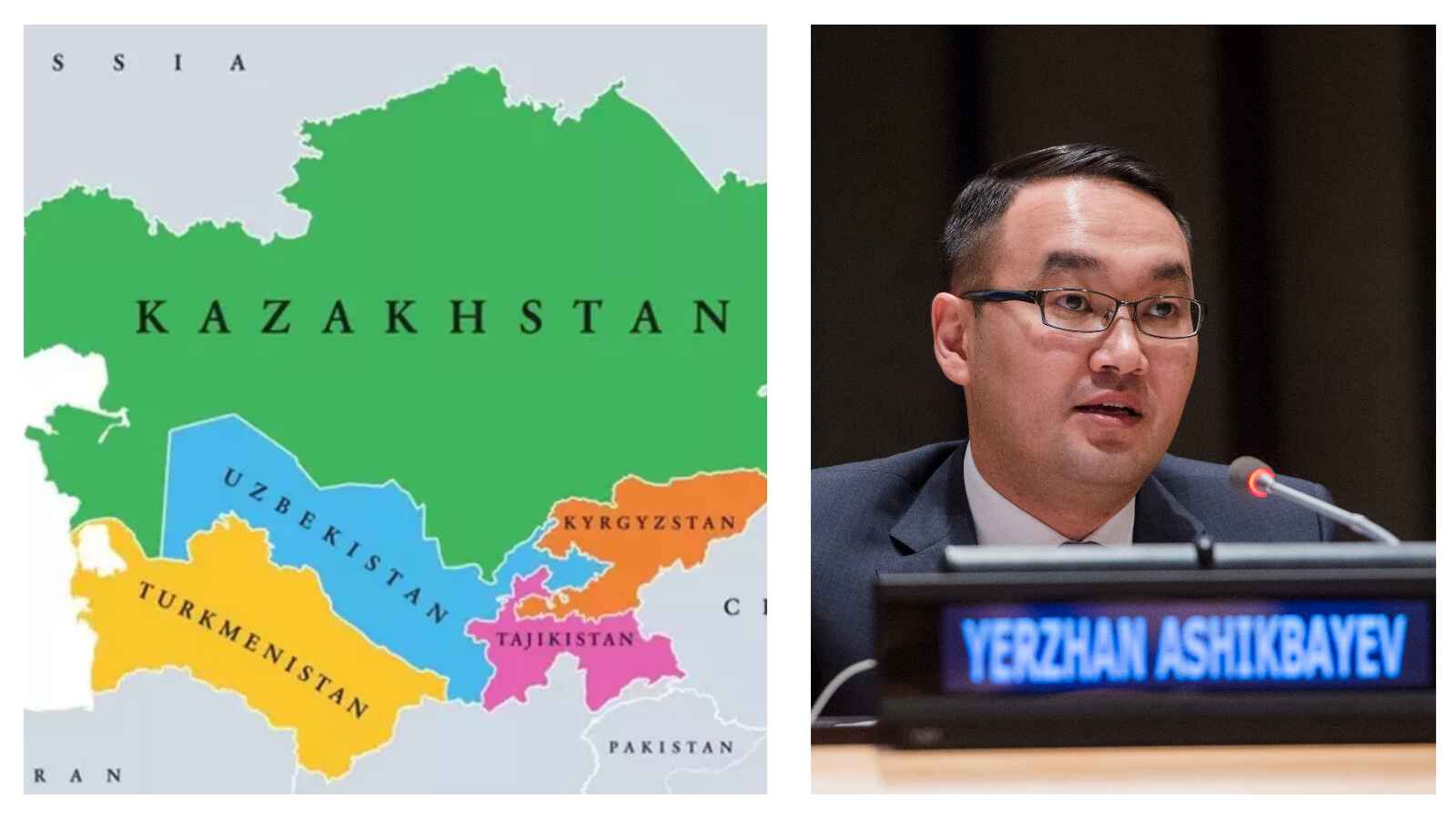
Twenty years ago at Semipalatinsk, Kazakhstan — once the Soviet Union’s testing ground for nuclear weapons — a group of Central Asian countries jointly endorsed the Central Asian Nuclear-Weapon-Free Zone (CANWFZ) treaty, a legally binding commitment not to manufacture, acquire, test or possess said weapon of mass destruction.
The landmark accord, commonly known as the Semipalatinsk Treaty, saw Kazakhstan, Kyrgyzstan, Tajikistan, Turkmenistan and Uzbekistan renounce nuclear weapons in 2006, marking a major turning point in the security, stability and peace in the region.
Today, with a series of geopolitical tensions unfolding, a Kazakhstan senior diplomat believes the significance of this covenant extends far beyond Central Asia.
“The contribution of the Semipalatinsk Treaty to ensuring security not only in Central Asia but also beyond its borders, is undeniable,” First Deputy Minister of Foreign Affairs Yerzhan Ashikbayev, said at the 2026 review conference of the Nuclear Non-Proliferation Treaty at United Nations headquarters, adding that “in such critical periods the zone (referring to CANWFZ) demonstrates that its existence is a positive factor.”
He further pointed out that the creation of the Semipalatinsk Treaty reflects a shared commitment by the countries of the region to not only strengthen security, stability and peace, but also to overcome the legacy of nuclear testing.
However, the “establishment of such zones must be a sovereign decision of the States concerned,” Ashikbayev noted, as cited by UN News.
YOU MAY LIKE: World Bank approves funding to boost women’s employment in Tajikistan
UN expert weighs in
A UN expert who also took part in the Kazakhstan-organised conference on April 29 raised a similar commendation for the 20-year-old Semipalatinsk Treaty, stating that “nuclear-weapon-free zones (NWFZs) are not only historical achievements but also living instruments of regional security, non-proliferation and nuclear risk reduction.”
“Such zones contribute to transparency, confidence-building and risk reduction, and they can help maintain a practical bridge between regional security concerns and global non-proliferation and disarmament architecture,” added Christopher King, Chief of the Weapons of Mass Destruction Branch at the UN Office for Disarmament Affairs (UNODA).
Other nuclear-weapon-free zones
According to the UN Office for Disarmament Affairs, the world has five major treaties prohibiting the development, testing and deployment of nuclear weapons, covering the regions of Central Asia, Southeast Asia, South Pacific, Latin America and Africa, with Antarctica and Mongolia having a special nuclear-weapon-free status as well.
Other treaties that deal with the denuclearisation of geographical regions include the Outer Space Treaty, signed in 1967 to put forward “principles governing the activities of States in the exploration and use of outer space.”
There is also the 1979 Moon Agreement. It was designed to govern the activities of States on the moon and other celestial bodies.
The Seabed Treaty of 1971 is another. It stipulates the “prohibition of the emplacement of nuclear weapons and other weapons of mass destruction on the sea-bed and the ocean floor and in the subsoil thereof.”
READ NEXT: More than half of nations restrict press freedom, report finds
 Hazel Camba
  Carmela Calling
  Jheruleene Anne Ramos