
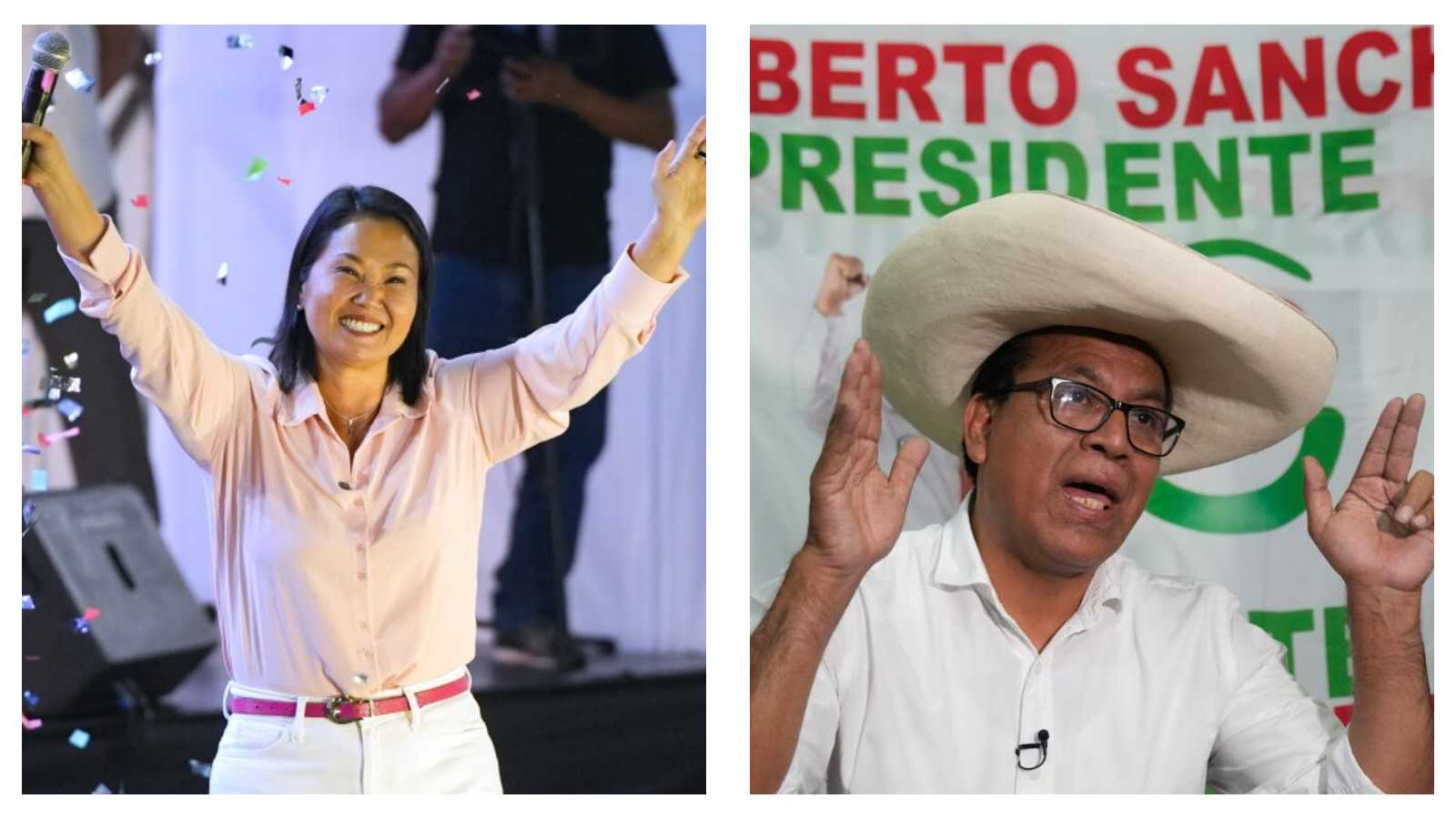
Peruvians are headed for a pivotal presidential run-off on June 7 after the country’s electoral body confirmed the official results of the first round, which was marred by fraud allegations.
According to Peru’s National Jury of Elections (JNE), right-wing candidate Keiko Fujimori will face left-wing Congress member Roberto Sanchez in the run-off following the polarising first round of voting on April 12.
JNE confirmed that the 50-year-old Fujimori of Fuerza Popular secured first place with 2.8 million votes, or 17.19% of the total, earning her a place in the presidential run-off for the fourth time, National Public Radio reported.
Sanchez of the Juntos por el Peru party garnered 2.015 million votes, or 12.03%, to secure second place, narrowly ahead of conservative former Lima mayor Rafael Lopez Aliaga, who received 11.90%.
Both defeated 33 other candidates vying for the presidency, but neither won more than 50 per cent of the vote required to secure an outright victory in the first round.
Two different visions for Peru
The run-off is expected to highlight two starkly different visions for leading the troubled South American country and addressing mounting security concerns.
Fujimori, the daughter of late president Alberto Fujimori, has increasingly leaned on her father’s divisive legacy, vowing uncompromising security measures, stricter anti-terrorism laws and an expanded role for the military, Reuters reported.
She has also pledged greater financial assistance for children and the elderly while advocating pro-business policies and a “deregulatory shock” aimed at spurring economic growth.
Meanwhile, Sanchez has vowed to convene a constituent assembly to replace the current constitution adopted in the 1990s under the late Fujimori, who died in 2024.
The leftist lawmaker has also advocated greater state oversight of natural resources and pledged to review existing mining and gas contracts, impose taxes on windfall profits and introduce a wealth tax on higher earners.
YOU MAY ALSO LIKE: Cockroach Janta Party: India welcomes a new political party of… roaches?

A close electoral battle
Their sharply contrasting platforms are expected to intensify political divisions ahead of what analysts predict will be a highly competitive presidential run-off.
According to an April 26 Ipsos opinion poll, Fujimori and Sanchez are tied, with each projected to secure around 38 per cent of the vote.
“The second round may be bitterly polarising. Peruvians are actually crying out for more of a moderate national unity government after a decade of political and social strife,” said Eileen Gavin of Verisk Maplecroft, as quoted by Reuters.
Another Ipsos survey found that 48 per cent of respondents said they would not vote for Fujimori, down from 59 per cent before the April polls, while 43 per cent rejected Sanchez, up from 39 per cent, according to US News & World Report.
This suggests both candidates face significant voter resistance and, with a large share of the electorate still undecided, the race to replace interim President Jose Maria Balcazar for a five-year term is expected to remain close.
JNE vows to ensure fair, free polls
With the run-off expected to be tightly contested, JNE pledged to strengthen oversight measures to ensure the second round is conducted fairly and freely.
JNE President Roberto Burneo said during a press conference that the electoral body would further enhance monitoring efforts.
He also said JNE would form a committee of national and international experts to ensure a smoother voting process and avoid logistical problems during the run-off, Al Jazeera reported.
The pledges came as Burneo acknowledged that “difficulties” had delayed the first-round results by nearly a month.
“We cannot deny that there were many difficulties and flaws in the logistical deployment by the organising entity,” he said.
Calls to annul vote
The announcement came after Lopez Aliaga’s Popular Renewal party said it would seek to annul the first-round results, alleging “electoral fraud.”
Lopez Aliaga, popularly known as Porky, repeatedly claimed in recent weeks that the election was fraudulent and amounted to an “electoral coup d’état.”
However, JNE rejected calls to annul the vote and rerun the presidential election after conducting a comprehensive “technical and legal analysis” and reviewing reports from electoral authorities, Anadolu Agency reported.
Election observers also acknowledged shortcomings in the electoral process, but said there was no strong evidence of fraud.
Deepening political crisis
Despite these assurances, the chaotic first-round vote is expected to deepen public dissatisfaction with Peru’s political system and further erode trust in government institutions.
Before the April election, around 68 per cent of Peruvians said they had little or no trust in electoral authorities, according to a survey conducted by the Institute for Peruvian Studies and the Institute de las Casas.
The turmoil also underscores Peru’s deepening political crisis, which has seen the country cycle through nine presidents in the past decade due to repeated impeachment efforts led by Congress.
The instability has contributed to entrenched corruption, a fractured party system and frequent clashes between Congress and the executive branch, fuelling civil unrest and widespread public dissatisfaction.
READ NEXT: Philippines tourism campaign in Palawan shifts focus as rising travel costs affect arrivals
 Kamille Q. Cabreza
  Wendellyn Mateo