
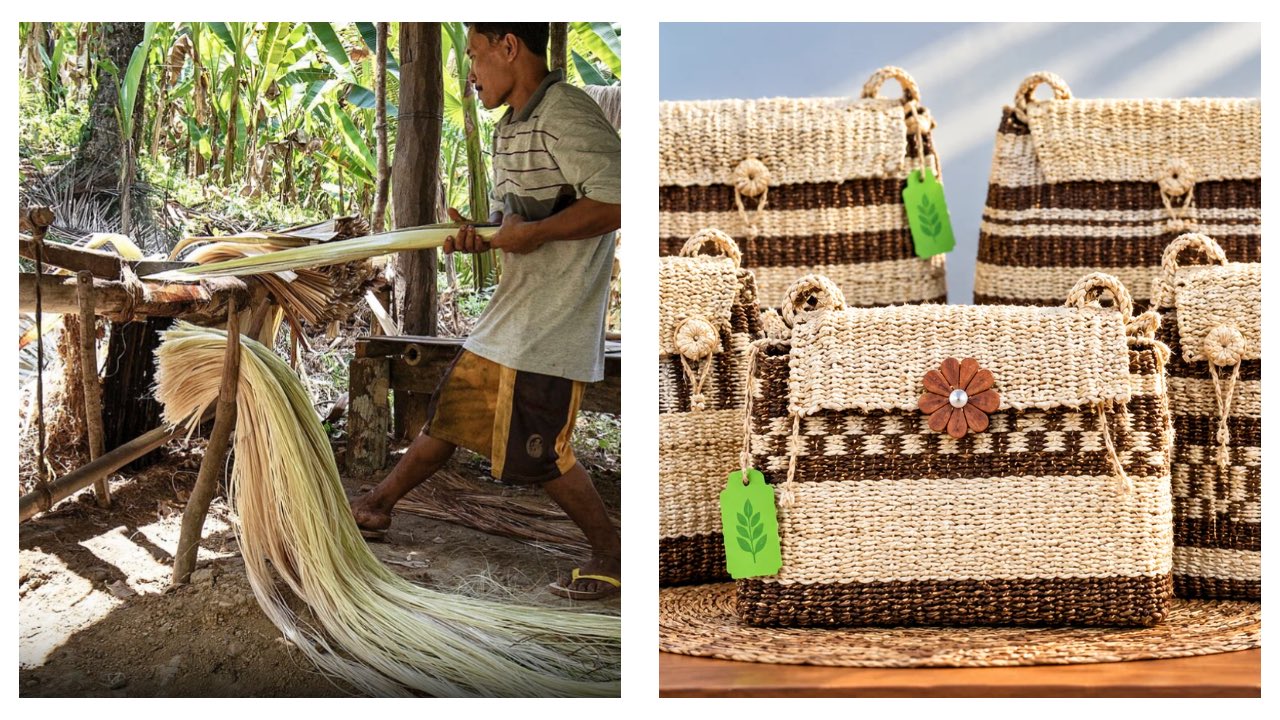
The Philippine government has begun training rural artisans in Leyte to weave locally grown abaca fibre into school bags as part of a wider effort to revive an industry reshaped around small-scale and sustainable products.
The training, held in Southern Leyte from 1 to 4 September and due to roll out in Leyte province from 8 to 11 September, forms part of the Philippine Fiber Industry Development Authority’s (PhilFIDA) drive to revitalise fibre-based handicrafts in the region.
According to a report by the Philippine News Agency (PNA), 25 trainers worked through every stage of school bag production, design, assembly, finishing and quality control, producing durable bags from locally spun abaca twine.
The programme draws on data from PhilFIDA’s National Fibercrop Survey and Mapping Project, which has already covered 1,250 farmers and more than 2,657 hectares in Sogod, Southern Leyte, documenting 923,502 abaca hills, of which 15,772 were found affected by disease.
A region rebuilding from disease
Eastern Visayas was once the country’s leading fibre-producing region until bunchy-top disease devastated farms there in the early 2000s.
In Anonang village, Burauen, farmer Francisco Renomeron harvested 25 kilograms of abaca fibre last year from a newly rehabilitated plot, his first yield in more than two decades.
Though it was far short of the 400 kilograms he used to harvest before the disease outbreak, Renomeron said he was “happy that there is a chance of recovery,” in an interview with the PNA.
READ MORE: Vietnam to celebrate first Culture Day on 24 November

A fibre entwined with the nation
Known also as Manila hemp, abaca’s history predates the Philippines as a modern state.
Historian Patricia Irene Dacudao told the Manila Bulletin’s Yvette Tan that the plant was used by indigenous groups such as the Bagobo and T’boli long before Spanish contact.
Davao’s abaca boom in the early twentieth century also drew settlers of 25 nationalities before collapsing by the 1950s under disease and the rise of synthetic fibre.
Dacudao added that there is money to be made in abaca production, pointing to emerging uses in car manufacturing and polymers as evidence that the fibre’s next chapter depends on innovation rather than nostalgia.
READ NEXT: Australia wants choice to ‘opt out’ of social media algorithms
 Mary Mae Balasanos
  Rosemarie Zamora
  Elan Castanares