
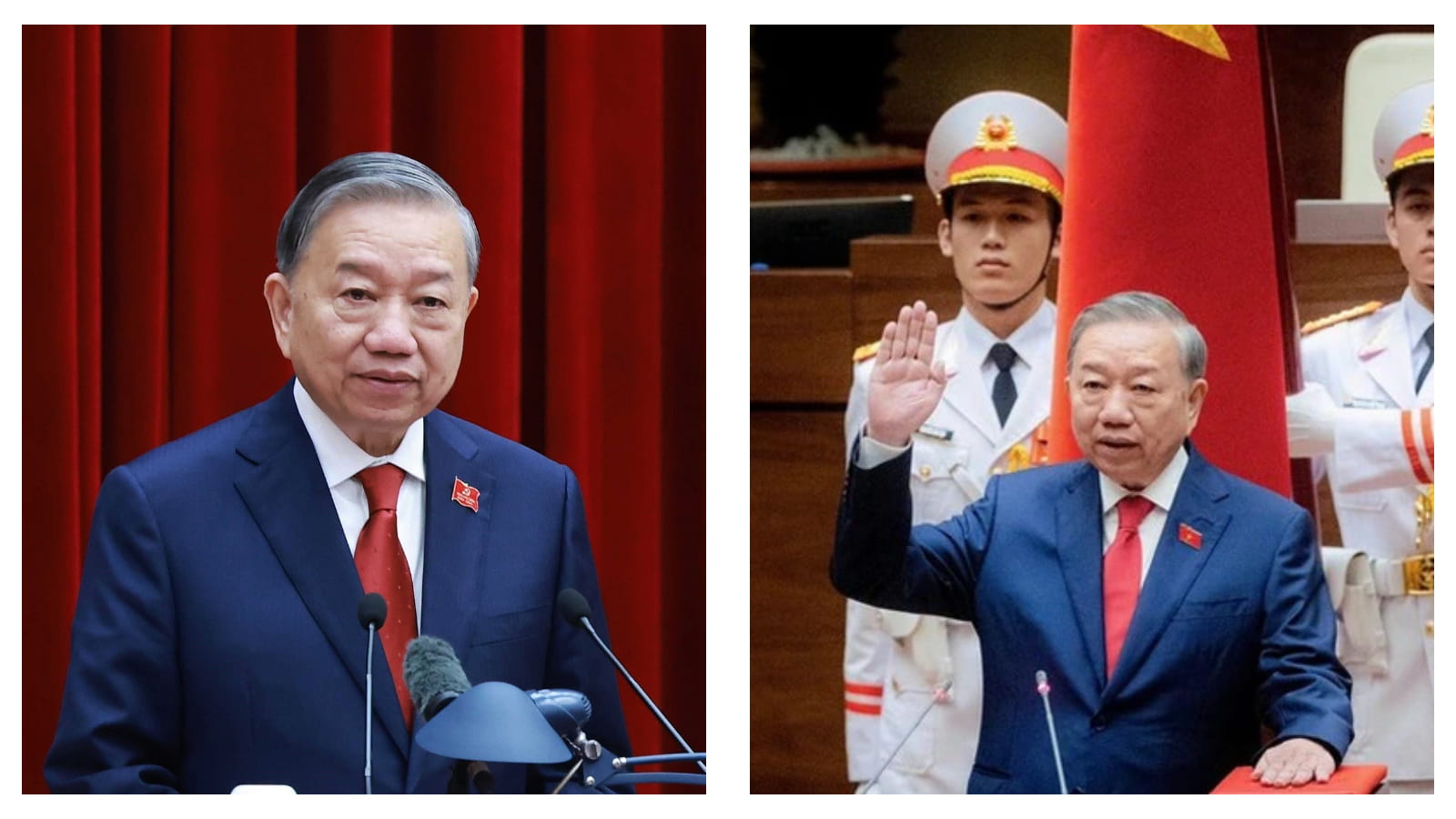
Vietnam’s newly minted legislature elected To Lam as state president for the next five years on Tuesday.
Lam won votes from all 495 deputies present in a secret ballot held during the 16th National Assembly’s (NA) first plenary session in Hanoi.
The result came nearly three months after the 68-year-old won re-election as general secretary of the ruling Communist Party with a pledge to continue stamping out corruption and drive the Southeast Asian country’s annual economic growth to 10% by 2030.
This marks Lam’s second stint at the helm, having previously served as both party chief and president for a brief time after the death of his predecessor, Nguyen Phu Trong, in 2024.
It also means that Vietnam has now pivoted to a leadership structure similar to that of neighbouring China and Laos.
New era begins under Lam
In his inaugural address, Lam called his dual role an “extremely great honour” and a reflection of the “trust and expectations placed by the entire party, people, and armed forces”.
He outlined his key priorities for the 2026–31 period, including maintaining a peaceful and stable environment; promoting Vietnam’s rapid and sustainable national development; improving people’s living standards; and enhancing the country’s contributions to regional and global peace, stability, and development.
Lam also pledged to establish a new growth model, with science and technology, innovation, and digital transformation as key driving forces, according to a transcript of his speech published by the Communist Party’s official newspaper, Nhan Dan.
READ MORE: Vietnamese travelers among Asia’s top food explorers
Economist Le Minh Hung becomes PM
Tuesday’s session also saw the election of economist and former central bank governor Le Minh Hung as prime minister.
A Lam ally and son of a former public security minister, he succeeded the now-retired Pham Minh Chinh.
At 55, Hung is Vietnam’s youngest cabinet leader since 1955. He is also the second head of the Organisation Commission — the Party Central Committee’s advisory body — to have assumed the premiership.
Addressing the NA after he was sworn in, Hung said the new government will focus on establishing a modern government that serves the people; achieving double-digit annual economic growth in the next five years; ensuring the effective implementation of the two-tier local administration model; and developing an “incorruptible, disciplined, resilient, and responsible government”.
23-member Cabinet takes office
Hung’s 23-strong Cabinet — comprising six deputy prime ministers, 14 ministers, and three heads of ministerial-level agencies — was unveiled the next day after securing approval from the legislature.
His deputies are first-time appointees Pham Gia Tuc, Phan Van Giang, Nguyen Van Thang, and Le Tien Chau, as well as Pham Thi Thanh Tra and Ho Quoc Dung, according to state-run Vietnam News.
Giang will also double as minister of national defence for the 2026–31 term.
Rounding out the Cabinet is a diverse group of senior ministers overseeing key portfolios across government.
General Luong Tam Quang has been appointed Minister of Public Security, while Le Hoai Trung takes on the role of Minister of Foreign Affairs. Do Thanh Binh will oversee Home Affairs, and Hoang Thanh Tung has been named Minister of Justice.
In the economic sphere, Ngo Van Tuan assumes responsibility for Finance, with Le Manh Hung leading the Ministry of Industry and Trade. Trinh Viet Hung has been appointed Minister of Agriculture and Environment, and Tran Hong Minh will head Construction.
The Cabinet also includes Lam Thi Phuong Thanh as Minister of Culture, Sports, and Tourism, alongside Vu Hai Quan, who will oversee Science and Technology. Hoang Minh Son has been appointed Minister of Education and Training, while Dao Hong Lan takes charge of the Health Ministry.
Nguyen Dinh Khang will oversee Ethnic and Religious Affairs, completing the core ministerial lineup.
Additional senior appointments include Pham Duc An as Governor of the State Bank of Vietnam, Nguyen Quoc Doan as Inspector-General, and Dang Xuan Phong as Minister-Chairman of the Government Office.
Among them, only three are women: Deputy PM Tra and Ministers Thanh and Lan.
READ NEXT: Qingming Festival: Honouring China’s fallen amid holiday travel surge
 Carmela Calling
  James Mario Ajero