
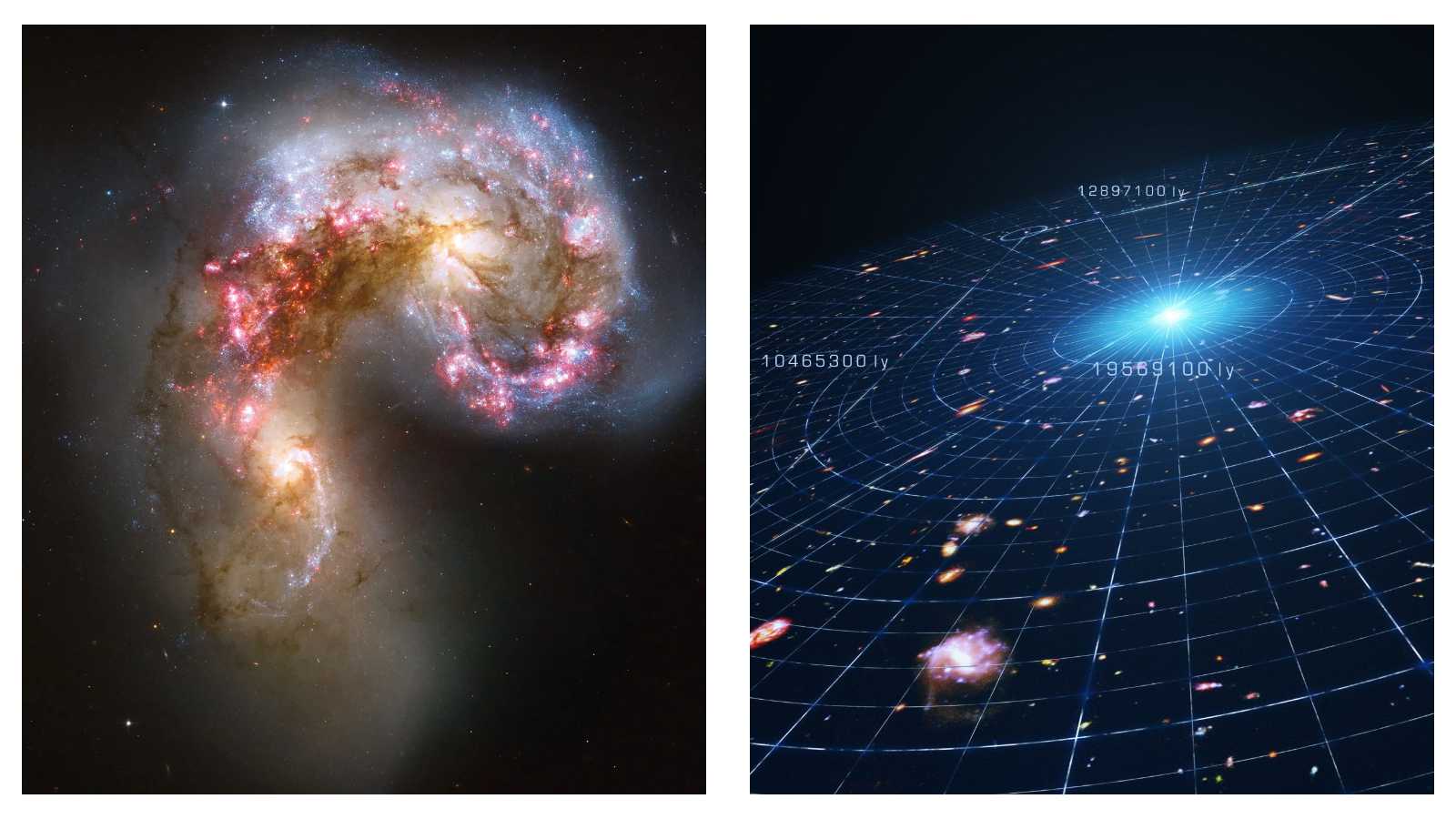
If intelligent extraterrestrial civilisations exist, then where are they?
The perplexing mystery was named after Italian-American physicist Enrico Fermi, who raised the same question with his colleagues in a lunchtime session in Los Alamos in 1950.
Since then, the Fermi paradox has appeared in numerous scientific papers as an enduring conundrum that has captivated the imagination of the most brilliant minds, from physicists to sci-fi writers, all offering solutions to the elusive mystery.
The paradox rests on the Drake equation, a probabilistic argument by astronomer Frank Drake, which suggests that the sheer number of planets in the galaxy implies that thousands, if not millions, could harbour intelligent life.
Yet the mystery persists: if the mathematical probability points to a vast number of habitable planets, why is there no clear evidence of intelligent extraterrestrial existence?
While this topic tends to be too science-y, let’s take a look at some of the most terrifying yet mind-boggling solutions to this famous paradox.
Zones of Thought
Many astronomers, like Sebastian von Hoerner, believe that humans are unable to communicate with any interstellar civilisation because we lack the technology powerful enough to detect messages from them, meaning we are simply not intelligent enough to be worth contacting.
In the sci-fi novel “A Fire Upon the Deep” by Vernor Vinge, stupidity is not treated as a character flaw, but a byproduct of geography. In the story, the galaxy is divided into regions called the Zones of Thought.
Each region is unique. For instance, in the region called the Slow Zone, where Earth resides, intelligent life can emerge. Yet technological advancements are limited, and civilisations are slow to develop. The physical laws of the region literally limit how advanced a civilisation can be.
In the Slow Zone, certain technological milestones like faster-than-light travel or sentient artificial intelligence are impossible to create. Any alien civilisation from higher regions will be literally handicapped the moment they enter the Slow Zone: Earth is simply not worth visiting or conquering.
YOU MAY ALSO LIKE: The Nobel Prize’s quirky cousin, Ig Nobel, puts wacky science on spotlight

Periodic extinctions
Maybe intelligent life is common across the universe after all, but so are mass extinctions, rendering extraterrestrial civilisations dead before they can even reach the stars.
Throughout its history, Earth’s flora and fauna have experienced five mass extinctions, with the latest Cretaceous-Paleogene extinction wiping out about 75 percent of species, possibly due to an asteroid impact. The dinosaurs died out, remember?
Even at the height of human technological development, there is no shortage of potential causes of death on a planetary scale. Earth’s life is under constant threat from large volcanic eruptions, asteroid explosion, gamma-ray bursts, global pandemics, and even nuclear war.
Periodic extinctions could make the galaxy appear devoid of living organisms, but in reality, it’s just too dangerous an environment to host a multitude of intelligent life forms.
Zoo hypothesis
What if aliens are really out there in deep space, waiting for us to reach our potential?
In 1973, radio astronomer John A. Ball introduced the Zoo hypothesis as a potential solution to the Fermi paradox. Under the hypothesis, our galactic neighbours are intentionally avoiding us to allow humanity to develop on its own.
There is a sociological angle to this perspective, particularly the assumption that aliens may be operating under an ethical or cultural principle that promotes non-contact instead of intervention.
Imagine an animal in a zoo, being kept there for safety, or worse, for entertainment. If we push this idea further, it could be that humanity is too dangerous to be admitted as an official member of the galactic community (if there is one).
Considering our current sociopolitical climate, it’s easy to see that we are not making a good case for ourselves. The aliens might see us actually going backwards due to the same policies that led to two global wars before.
READ MORE: German startup Isar Aerospace achieves historic orbital launch

The Dark Forest
This hypothesis is named after the sci-fi novel “The Dark Forest” by Chinese writer Liu Cixin.
The novel is a sequel to “The Three-Body Problem”, which Netflix adapted as a series titled with the same name.
Imagine the galaxy as a dark forest; in it, various animals of shapes and sizes exist, big and small, long and short, prey and predator.
According to this hypothesis, any intelligent alien civilisation would likely avoid sending signals across deep space to prevent hostile interstellar aliens from detecting its location.
If we look at human history, civilisations with differing cultures, languages, and technological levels meeting each other for the first time often result in violence.
One good example of this trend is the European colonisation of the Americas and some parts of Asia.
A hostile civilisation could either enslave or massacre the natives of its newly conquered territory for whatever reason, such as for the purpose of stealing its resources, or simply due to evil.
This hypothesis is particularly sinister because it draws from humanity’s experiences throughout its recorded history.
If this hypothesis is true, wouldn’t it make more sense that humanity refrain from contacting extraterrestrials at all?
The answers are out there in deep space.
READ NEXT: France first to impose levy targeting ultra-fast fashion
 Angelica N. Hall
  Kamille Q. Cabreza
  Geoffrey H. Latayan