
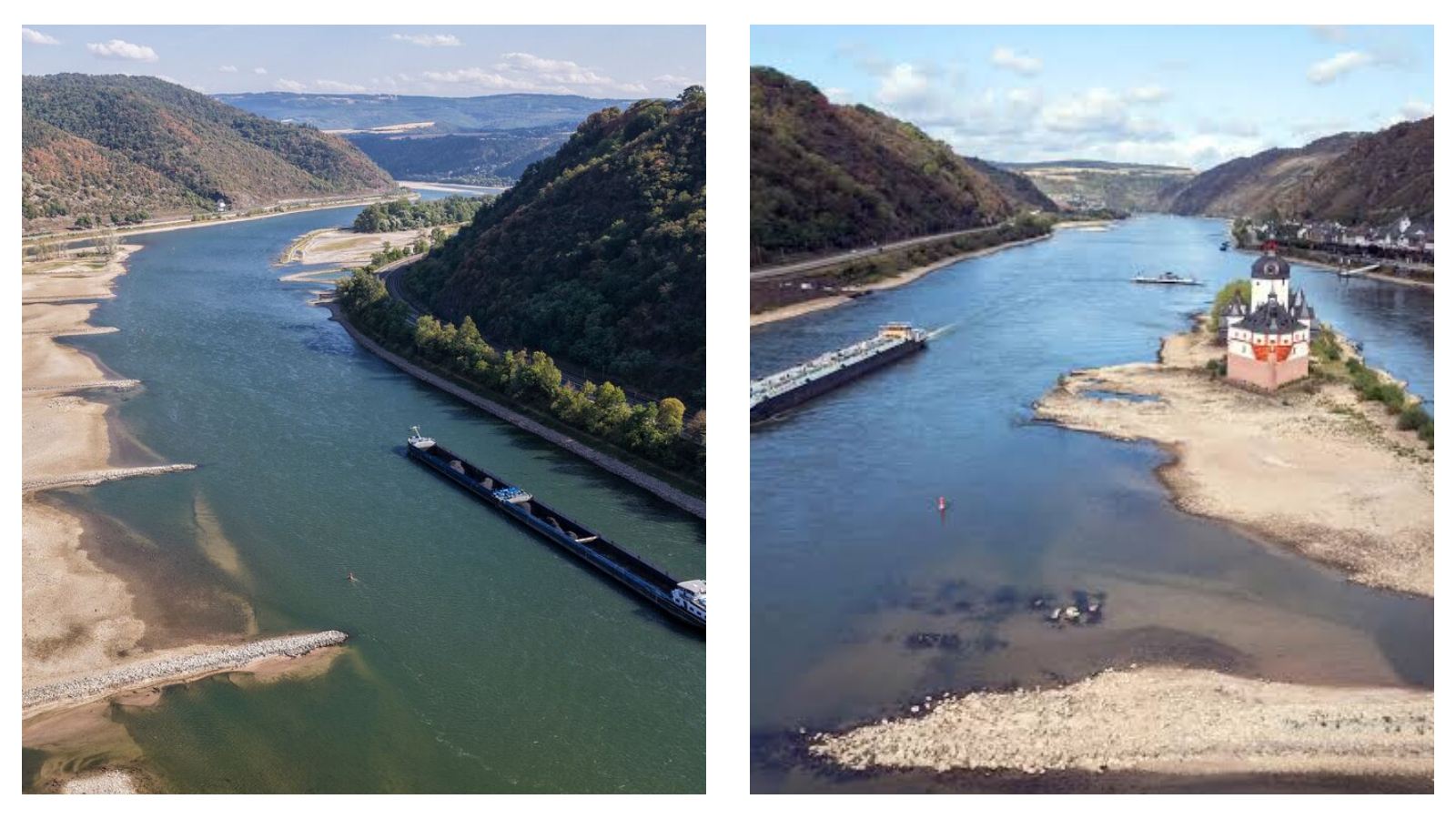
Experts have confirmed that water levels of the Rhine River have reached yet another grim record not seen since the 1800s.
Companies relying on the waterway have been forced to be creative and innovative to cushion the impacts of the drought.
Becoming a ‘source of uncertainty’
According to the latest survey, the Rhine’s water level dropped again by two centimetres on Thursday, September 17, then recovered by a mere five centimetres the following day.
Despite the recovery, the river remains below the gauge used to measure whether vessels can pass through it.
The news has pushed companies to create designs fitting to the situation, with the Development Centre for Ship Technology and Transports Systems (DST) releasing a line of initial designs of model ships and small-scale prototypes of vessels that can be used to traverse the drying Rhine.
DST researcher Cyril Alias called the Rhine a “source of uncertainty” as the drought in the region is expected to last longer than usual due to climate change, making the river’s recovery difficult and unpredictable.
READ MORE: Italy greenlights development of 13,500-tonne destroyers
Pushing for new-gen vessels
Major chemical plants along the Rhine are now facing pressure to bolster and adjust their fleets to cope with the prolonged low water levels of Germany’s key waterway.
Of the 13 low-draft vessels in Germany, nine are owned by HGK and are seen as indefinitely replacing its usual wider and bigger ships.
Experts said that while opting for smaller ships would be a temporary answer to the current issue on the Rhine, some companies would not swiftly invest in newer fleets, as industries have initially struggled to cope with weak demand and rising international competition.
HGK’s chief executive officer Steffen Bauer has called for government support for potential steps in using smaller ships along the Rhine River, especially for small- and medium-sized businesses.
ALSO ON NJN: SpaceX to launch Starship on historic orbital test flight

German economy taking another hit
The Rhine River has long been a vital waterway for Germany and a major asset for the country’s export and industrial sectors.
The Association of German Banks said in its latest report that a whopping 173 million tons of goods were transported in Germany’s inland waters, including the Rhine, where most of the country’s major chemical plants are situated.
Some of the raw products that pass through the 1,233-kilometre river include ore, coal, sand and petroleum products meant to be sent to neighbouring European nations.
With the record-breaking depletion of the river, the German economy now becomes vulnerable to a potential slowdown in development, with experts from the German Economic Institute warning of a 0.4% drag on the growth of Germany’s gross domestic product (GDP) in 2026.
The situation in Rhine was an addition to the string of setbacks that Germany has been facing this year amid projected sluggish national GDP growth, skyrocketing energy costs driven by the Middle East war, and its once-prized industrial sector losing competitiveness.
READ NEXT: ‘Europe is with you’: EU chief unveils fresh relief package for conflict-torn nations
 Elan Castanares
 Ciara Mina
 Jheruleene Anne Ramos