
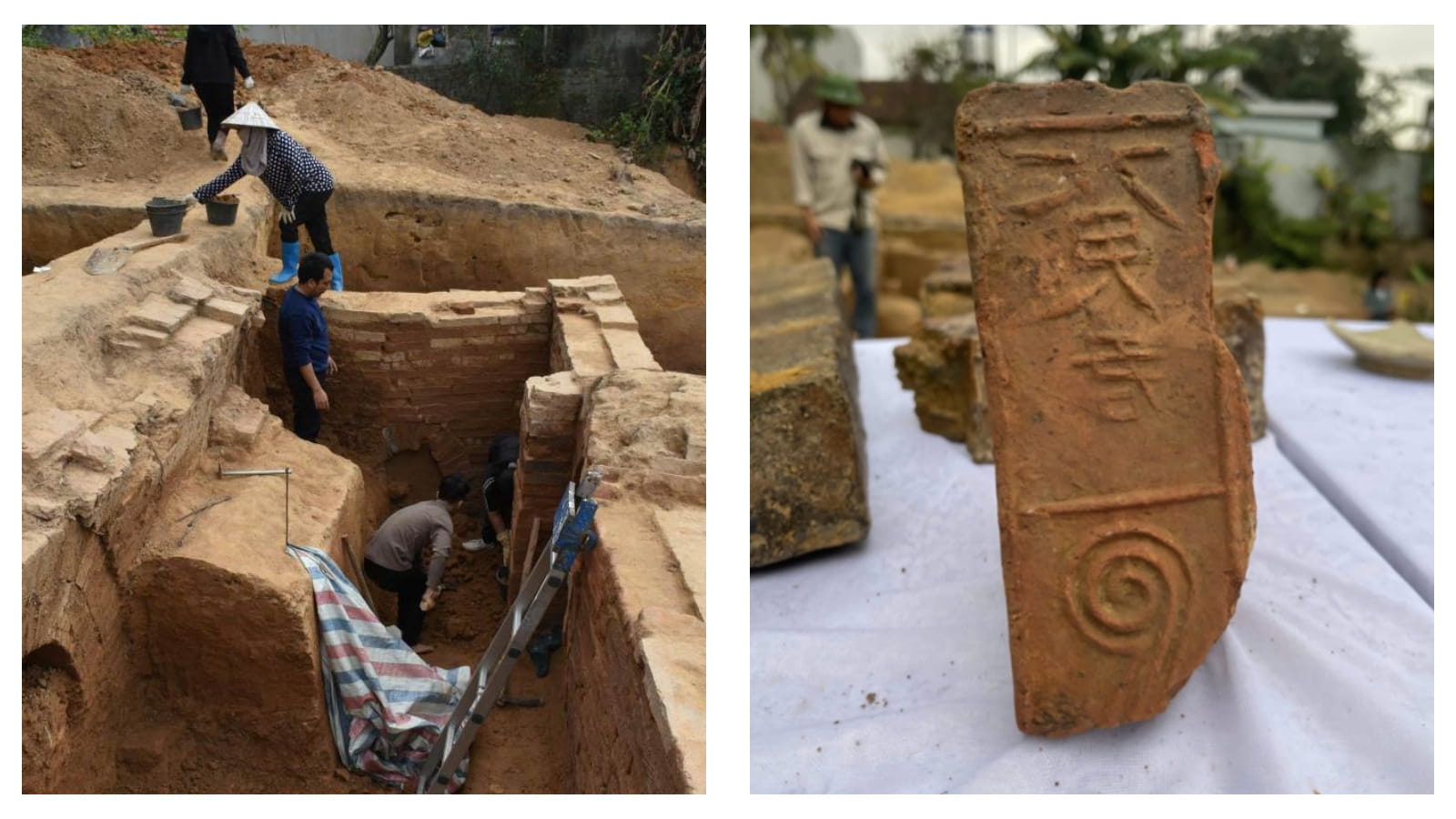
An ancient tomb has been unearthed in Vietnam’s Quang Ninh province, with initial findings now released.
The Quang Ninh Museum and Library complex has shared preliminary results from the excavation and is consulting experts to assess the tomb’s features, historical significance, and appropriate conservation measures to safeguard and promote the site.
Called the Chap Khe brick tomb, the structure lies near Chap Khe Church in Vang Danh ward and was discovered during local land-levelling activities, according to a report by The Star.
Since December 2025, the Quang Ninh Museum has been working with an archaeological team led by Dr Nguyen Van Anh, head of the History Department at the University of Social Sciences and Humanities, Vietnam National University, to carry out the excavation.
Built 2,000 years ago
Researchers cited by Vietnam News identified the site as a large brick tomb built on an elevated mound, spanning roughly 150 square meters.
This is considerably larger than similar brick tombs found elsewhere in the Southeast Asian country.
At a depth of around 2.5 metres, the tomb revealed a complex layout comprising two front chambers, a central chamber, and three rear chambers.
The structure is made of high-fired rectangular bricks and capped with a vaulted roof.
Decorative elements on the bricks include coin patterns, diamond shapes, concentric circles, and S-shaped motifs, all typical of artistic styles from the early Common Era.
READ MORE: Japan climate report flags urgent risks to food security, disaster resilience
Artefacts recovered
According to the researchers, artefacts recovered from the site fall into three main categories.
First, architectural materials, such as rectangular and grapefruit-shaped bricks.
Next, terracotta pottery, including house and pot models.
And lastly, glazed ceramics, featuring vases, jars, and lampstands.
Analysis of the tomb’s architecture and decorative details suggests it dates to the first and second centuries of the Common Era, approximately 2,000 years ago.
This kind of burial site has been found in the Bach Dang River basin, specifically in the former districts of Quang Yen, Uong Bi, and Dong Trieu (Quang Ninh province).
It has also been seen in the former districts of Thuy Nguyen (Hai Phong city) and Kinh Mon (former Hai Duong province), Vietnam News said.
READ NEXT: High Seas Treaty brings rules to international waters
 Carmela Calling
  James Mario Ajero