
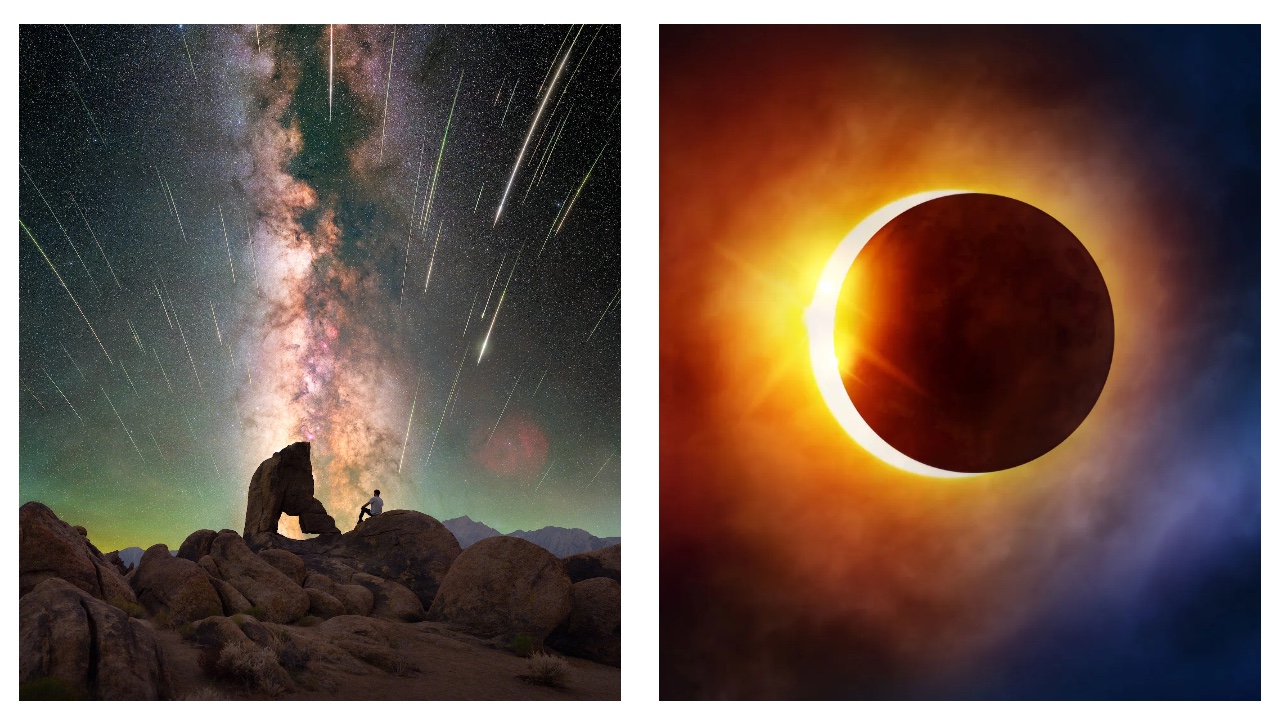
The night sky on Wednesday, August 12 will be a sight to behold: Europe’s first total solar eclipse in 27 years will occur alongside a show of meteor showers and the alignment of six planets under the new moon.
Jupiter, Mercury, Mars, Uranus, Saturn and Neptune will all parade across the sky at dawn.
Expect our planetary neighbors to form an arc, where it will be easier to see Jupiter, Mercury, Mars, and Saturn with the naked eye.
However, binoculars will be needed to sight Uranus, while Neptune is far enough to need a telescope.
The meteor shower is expected to pass through the view of the six-planet parade.
Total solar eclipse makes a comeback
This will be Europe’s first total solar eclipse since 1999.
According to the National Aeronautics and Space Administration (NASA), it will cross northern Russia, Greenland, Iceland, northern Spain and a small portion of Portugal.
NASA noted that from GMT 3:34PM, the moon will start blocking the sun, creating a gradual transition of day to night for around two minutes.
The eclipse reaches totality by GMT 5:46PM for two minutes and 18 seconds, while Reykjavik, Iceland witnesses its maximum by GMT 5:48PM.
At least 980 million people across the globe will witness the sun being partly covered, depending on the weather.
MORE SPACE NEWS: Germany enhances military space capabilities

Meteor shower all day
After the long-awaited eclipse, the night is only just getting started, as the peak of the Perseid meteor show will occur between Wednesday to Thursday.
The Perseid meteor shower is a popular nightwatch for astronomy enthusiasts in the Northern Hemisphere, where you can see meteors moving at high speeds with the occasional bright fireball sparks.
New moon advantage
On top of everything else, we are also blessed by the new moon that same evening.
There’s a lot to unpack here.
With all these cosmic events, the new moon helps to make everything much more visible.
Since the new moon has more moonlight, it will provide an advantage to see the faint meteors despite the typical light pollution.
While the visibility of these events vary in locations and weather, August is a great month for skywatching.
Other upcoming astronomy events within the month will be Venus seen at its greatest eastern elongation on August 15, the full moon, and a partial lunar eclipse on August 28.
READ NEXT: Europe prepares for fullest solar eclipse since 1999
 Ian Trinidad
  Eugene Nicklaus S. Laqui
  Newsjustnews writers