
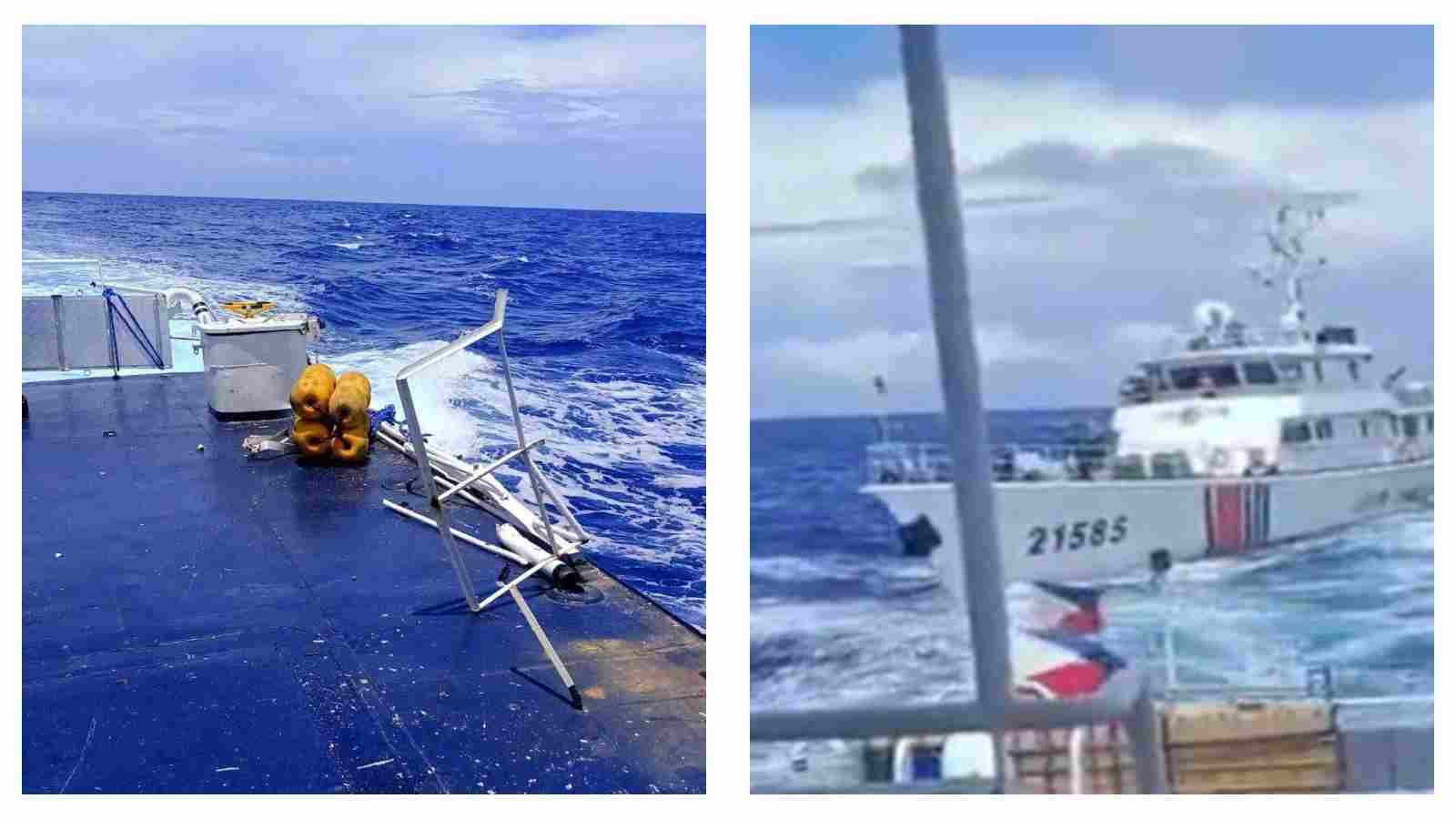
A China Coast Guard vessel collided with a Philippine fisheries ship during a government mission to deliver fuel supplies to Filipino fishermen in waters off Palawan, the Philippine Coast Guard said.
The incident involved China Coast Guard ship CCG-21585 and the Bureau of Fisheries and Aquatic Resources (BFAR) vessel BRP Datu Magat Salamat, which was operating about 54 nautical miles off Palawan and within the Philippines’ exclusive economic zone.
Background
According to Philippine authorities, the Chinese vessel carried out a series of close maneuvers before crossing behind the Philippine ship and striking its starboard side.
The collision damaged portions of the BRP Datu Magat Salamat, including its railings, metal stanchions, and equipment on the deck.
Philippine officials said the incident caused significant structural damage, although no injuries were reported.
The BFAR vessel was conducting a civilian mission to provide fuel assistance to Filipino fishermen operating in the West Philippine Sea.
Philippine officials described the encounter as an aggressive maneuver by the China Coast Guard and said the incident endangered the crew aboard the civilian vessel.
Territorial disputes
The collision has added to tensions between Manila and Beijing over disputed areas of the South China Sea, where Chinese and Philippine vessels have repeatedly faced off in recent years.
The Philippines maintains that the area where the incident occurred falls within its exclusive economic zone under the United Nations Convention on the Law of the Sea.
The 2016 arbitral ruling on the South China Sea also rejected the legal basis of China’s expansive claims to historic rights within the so-called nine-dash line.
China does not recognisee the 2016 ruling and continues to assert its claims over large portions of the South China Sea.
The incident has also raised concerns about the vulnerability of civilian government vessels operating in areas where encounters with larger foreign law-enforcement ships are possible.
READ MORE: Beijing urges US to stop ‘militarisation’ of space
Grey water tactics
Philippine maritime authorities have increasingly relied on coast guard escorts, aerial surveillance and communications systems to monitor encounters and document incidents at sea.
The latest collision could further intensify discussions about strengthening the country’s civilian maritime fleet and improving its ability to withstand and respond to dangerous encounters.
Despite the incident, Philippine authorities have reiterated their intention to continue government missions supporting Filipino fishermen in waters within the country’s maritime jurisdiction.
The collision is likely to add another point of diplomatic tension between Manila and Beijing as both countries continue to contest maritime activities and rights in the South China Sea.
READ NEXT: Kosovo’s political deadlock persists despite PM Albin Kurti’s re-election
 Carmela Calling
  Angelica N. Hall
  KC Maderia