
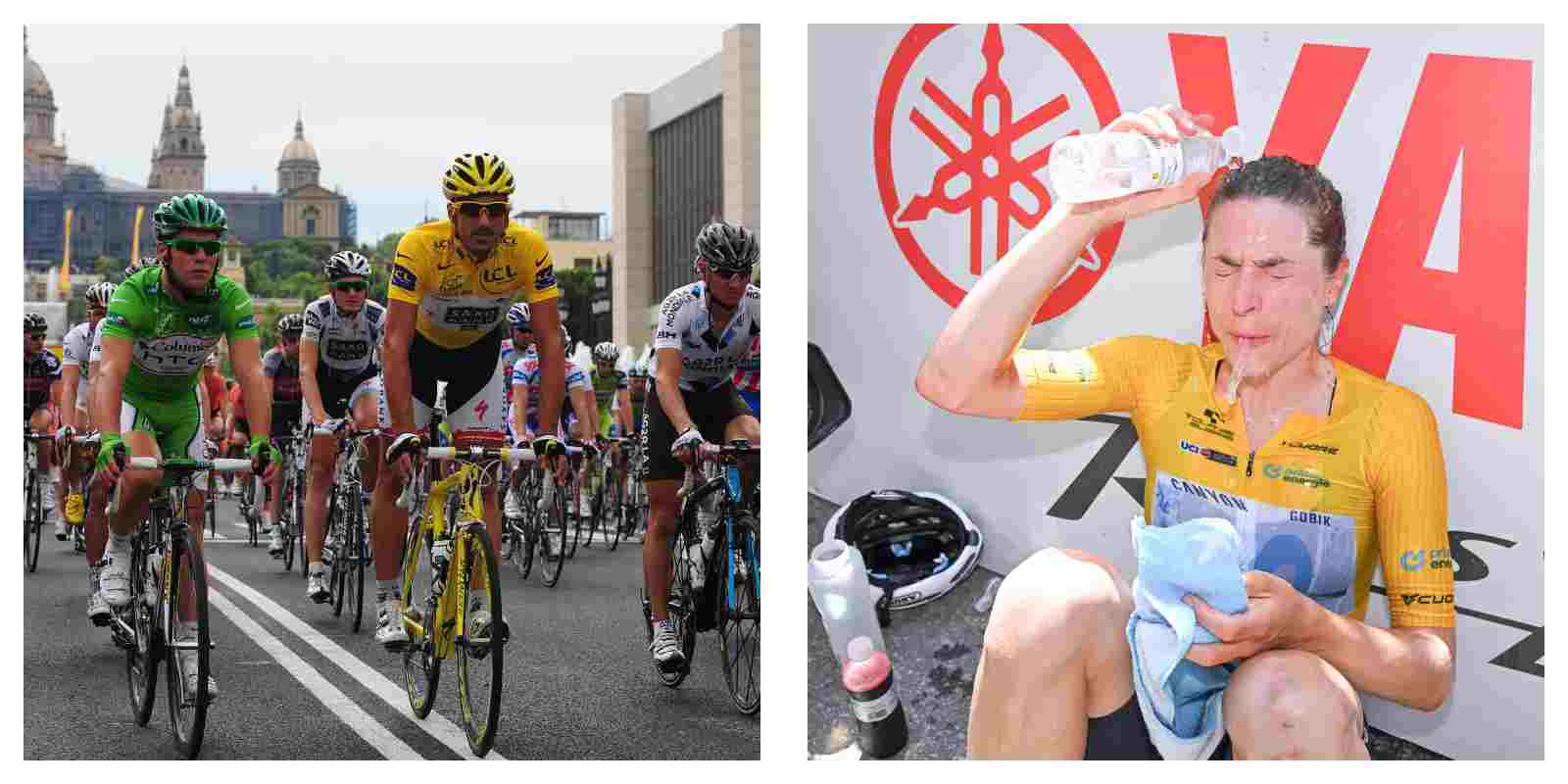
As if battling rivals and riding through gruelling mountain slopes weren’t enough, riders set for the Tour de France this Saturday will also have to contend with a heatwave sweeping throughout the European region.
The biggest Grand Tour in the world of cycling will begin in Barcelona on Saturday, pitting riders against each other for another battle of the giants.
But extraordinary heat may come into play soon enough as it grips the European continent, raising concerns for not only the riders but also the spectators.
‘Adaptation’ is the key word
Organisers of the Tour de France this week assured they were “ready to adapt” to the scorching heat.
“We will obviously experience high temperatures during the Tour de France. Protecting the riders and the public is paramount for us,” race director Christian Prudhomme told Agence France-Presse.
“The watchword is adaptation.”
YOU MAY ALSO LIKE: Sport Top stories PBA news: Can Jimmy Alapag lead NLEX Road Warriors to a deeper PBA run?

Precautionary measures will be taken
Prudhomme cited the International Cycling Union’s (UCI) extreme temperature protocol, which takes into account the temperature, humidity levels, wind, and rider speed that can be applied for the race.
More refreshment zones may also be established, while organisers may relax the time limits for elimination so riders who end up falling behind won’t have to use excessive effort.
Although he said “riders are used to intense heat” given the high temperatures seen in the season-opening Tour Down Under in Australia in January, he clarified it was a different thing entirely when they have to face soaring temperatures for several consecutive days.
Prudhomme also confirmed they were communicating with officials in regions where the route will pass through to help spectators beat the heat.
The Tour caravan, he said, often provides 2.5 million hats and 550,000 cans, alongside 400,000 litres of bottled water.
In the end, he underscored the importance of prevention and common sense and urged fans and spectators to bring hats and hydration.
He also urged them to be aware of their surroundings, particularly when there are children and elderly.
Watch out for heat stress
While there are shorter stages this year – with a maximum of 205 kilometres – organisers have been leaning towards more shaded routes, including the ascent of the Haag in Alsace.
“(A climb) emblematic of what the Tour de France of the future might look like, bearing in mind that there is, of course, no question of saying there will be no more Ventoux, Alpe d’Huez, Galibier, or Tourmalet,” Prudhomme said.
A new study published in the Scientific Reports earlier this year found that France has been seeing rising temperatures since the mid-70s, putting competitors of the Tour de France at “high risk,” according to Carbon Brief.
Using 50 years of climate data, the study sought to determine the potential heat stress riders faced across different locations during the race.
According to the study, the severity and frequency of high-heat-stress events have grown in the last few decades.
But it also said the heat-stress threshold for safe competition, set by the UCI in 2024, has rarely been passed.
Despite this, researchers warned it was “only a question of time” before the threshold gets breached, given the continuing rise of average temperatures in the country.
Dr Ivana Cvijanovic, a climate scientist at the French National Research Institute for Sustainable Development, said organisers and riders have been “lucky” in avoiding the worst of the heat stress.
“It has worked really well for them so far. But as the frequency of these [extreme heat] events is increasing, it will be harder and harder to be lucky,” Cvijanovic added.
READ MORE: Extreme heat safety: Keep yourself protected during a heatwave

Show must go on
Come rain or shine, the curtains are still expected to open for the Tour de France 2026 this Saturday.
The opening team time trial stage will start in Barcelona and end in Paris on July 26.
Riders will have to race across seven flat stages, four hilly stages, and eight mountain stages, which will include five summit finishes at Gavarnie-Gèdre, Plateau de Solaison, Orcières-Merlette and twice at Alpe d’Huez.
The French tour will also open to some of the most intriguing narratives to follow, such as whether four-time Tour de France champion Tadej Pogačar can grab his fifth title and if his greatest rival Jonas Vingegaard will stand in his way.
Remco Evenepoel and Florian Lipowitz will also have to work together as co-leaders for Red Bull – BORA – hansgrohe’s hopes for another podium.
And the new youngsters may even have a say on how the race will take shape with the debut of French prodigy Paul Seixas and Mexican wonder Isaac del Toro.
READ NEXT: LeBron James to end Lakers era, eyes new team in 24th NBA season
 Kamille Q. Cabreza
  Jheruleene Anne Ramos