
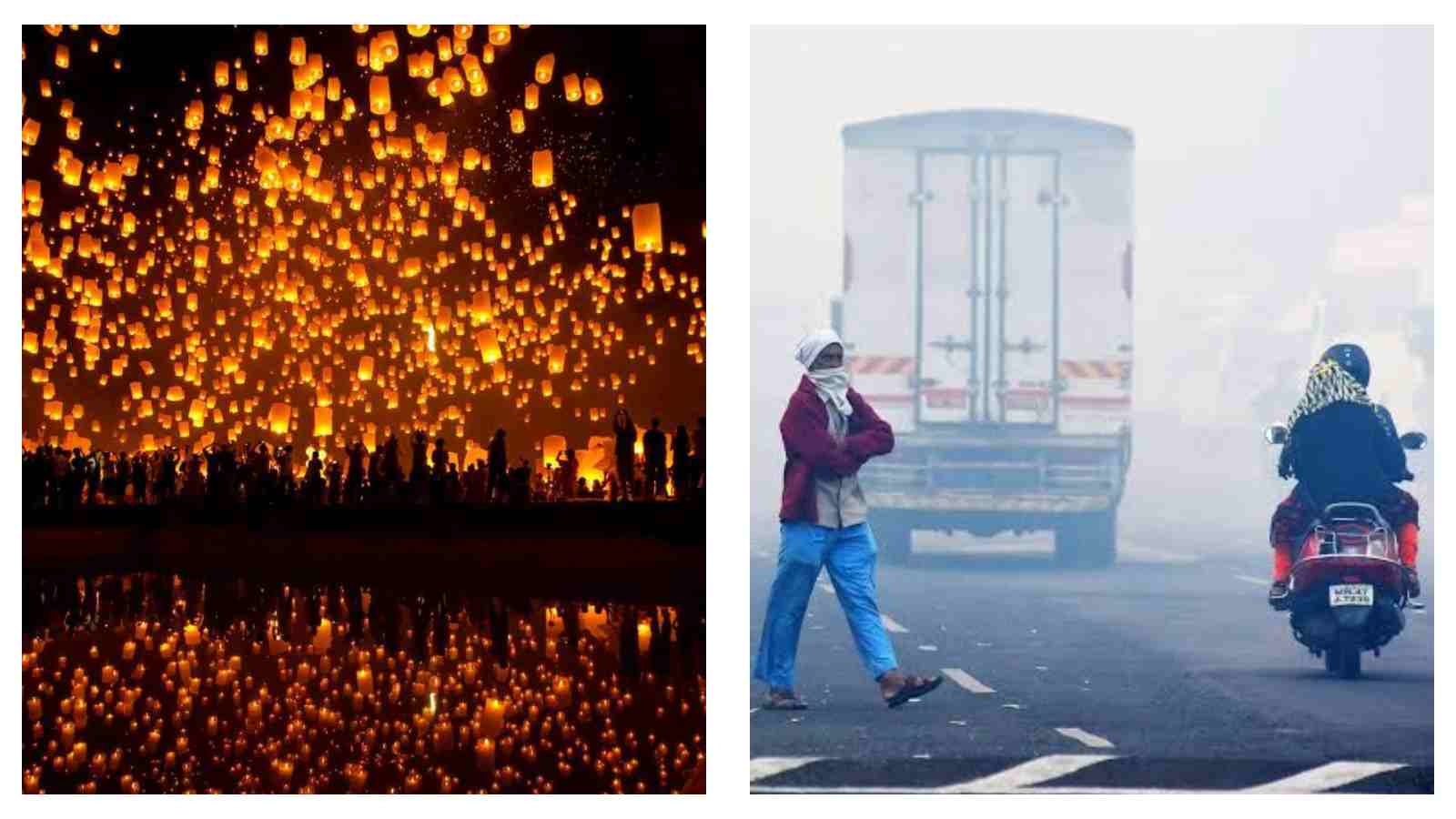
Homes, temples, offices and streets across India glowed in the dark between Sunday evening and early Monday morning, as millions across the country celebrated Diwali, Hindu’s annual festival of light.
Regarded as India’s most important festival, Diwali falls on the darkest night of the Hindu lunar month of Kartik, which falls November 8, Sunday, this year.
It is widely observed with oil lamps and colourful lights, with families during this time gathering for a feast and gift exchanges, while faithfuls isolate themselves for prayers.
But central to the annual celebration is setting off firecrackers and fireworks to symbolise the triumph of “light over darkness” or “good over evil,” a tradition that comes at the expense of the nation’s already deteriorating air quality.
Pollution reaches hazardous levels
In the capital, New Delhi, air pollution reached hazardous levels early Monday, according to monitoring organisation IQAir, which cited local data.
In the Mandir Marg locality alone, levels of cancer-causing PM 2.5 microparticles hit 879 micrograms per cubic metre, eight hours after the peak of Diwali celebrations.
This is about 59 times higher than the recommended daily limit from the World Health Organisation (WHO), data showed.
Diwali firecrackers have also triggered overnight pollution spikes in Mumbai, India’s financial capital, with nine of the city’s 25 air quality monitoring stations recording “poor air quality” early Monday, Hindustan Times reported.
The surge in pollution levels comes against the backdrop of minimal state efforts to curb the environmental impacts of this year’s Diwali celebrations, particularly in New Delhi, one of the world’s most polluted capitals.
The Supreme Court allowed this month the manufacture, sale and use of so-called “green” firecrackers in the city and surrounding areas for a limited period.
These firecrackers are designed to produce fewer emissions, although their effectiveness in reducing pollution in the capital city remains in question.
India one of world’s most-polluted countries
While there is no question that the annual Diwali celebrations make the air situation in New Delhi worse, several other social and seasonal factors contribute largely to the pollution in the capital city of more than 30 million.
According to the Ministry of Environment of India, secondary particles from vehicles, industry, power plants, and biomass burning emissions account for 27% of the city’s winter pollution, making them a primary pollutant.
India, in general, has been consistently ranked among the most polluted countries in the world in recent years.
In 2025, the country ranked sixth among 143 nations in IQAir’s “Most Polluted Countries and Regions,” below Pakistan, Bangladesh, Tajikistan, Chad, and the Democratic Republic of the Congo.
READ NEXT: Eurovision Asia takes center stage: Will it hit the right note or fall flat?
 Levi Mora
 Eugene Nicklaus S. Laqui
 Rosemarie Zamora