
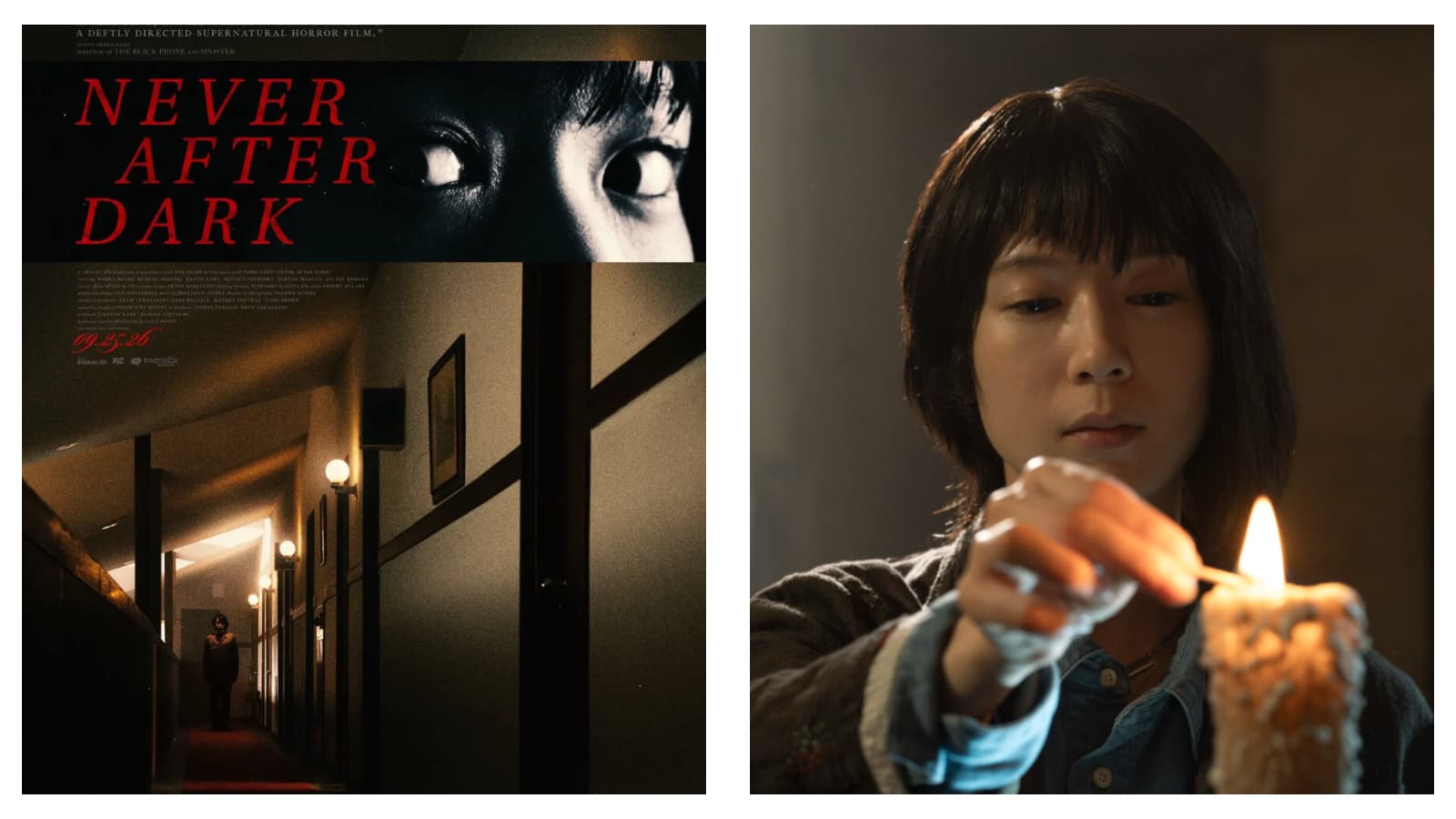
What do you do when you think your new house is haunted? Call a psychic medium, of course. In Never After Dark, however, not everything is what it seems.
The new film from Dave Boyle has all the elements that make up a retro Japanese horror movie: eerie cinematography, slow-burn tension and the kind of dread that settles rather than shocks.
It also pays homage to the J-horror classics that took the film world by storm from the late 1980s into the 1990s.
But Never After Dark goes one step further than homage – it subverts the tropes to tell a story about fear, only you’re not quite sure what you should really be afraid of after dark.
Boyle sets about subverting J-horror
In the film, you follow Airi (played by Moeka Hoshi from Shogun), a psychic medium who helps souls cross over to the realm of the dead.
She gets called to do a cleansing in a big house in the middle of the woods, where she ends up facing more than she ever thought she would.
If it sounds familiar, it’s because it echoes tropes and elements usually seen in J-horror classics, like cursed houses, ghostly folklore and psychological dread.
Writer-director Boyle had other things in mind, though.
“I think part of the way that we tried to show respect for the genre as well as the grander J-horror tradition was by subverting some of their usual patterns,” Boyle told Bloody Disgusting in an interview.
“We talked a lot about the touchstones of not just J-horror, but traditional Japanese ghost stories – kaidan.
“One of the patterns that you notice when reading these stories and watching them is that the ghost at the centre of it is usually the vengeful spirit of a victim, who is typically a female victim, nine times out of 10.”
READ MORE: Film news: Italy taking a darker route to the Oscars with ‘L’Estranea’
Fear the dead – or the living?
One prime example of the subversion is the ghost.
In Never After Dark, the ghost is not named, but he’s credited as the “slit-mouth man” or the “gaping mouth man” – a version of the popular Japanese folklore about the slit-mouthed woman.
This tells Japanese audiences, in particular, of the film’s apparent shift away from traditional ghost-related storytelling.
The theme also gets subverted.
Instead of fearing the dead, it could be argued that perhaps the living are much more terrifying.
Boyle moreover talked about working with a lot of veterans of the Japanese film industry, which he said brought “a real sense of history and experience”.
“They understood that we were trying to do something that was a little bit of a twist on the usual,” he explained.
YOU MAY ALSO LIKE: Taylor Swift drops ‘The Life of a Showgirl: The Encore’ featuring four new tracks
Continuing the acclaimed J-horror phenomenon
Boyle is no stranger to the Japanese film industry.
He has worked with numerous Japanese cast and crew in his previous movies, such as his 2006 debut feature Big Dreams Little Tokyo, the 2014 mystery-thriller Man from Reno and his recent show House of Ninjas for Netflix.
Never After Dark, however, will be his first plunge into the horror genre.
And what better approach to take than to echo the J-horror classic phenomenon?
J-horror is known for its distinct, uncanny approach to the narrative, relying on lingering dread, haunting folklore and quiet tension rather than jump scares.
Popular J-horror classics that went beyond Japan’s doors include Ringu (1998), which told a story about a cursed videotape and gave audiences quite a scare through Sadako, the long-haired girl who crawls out of the well and television screens.
There was also Ju-On: The Grudge (2002), a story about a haunted house in Tokyo.
One of the definitive classics is techno-horror Pulse (2001) – which Boyle, incidentally, is set to reimagine in a new remake for Screen Gems, Spyglass and Parker Finn’s Bad Feeling.
There’s no definite timeline for that project yet, but Never After Dark hits American theatres on September 25 after its initial release earlier this year, just in time to get a scare fix right before Halloween.
It has garnered some rave reviews already, including from horror icon Stephen King, who called it “amazing and haunting”, and The Black Phone director Scott Derrickson, who praised it as “intelligent, unpredictable and bone-chilling”.
If you do intend to watch the film, this is perhaps a good time to remind you to never do it after dark – you may not know who’s watching with you.
READ NEXT: K-pop girl group UNIS officially disbands
 Elan Castanares
 Ciara Mina
 Jheruleene Anne Ramos