
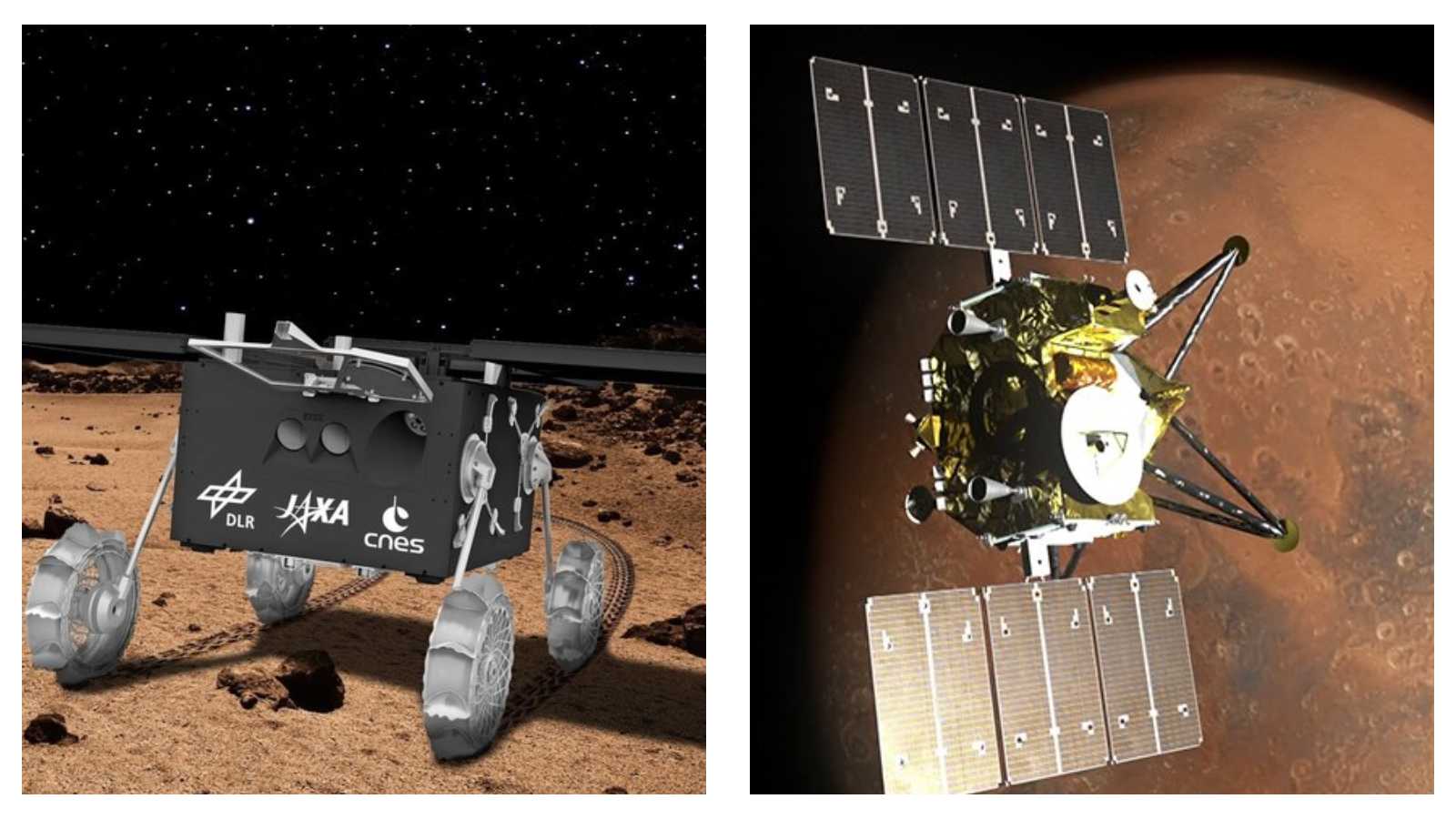
Humanity’s search for origins continues – taking off from Japan this time.
The Japan Aerospace Exploration Agency (JAXA) has announced an ambitious mission to explore the moons of Mars – Phobos and Deimos – in an attempt to determine how the solar system and life on Earth came about.
Called the Martian Moons eXploration (MMX), the unmanned undertaking is set to begin in September and will last for five years.
Phobos landing
According to the timetable provided by JAXA, the MMX aircraft is scheduled to blast off from Tanegashima Space Centre on board the H3 rocket next month, and a return capsule from the mission is expected to land in Australia in around 2031.
The aircraft is scheduled to reach the Martian sphere a year after its take off from Earth.
It is expected to land on Phobos for sample-taking and surface observations and stay within the Red Planet’s orbit for three years.
The core objective of the mission is to take at least 10 grams (0.35 ounces) of material from the surface of the moon with help from the IDEFIX rover, named after the dog in the comic series Asterix.
The MMX will also observe the other Martian moon, Deimos, without making a landing.
YOU MAY ALSO LIKE: Filipinos turn to AI as mental healthcare gaps persist

Two theories of origin
After reaching Earth in 2031, the samples taken from Phobos will undergo extensive study.
Scientists believe that determining the composition of the Martian moons is fundamental in working out how the solar system was born, and accordingly, the existence of life.
The study will revolve around two theories on how Phobos and Deimos were formed, namely the “giant impact” and the “capture”.
The “giant impact” theory suggests that two Martian moons came from a collision between a celestial body and the Red Planet, while the “capture” theory proposes that the twin satellites were once asteroids, until they were captured by Mars’ gravitational system.
According to JAXA, determining which of the two theories is right will help reveal “how a habitable environment for life might have arisen on the terrestrial planets”, referring to the group rocky worlds in the solar system that includes Earth.
“The origin of Mars and the planet’s two moons has long been considered one of the unsolved problems in the theory of the Solar System’s formation,” the space agency noted.
According to French astrophysicist Patrick Michel, who works on IDEFIX rover, the MMX mission “will shed light on the transport mechanisms that delivered water, volatiles and organic compounds from the outer Solar System to the inner rocky planet region – processes that may have played a key role in making these worlds habitable.”
“If Phobos and Deimos are indeed remnants of these early delivery systems, they may hold clues to the origins of life itself, or to be more correct, to the transport of the materials that were key to the emergence of life on rocky planets,” he told Agence France-Presse.
READ MORE: Apple developing photo verification tool for iOS 27

Gateway to manned mission
Apart from possibly unveiling evolutionary history, the MMX mission could also be a gateway to deeper space exploration.
According to JAXA, it could also be determined through the mission the possibility of using Phobos as a natural space station for a round trip between Earth and Mars, something that could make manned missions to the Red Planet possible.
The observation of the Martian sphere could provide key knowledge for the development of technology required for human exploration on the planet, the space agency has noted.
MMX is the latest addition to mounting sample-taking missions to Mars from Earth.
The Chinese government has previously announced a similar undertaking, involving its Tianwen-3 spacecraft, set to launch around 2028.
The National Aeronautics and Space Administration (NASA) of the United States was planning to return samples from Mars through its Perseverance rover, but the mission was effectively cancelled by the Donald Trump administration early this year.
READ NEXT: Netizens voice concern over recent spate of earthquakes around the globe
 Ian Trinidad
  Eugene Nicklaus S. Laqui
  Newsjustnews writers