
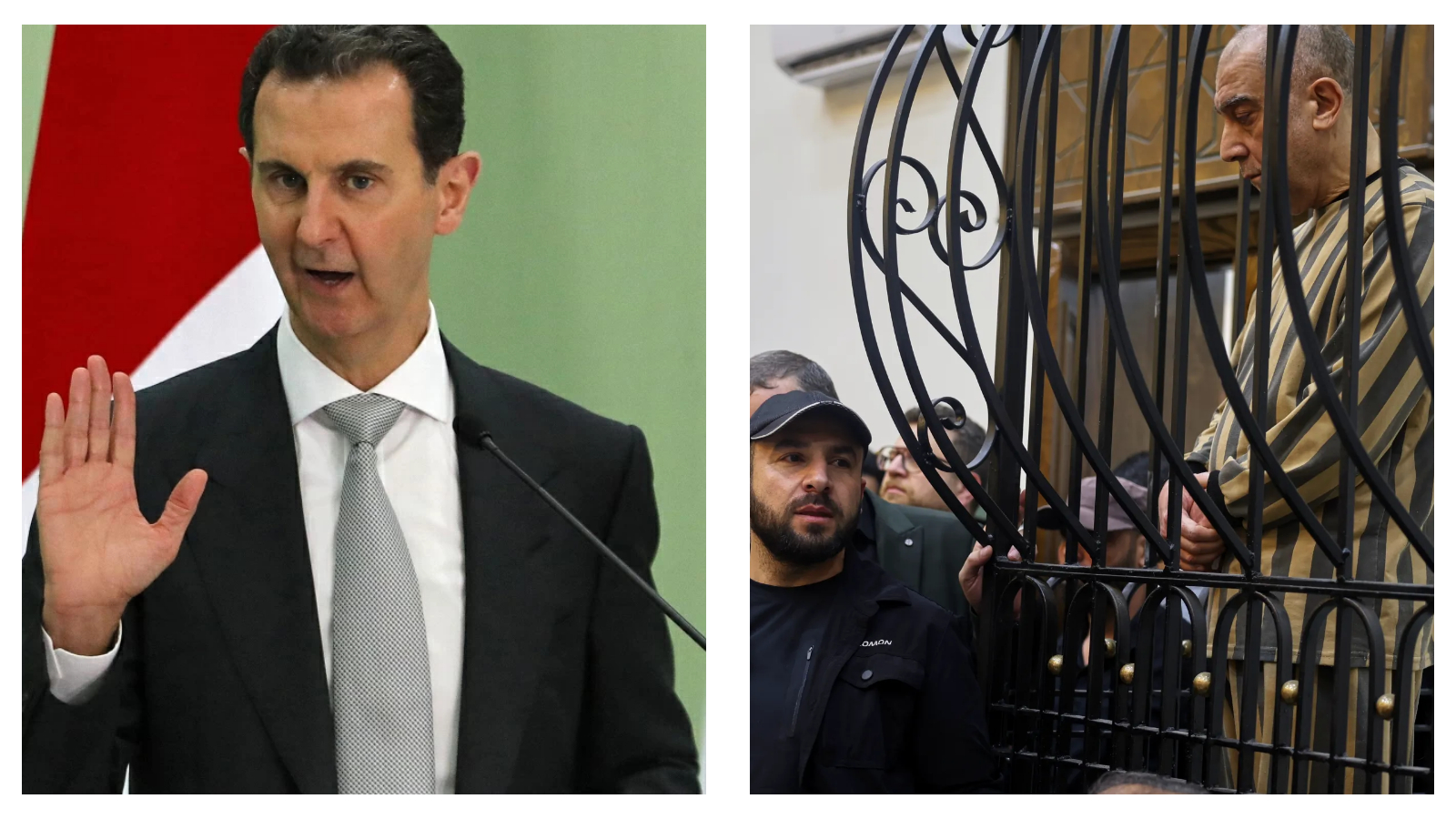
A Syrian court has sentenced ousted President Bashar Assad and his brother, Maher Assad, in absentia to the death penalty for murder, torture and crimes against humanity linked to the brutal repression that preceded and fueled Syria’s 14-year civil war.
The verdict, delivered on Tuesday, August 11, in Damascus, marks the first major judicial action against Assad or members of his inner circle since his family’s decades-long rule collapsed in December 2024.
The brothers are unlikely to serve their sentences, however, after fleeing to Russia, where they were granted asylum following the fall of the Syrian government.
The court also handed down death sentences to six other former officials in absentia. Among those sentenced to death, only Atef Najib is currently in Syrian custody.
Guilty sentence
Najib, Assad’s maternal cousin and a former army brigadier general, appeared in court wearing a prison uniform and standing inside a cage as the judge announced his sentence.
He previously headed political security in Daraa province, where the detention and torture of teenagers accused of writing anti-government graffiti helped ignite protests in 2011.
Judge Fakhareddine al-Aryan said Assad had used state institutions to carry out war crimes and crimes against humanity.
The court found the defendants responsible for premeditated killings, including the deaths of children, as well as torture and other abuses.
The proceedings were broadcast live on Syrian state television, a striking departure from the secretive trials conducted under Assad’s government.
For many Syrians who suffered under the former regime, the verdicts represented an important moment of accountability.
Families of victims and survivors gathered outside the heavily guarded courthouse, while some expressed hope that former regime officials would face further prosecutions.
READ MORE: Myanmar rejects ASEAN call to release Aung San Suu Kyi

A step toward justice
Attorney Adnan al-Masalmeh, who represented families of Najib’s victims, hailed the verdict, stating this was a victory for the Syrian people against the previous regime.
Najib was a central figure in the early crackdown on dissent in Daraa. Human rights advocates say security forces under his authority arrested and tortured teenagers whose graffiti helped spark demonstrations that eventually grew into a nationwide uprising and civil war.
Nayef Abazeid, who said he was detained at age 13 in 2011, welcomed the sentence but said true closure would come only if Assad himself were brought to justice.
Maher Assad, who previously commanded Syria’s elite 4th Armoured Division, has also faced longstanding accusations from opposition activists of involvement in killings, torture, extortion and drug trafficking, as well as operating detention facilities.
ALSO ON NJN: Pax Silica Project: A promise of innovation, but at what cost?

Post-Assad justice system
Despite the significance of the convictions, human rights organisations have raised concerns about the fairness and speed of the proceedings.
Human Rights Watch researcher Hiba Zayadin said the scenes outside the courthouse reflected years of suffering but warned that justice must still meet international standards.
The organisation also opposes the death penalty, including in cases involving former Syrian officials, arguing that capital punishment is irreversible and particularly troubling when defendants may not have received a fully fair trial.
The convictions therefore represent both a milestone and a challenge for Syria’s post-Assad government: victims are finally seeing former regime figures prosecuted, but the country’s new justice system faces scrutiny over whether it can deliver accountability while maintaining due process.
READ NEXT: Philippine city sets deadline for research funding tied to press freedom pioneer’s legacy
 Ian Trinidad
  Eugene Nicklaus S. Laqui
  Newsjustnews writers