
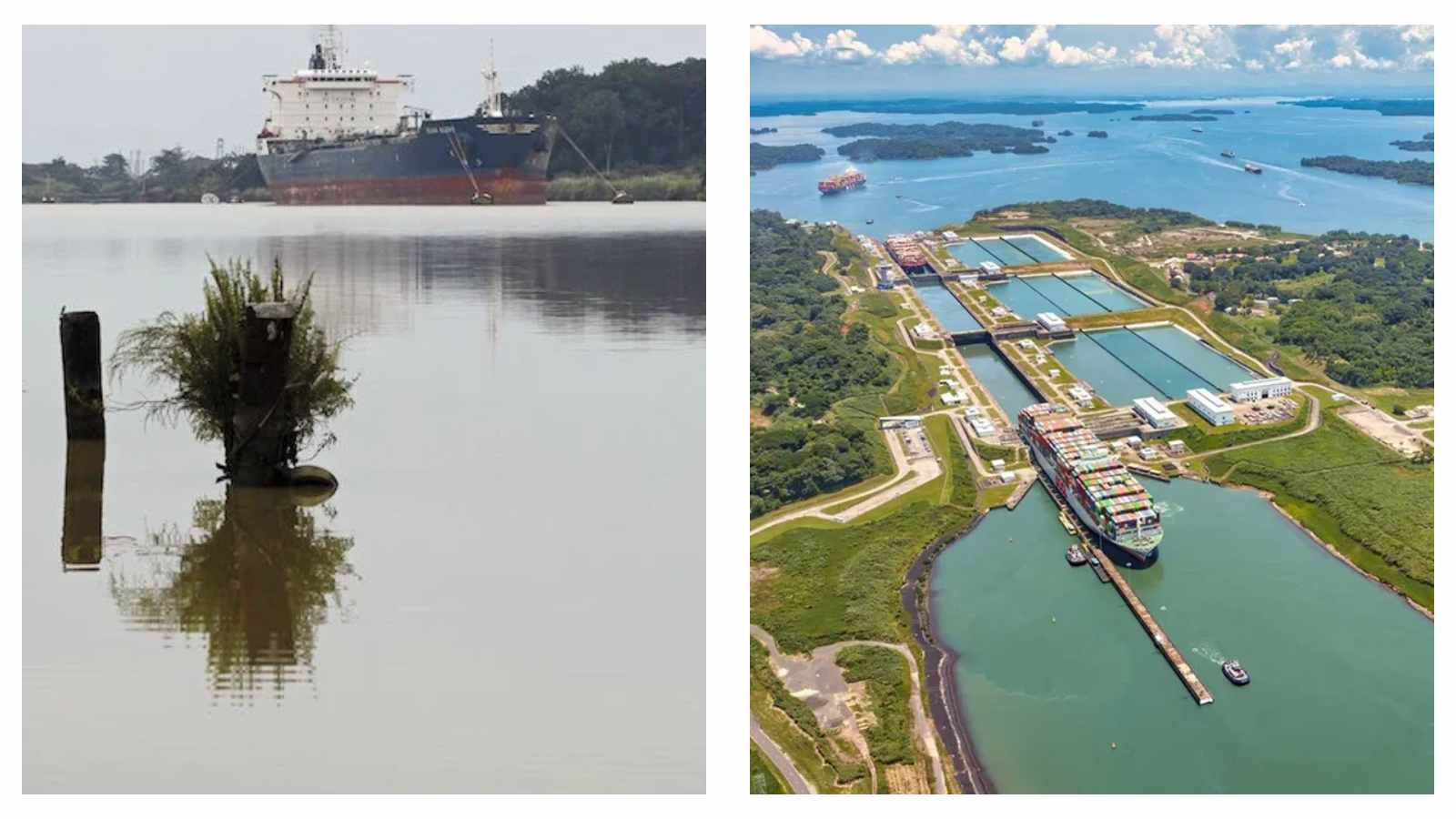
Just days after announcing additional draft restrictions to conserve water ahead of the anticipated dry season, the Panama Canal is now preparing for the possibility of another dry season affecting its watershed.
Growing concerns over the strengthening El Niño phenomenon have raised expectations that it could develop into one of the most powerful events ever recorded, potentially disrupting global shipping operations.
The Panama Canal Authority announced last week that it will gradually tighten draft restrictions for Neopanamax vessels, lowering the maximum allowable draft from 49.5 feet to 49.0 feet beginning July 24 and further to 48.5 feet on August 15.
The measure is intended to support water conservation efforts as the canal prepares for the anticipated effects of the El Niño weather pattern.
YOU MAY ALSO LIKE: Air quality in Canadian cities among ‘world’s worst’ as wildfires rage on
Forecast on ‘very strong’ dry season
The US Climate Prediction Center (CPC) reported in its latest ENSO Diagnostic Discussion, released on Thursday, that El Niño is increasingly likely to strengthen in the coming months.
According to the agency, there is an 81 percent chance the phenomenon will reach “very strong” intensity from October to December and a 97 percent probability it will persist through early spring 2027, gCaptain reported.
The report also said that over the past month, ocean and atmospheric conditions have continued to strengthen.
Additionally, due to the downwelling Kelvin wave that has increased subsurface ocean heat, the eastern Pacific warmed to +2.7°C, as the latest weekly Niño 3.4 index reached +1.2°C.
The National Oceanic and Atmospheric Administration also reported that they observed signs of a strengthening, fully coupled El Niño – the persistent low-level westerly winds, enhanced convection over the central Pacific and suppressed rainfall over Indonesia.
Should these forecasts prove accurate, the climate pattern would be among the strongest observed since record-keeping began in 1950.
READ NEXT: Cameroon resumes port operations after swift response to vessel collision
 Diana Mae Y. Cleto
  Levi Mora
  Rosemarie Zamora