
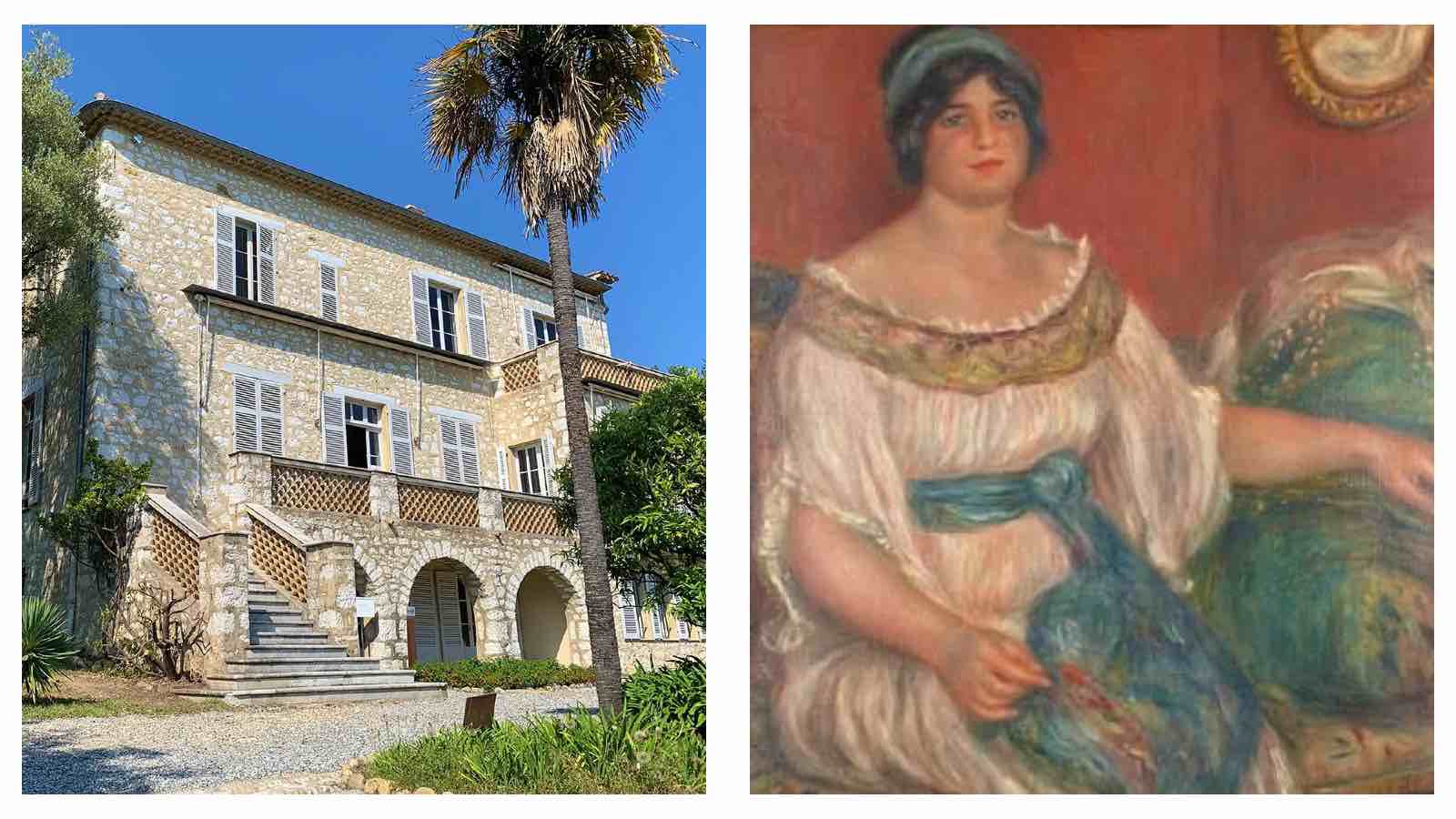
A simple method was all it took to steal two paintings by Pierre-Auguste Renoir from his former home on the French Riviera.
The works have now been recovered and six suspects arrested, but the heist has put a spotlight on how thinly protected many smaller museums remain.
How the thieves got in
According to the town hall, the thieves began their scheme on September 8 by cutting through a fence and smashing a window to gain entry to the Renoir Museum in Cagnes-sur-Mer.
Once inside, an electric saw was utilised to dismount the hanging paintings.
Four works were initially taken but dropped two in the museum’s garden as they escaped.
The two they kept, “Portrait of Madame Colonna Romano” (1910) and “Jeune fille au puits” (1886), were recovered a month later.
Several weak points were realised during the investigation, such as a perimeter that could be breached with basic cutting tools, a window that gave way to force, and fixtures that offered little resistance to a power saw.
The town hall has not said whether alarms were triggered or how quickly anyone responded.
YOU MAY ALSO LIKE: Poet, classicist Anne Carson wins Nobel Prize in Literature

A home, not a vault
The museum, which opened in 1960, is the house where Renoir spent his final years.
It holds 12 of his works alongside his easel, wheelchair, photographs and personal letters.
Historic-house museums face a dilemma: their appeal lies in preserving the original building, which makes it hard to add stronger windows, barriers or cameras without changing the property.
Larger institutions also suffer a similar risk.
Last October, thieves disguised as construction workers entered the Louvre’s Apollo Gallery during opening hours and used an angle grinder to open display cases, escaping with EUR88 million ($102 million) in jewels.
The Louvre was later criticised for under-investing in security.
The recently recovered paintings by Renoir, Paul Cézanne and Henry Matisse also shared a similar fate after being taken from a museum near Parma, Italy, in a roughly four-minute raid earlier this year.
Across all three cases, the common features were speed and simple tools, which favoured thieves to execute their schemes more easily.
Questions still unanswered
The BBC confirmed that the town hall cancelled a press conference on Friday, where it had been expected to give further details of the recovery.
It has not said how the paintings were found, what condition they are in, or whether the museum’s security will be upgraded.
Mayor Bryan Masson, of the National Rally, said the works were part of the city’s history and heritage and that their return brought immense joy and profound relief.
Whether the town can now afford to protect that heritage better is a question officials have yet to answer.
READ NEXT: Dutch museum displays Van Gogh’s 88-painting collection after 42 years
 Jheruleene Anne Ramos
  Wendellyn Mateo
  Carmela Calling