
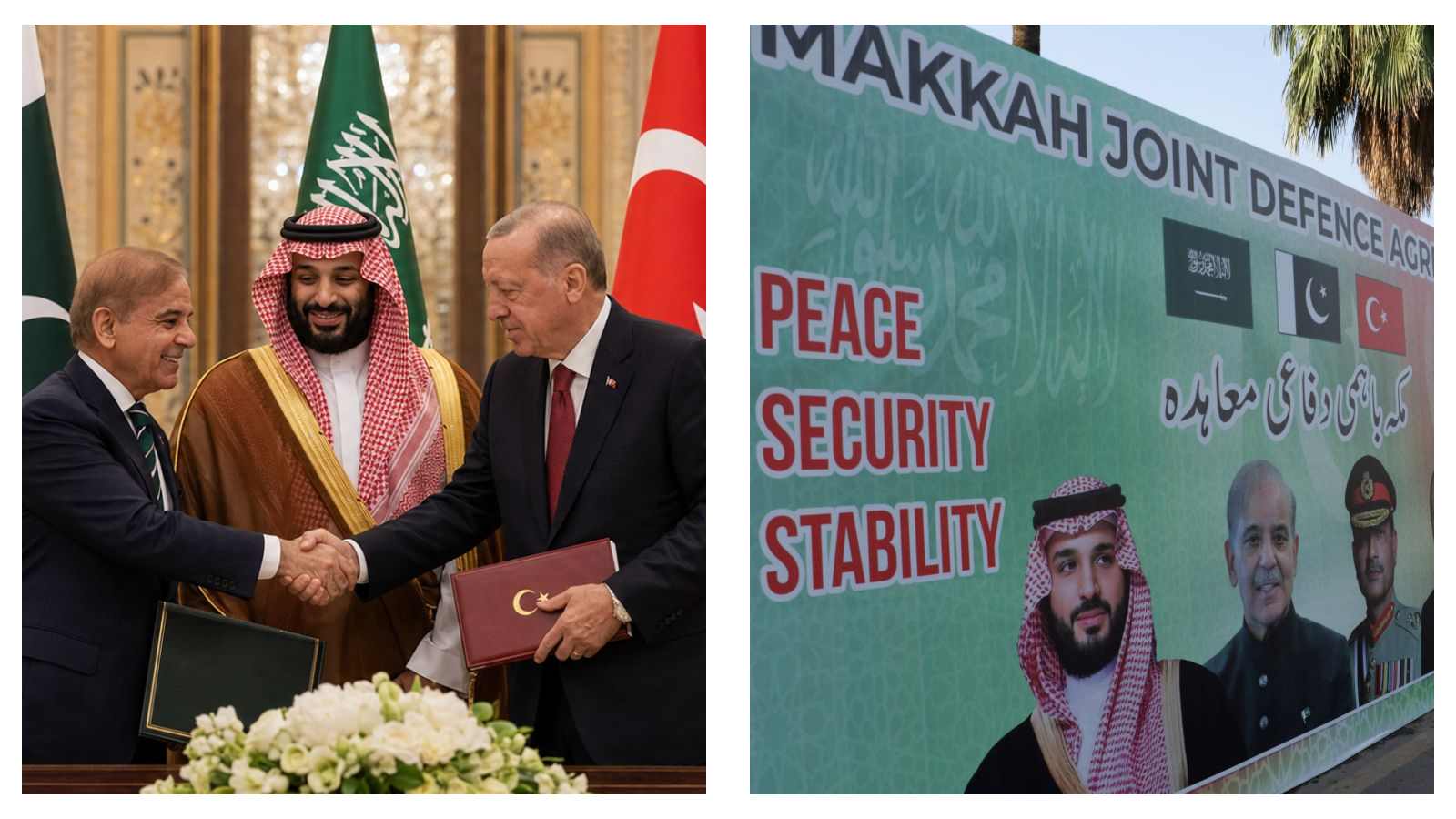
Saudi Arabia, Turkey and Pakistan have bolstered their security co-operation by establishing a new defence pact, as the unrest in West Asia continues to undermine regional stability.
Saudi Arabian Crown Prince Mohammed bin Salman, Turkish President Recep Tayyip Erdogan and Pakistani Prime Minister Shehbaz Sharif signed the trilateral agreement during a meeting in the holy city of Mecca on August 7, the involved parties announced in a joint statement.
Called the Mecca Joint Defence Agreement, the landmark accord “stipulates that any armed attack against any one of the three States shall be regarded as an attack against them all”, said the statement, according to BBC News.
“It further provides for the enhancement of all aspects of defence co-operation among the three States,” it noted.
What does each State get?
The development comes against the backdrop of the United States-Iran war, which emerged from the unprecedented and massive US-Israel attack on Tehran in late February.
In the past five months the armed conflict has spilled over to Saudi Arabia and other Gulf nations, with Iran-backed Houthi rebels enforcing a “maritime embargo” against the Washington-allied nation and targeting its oil facilities and tankers in the Red Sea.
With the Mecca Joint Defence Agreement, Saudi Arabia is able to muster “several layers of security rather than one American umbrella”, security expert Andreas Krieg said according to The Japan Times.
He further noted that while oil-rich Riyadh is wealthy, it lacks “indigenous military-industrial depth”, something Pakistan and Turkey have, as both face financial constriction on the other hand.
“Turkey has technology and manufacturing capacity but needs markets and investment. Pakistan has manpower, military institutional depth and nuclear deterrence, but needs financing and industrial opportunities,” Krieg, who is a lecturer at King’s College London, explained.
Such strength and limitations make the three countries “unusually complementary”, and thus the Mecca agreement a powerful punch in theory, the expert said.
YOU MAY ALSO LIKE: US links budget cuts to closure of diplomatic offices
Iran objects
But the fresh defence pact has drawn a strong objection from Tehran.
In a post on X, Ebrahim Rezaei, a member of the Iranian Parliament’s National Security and Foreign Policy Commission, said the establishment of the Mecca Joint Defence Agreement would not help Saudi Arabia.
“The Saudis should know that a paper agreement with Turkey and Pakistan does not bring them security, just as years of unilateral milking of the Americans did not bring them security,” the MP wrote.
“Change your policies so that you do not have to #BegForSecurity from others,” he said.
No target country
While the Mecca agreement comes under the shadow of US-Iran war, Turkish Foreign Minister Hakan Fidan clarified in a televised interview that the pact is not characterised by “a common threat”, but is rather a general mechanism for “collective defence”.
“It is not an approach of going on the offensive and saying, ‘Let’s do this or that together.’ Therefore, unless it is attacked by a country, whether from inside or outside the region, this alliance cannot have any dispute with any country,” Fidan told Anadolu’s Editor’s Desk on Saturday.
Within this context, Fidan emphasised that the agreement does not target Iran in particular, nor any country that does not attack the signatories.
“But, of course, the power composition we have put forward will make a constructive contribution to regional stability,” he said.
For the Turkish minister, the Mecca agreement “is the most important step toward bringing lasting stability to this region”, and therefore should not be limited to three countries.
“We should grow and, if necessary, bring all countries under this umbrella,” he said.
READ NEXT: Cameroon defends President Paul Biya’s prolonged absence amid growing concern
 Levi Mora
  Wendellyn Mateo
  Geoffrey H. Latayan