
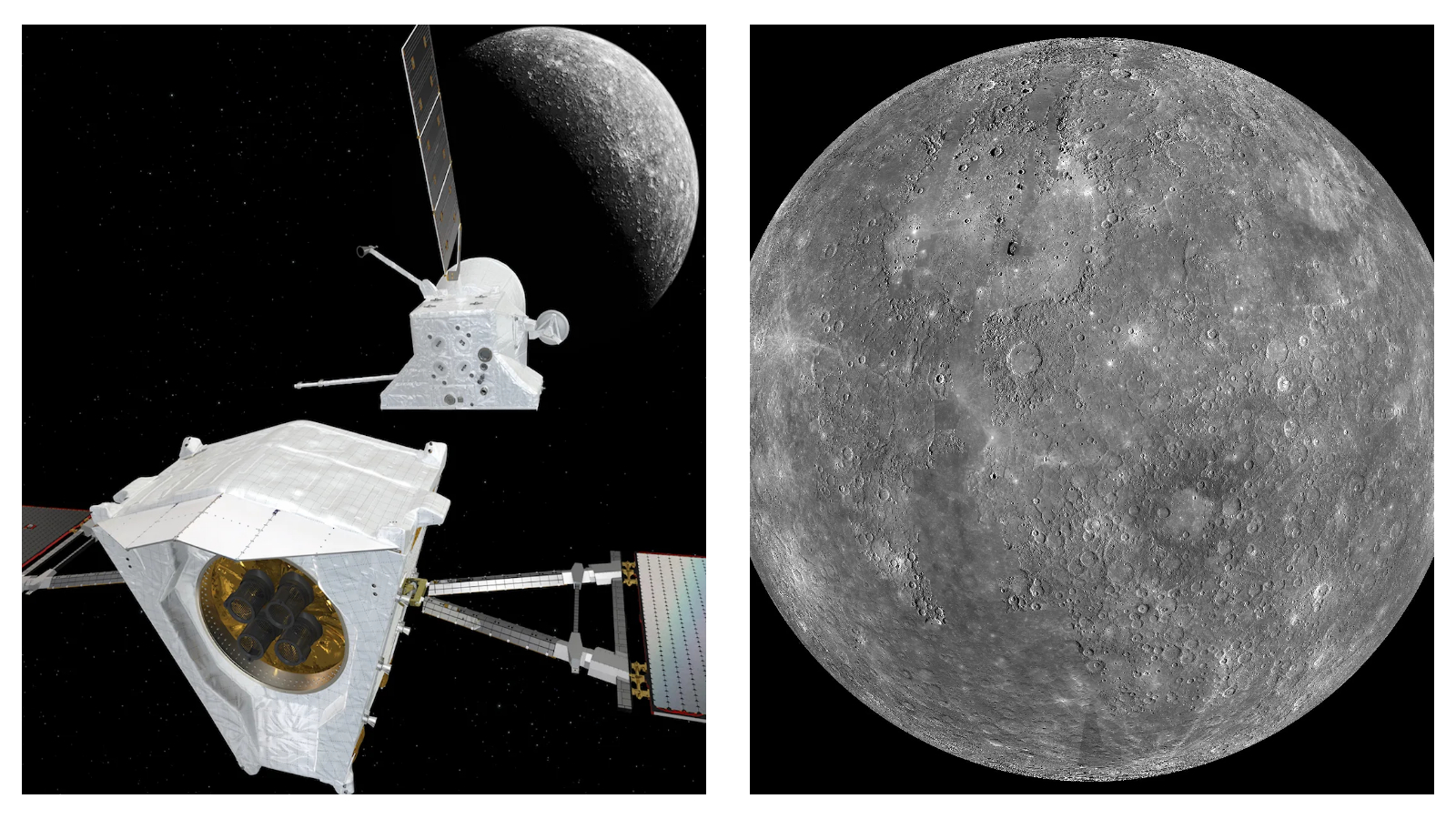
After an eight-year voyage through space, the European-Japanese BepiColombo mission is set to reach Mercury on Thursday, September 4, marking the beginning of a demanding series of operations around the Sun’s closest planet.
The mission, launched from Earth in 2018, was designed to deliver two scientific spacecraft into orbit around Mercury: the European Space Agency’s Mercury Planetary Orbiter (MPO) and Japan’s Mercury Magnetospheric Orbiter, known as Mio.
A journey to Mercury
Their journey has taken them along a complicated route through the inner Solar System as they gradually adjusted their speed and trajectory.
Arrival, however, will not mark the end of the mission’s most difficult phase.
The European Space Agency has described the upcoming months as among the most challenging planetary arrival operations it has ever undertaken.
One of the mission’s biggest challenges is Mercury’s relatively weak gravity.
Although the planet is only slightly larger than Earth’s Moon, its gravitational pull is not strong enough to easily capture a fast-moving spacecraft.
BepiColombo therefore had to follow an unusually complex trajectory, travelling more than 10 billion kilometres and completing nine planetary flybys to fine-tune its path.
YOU MAY ALSO LIKE: Donald Trump boasts ‘topline’ US Space Academy at NASA ceremony
Studying Mercury
Once the spacecraft enter their planned orbits, the two probes will take on different scientific roles.
Beginning in April 2027, the MPO will examine Mercury’s surface and interior in unprecedented detail, passing as close as 480 kilometres above the planet.
Mio, meanwhile, will investigate Mercury’s surrounding space environment, concentrating on its magnetic field and magnetosphere. Its highly elliptical orbit will take it as far as 11,000 kilometres from the planet.
Together, the spacecraft are expected to provide scientists with a much clearer picture of Mercury, including how the small, rocky world formed, evolved and continues to interact with the intense solar environment surrounding it.
READ NEXT: AI access cut off for elementary and middle school students in New York City
 Levi Mora
  Eugene Nicklaus S. Laqui
  Ian Trinidad