
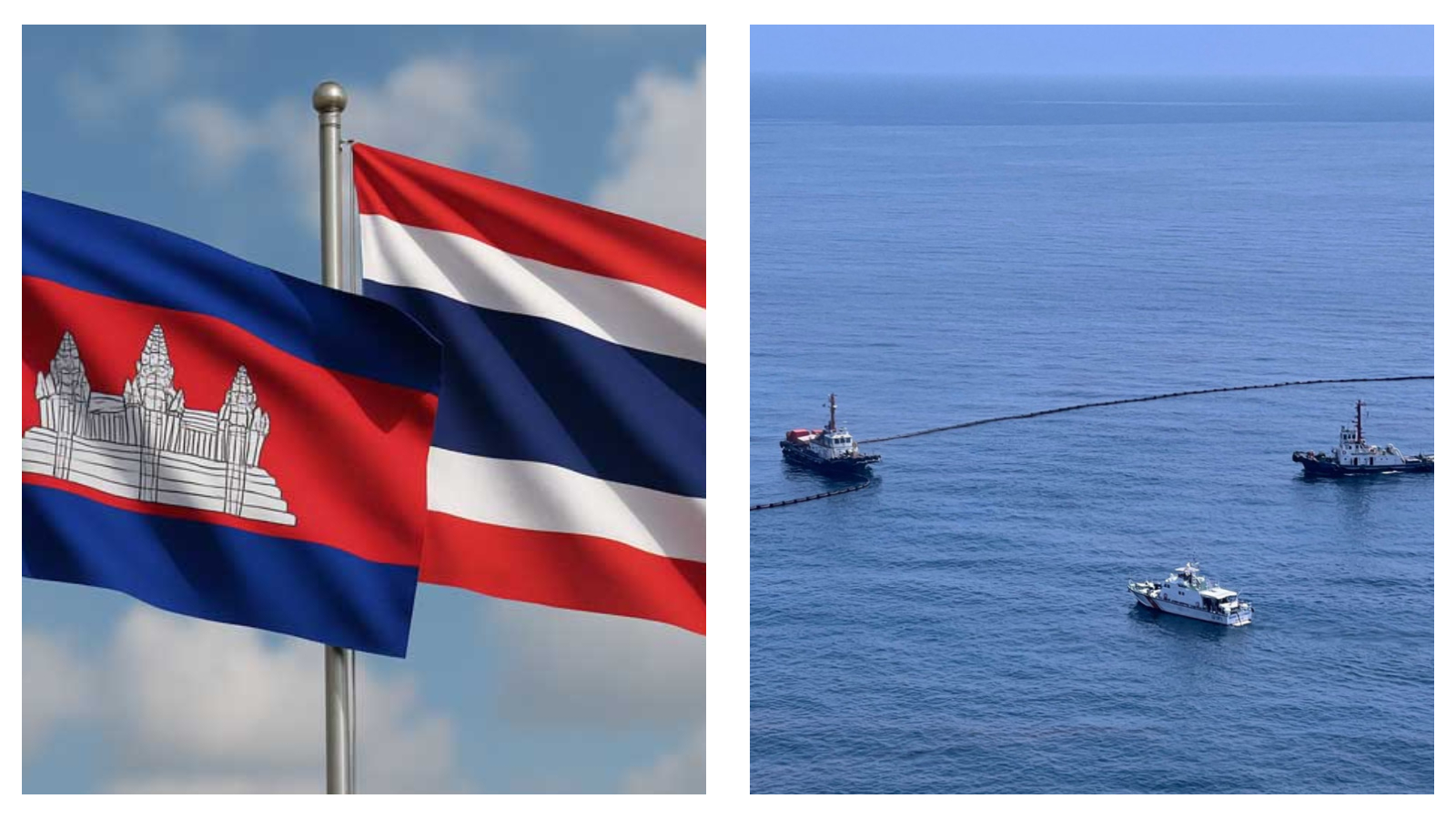
The governments of Thailand and Cambodia have been choosing the members of their five-member conciliation team to settle their differences on their maritime issues.
They are also adding weight to their respective concerns, including maritime sovereignty and potential collaboration on offshore projects.
In the latest development, the nations have mutually agreed to extend their deadline for forming a team of independent and international conciliators until August 19.
This team would oversee and resolve the issue, in accordance with the United Nations Convention on the Law of the Sea.
Both nations have yet to choose the final member of their conciliation commission, saying the person should have a “sound understanding of Thai-Cambodian relations,” as is the case for the initial four members.
Among the confirmed members of the conciliation team are German jurist Rudiger Wolfrum and South African jurist Albert J. Hoffmann, who both became heads of the International Tribunal for the Law of the Sea, as well as Danish diplomat Peter Taksoe-Jensen and French international-law academic Jean-Marc Thouvenin.
ALSO ON NJN: Prosecutors win access to Philippine Vice President Sara Duterte’s financial records

Polarising end goals
Both nations have laid down their respective pressing issues that are expected to take over the discussions of the commission.
This could potentially lead to an upholding of a treaty between the neighbouring Southeast Asian nations.
For Thailand, the topic of sovereignty should be prioritised before setting maritime and continental shelf boundaries between the nations, arguing that pushing ahead with discussions of shared offshore and maritime development would be premature without a clear understanding of where their overlapping claims would be set.
But Cambodia has raised the issue of swift exploration and usage of offshore resources, particularly natural gas, to curb the impacts of the energy crisis brought by the conflict in the Strait of Hormuz.
It said that the introduction of natural gas in the Gulf of Thailand, believed to be worth at least USD 300 billion, would be a tremendous advantage for Cambodia’s ailing energy sector that has currently relied on hydropower and solar farms, as well as exported gas and oil products.
READ NEXT: WNBA on a period of ‘hypergrowth’ amid challenges, tensions
 Angelica N. Hall
  Kamille Q. Cabreza
  Geoffrey H. Latayan