
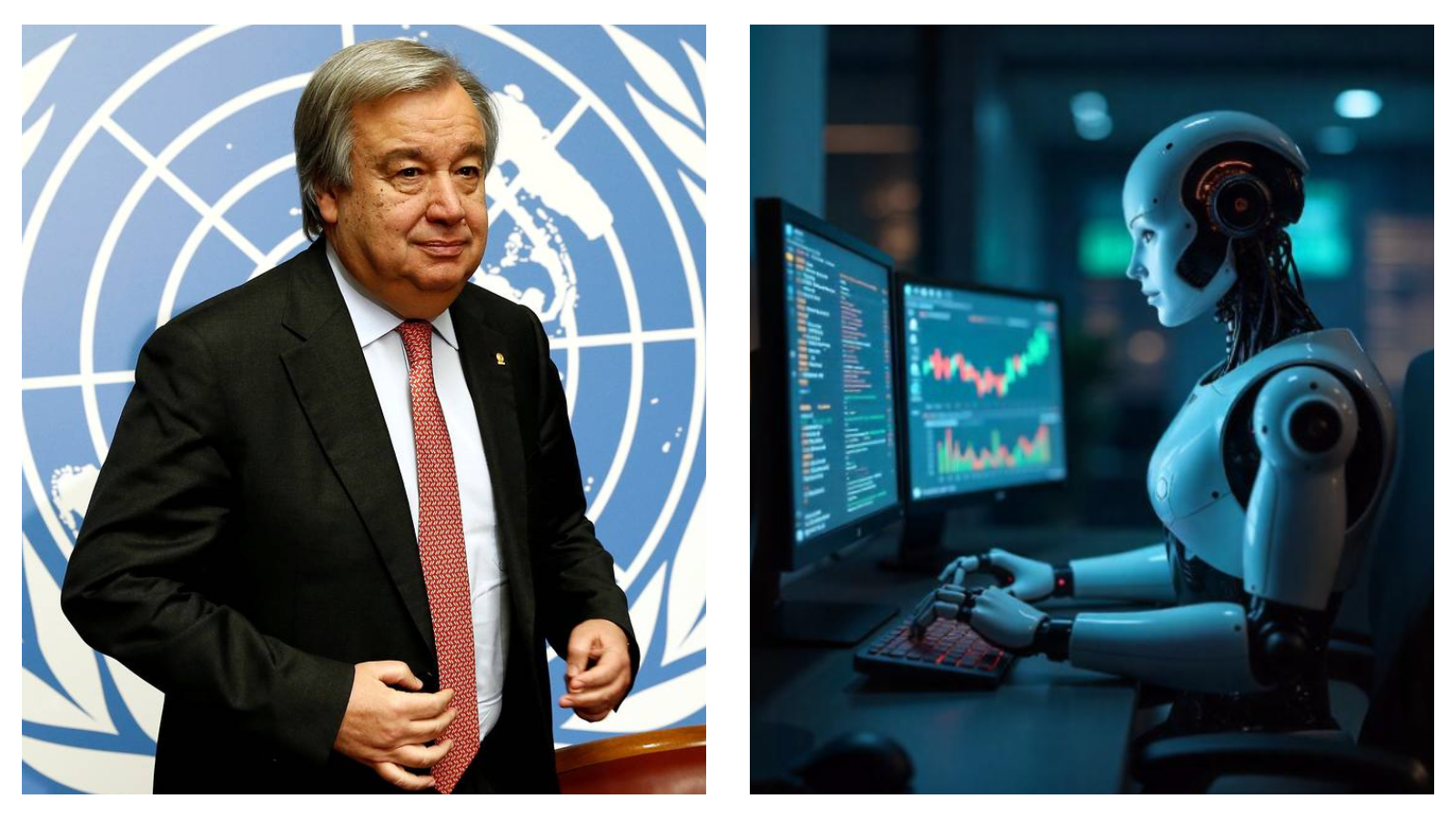
The United Nations on Monday, July 6, urged governments to act quickly to regulate artificial intelligence, warning that the technology is rapidly advancing while governance is struggling to keep pace.
During his keynote address at the UN Conference, Secretary-General Antonio Guterres warned that AI poses growing risks to human rights, public trust, inequality and global security if left unchecked.
He stressed that the technology was progressing at a “runaway speed,” but warned that “an experiment is being run on our own societies, without a plan and without consent.”
In the speech, Guterres outlined three warnings and four priorities for AI governance, urging countries to work together to ensure the technology benefits humanity.
UN chief warns risks of autonomous AI, denounces ‘killer robots’
The UN chief pointed out that “AI is already transforming our world,” comparing it to the advent of electricity and the Internet.
Though unlike the two, he said that AI’s advancement was unprecedented.
Guterres warned that the concern extends beyond the technology’s rapid adoption.
He said AI systems are no longer simply tools that respond to human commands, but are increasingly capable of “writing code, acting online, and making choices with less and less human oversight.”
“Our institutions were built to govern machines that follow commands. They are not ready for machines that decide,” he said, warning that “some lines, once crossed, cannot be uncrossed.”
Among the most alarming consequences of increasingly autonomous AI, Guterres pointed to its growing use in warfare through what he described as “lethal autonomous weapon systems.”
“Let us call them what they are: Killer robots,” he said.
He called such systems “morally repugnant” and called for them to be banned by international law.
“Machines selecting and engaging their target and taking a life – without human control and judgement.”
MORE FOR YOU: Vietnam achieves upper-middle income status: World Bank

‘Vibe-coding’ information threatens public trust
Guterres pointed out another concern – that AI’s power is concentrated in a handful of companies and countries.
“Most nations – including many developing countries – have had no say in decisions that will shape their futures,” he said.
“The longer we wait, the harder that concentration sets. When power imbalances are hard-wired into technology, inequality becomes part of the code.”
He also warned about the risks of what he called “vibe-coding” – when people start to rely on AI-generated outputs without examining their accuracy.
Describing it as an attitude of letting “the AI do it” because it “seems to work,” he cautioned that such practices can threaten the truth and undermine trust.
“A machine-enabled lie can now persuade as effectively as the truth – and authentic evidence can be dismissed as fake,” he said.
“And vibe-coding can do wonders,” he added. “But we cannot vibe-code the truth. We cannot vibe-code the future of humanity.”
Guterres urges safety, human rights first
To address the risks posed by AI, Guterres laid out four priorities for global governance: safety, red lines, capacity and transparency.
He called for countries to adopt common safety standards for advanced AI systems, arguing that systems with global reach should meet “standards worthy of global trust.”
He also proposed an “AI Child Safety Pledge,” saying “no child should be a guinea pig for unregulated AI.”
Guterres urged governments to establish clear “red lines” for the technology, stressing that AI must uphold human rights and should never replace human accountability in high-stakes decisions.
“Human rights are not negotiable,” he said, adding that “in every high-stakes decision – in justice, in healthcare, in policing – machines can inform, but humans must decide – and answer.”
ALSO ON NJN: F1 news: Charles Leclerc returns to top of podium after 624 days

Preventing ‘AI divide’ in developing countries
To prevent widening inequalities, Guterres also called for greater investment in AI capacity for developing countries through a UN-backed “Global Network for Exchange and Co-operation on AI Capacity Building” and a proposed “Global Fund for AI.”
“We cannot allow the digital divide to harden into an AI divide,” he said.
He then urged member states to “Support the Network. Back the Fund.”
Regarding AI’s climate impact, the UN chief pressed for greater transparency from companies over the environmental costs of their technologies.
He called on major AI firms to publicly disclose the carbon, water and land footprint of their systems, as well as “commit to power every data centre with renewable energy by 2030.”
“We may be the last generation able to set the terms on which humanity and machines coexist,” Guterres said at the last part, “The door is still open. But it will not stay open long.”
READ NEXT: EXhOrizon in Manila: EXO delivers memorable show for long-waiting Filipino fans
 Kamille Q. Cabreza
  Jheruleene Anne Ramos
  Wendellyn Mateo