
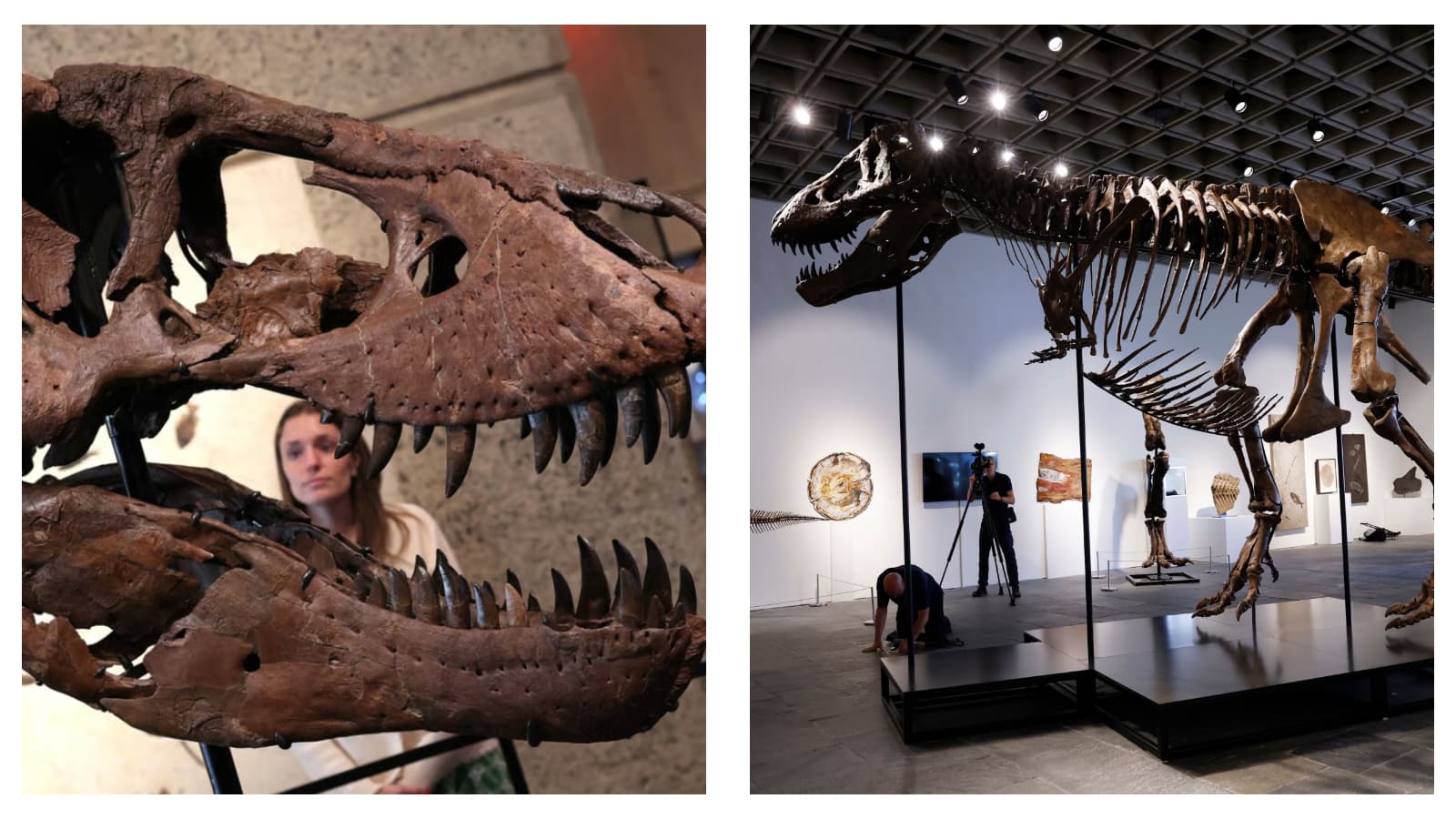
Deciding who should be the rightful owner of Gus, a 67-million-year-old Tyrannosaurus rex fossil and one of the most significant prehistoric discoveries in the world, has caused a stir within the scientific community following its recent record-breaking $50.1 million sale.
Sotheby’s in New York also revealed that the enormous fossil is the highest-valued dinosaur it has ever auctioned.
This pushes Apex, a stegosaurus fossil auctioned in 2024, down to number two on the list of most expensive fossils after it held the record for two years after a $44.6m sale.
From ancient predator to auction sensation
Gus is among the unearthed Tyrannosaurus rex fossils with the most complete bone structure, with over 60 per cent intact.
The towering specimen, measuring more than 12 feet (four metres), was excavated on a remote ranch in the US state of South Dakota between 2021 and 2023 before undergoing thorough laboratory preparation for three years.
During its restoration period, scientists considered the discovery of healed rib fractures and bite marks on its skull indicators of the predator’s violent past, such as battles with other dinosaurs.
Sotheby’s credited the years of meticulous effort as the driving force behind the auction.
“This result has been years in the making,” Cassandra Hatton, Sotheby’s worldwide head of science and natural history, was quoted as saying by the BBC.
“Gus is not only an exceptional find but a specimen that has been excavated, documented, prepared and cared for with real excellence.”
READ MORE: US rallies for global support to make ICC irrelevant

The battle continues beyond the bones
Despite the newsworthy price tag, the sale has reignited debate within the scientific community.
Some palaeontologists worry that key fossils being sold at surging prices to more private collectors could limit their accessibility for public education and scientific research.
Professor Richard Butler, a vertebrate palaeontologist at the University of Birmingham, said in a report published in The Guardian: “The current trend towards dinosaur fossils being marketed and sold like rare artworks at vast prices by auction houses is very concerning, as is the idea of buying dinosaur fossils as a status symbol or a commodity.
“A fossil not in a recognised museum collection cannot be studied and is therefore lost to research.
“Fossils have been bought and sold for hundreds of years, but prices are increasingly out of the reach of museums, much to the detriment of science.”
Nevertheless, others are hopeful that such acquisitions will not be a hurdle to the progressive exploration of this field.
An example of this is billionaire Kenneth Griffin, who acquired Apex and later lent the fossil to the American Museum of Natural History for public display.
Whether Gus ends up in a private collection or a museum exhibition, its sale signifies a significant shift in the expanding market for natural history artefacts.
With increasing interest from affluent collectors, the discussion around balancing private ownership with the preservation of fossils as scientific and cultural heritage for future generations escalates.
Since the sale of Gus, announced on July 14, 2026, the identity of the buyer has not been revealed, but past events suggest a museum display remains possible.
YOU MAY ALSO LIKE: Christopher Nolan’s ‘The Odyssey’ hits cinemas amid controversies and curiosity
 Ciara Mina
  Rosemarie Zamora
  Jacinth Banite