
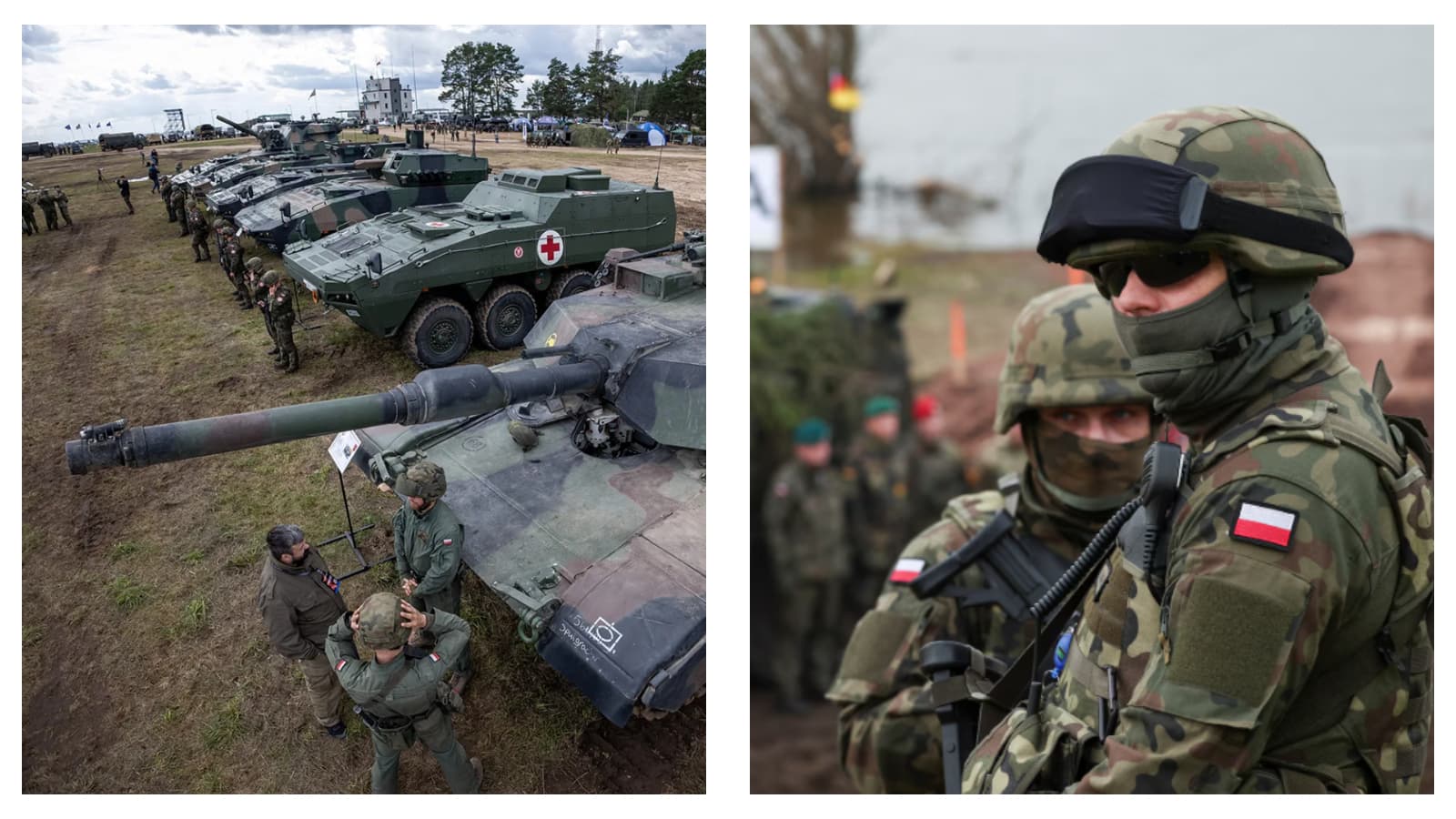
Poland has initiated one of the most ambitious military rearmament efforts in European history to tip the balance of power on the continent’s eastern flank amid the high-intensity combat between Ukraine and Russia.
The conflict has seriously challenged traditional viewpoints in military tactics, prompting stakeholder nations to reassess their strategies and adapt to emerging technologies.
Warsaw, meanwhile, aims to utilise precision firepower to offset the numerical and technological gap between Russia and its Eastern European neighbours.
Upending established dominance
Russia’s military posture, particularly its long-range strike assets, has long cast a huge shadow in Eastern Europe as countries like Poland have looked for a security umbrella from the United States.
With 12,000 Russian troops and Iskander missiles strategically positioned in Kaliningrad and the Suwałki Gap, it is believed that Moscow would have the firepower advantage over its Eastern European counterparts in the first hours of a potential conflict between Moscow and NATO.
However, shifting domestic politics in the United States and an aggressive Russia have made European military autonomy a real operational goal for many NATO countries interested in long-term protection of their sovereignty.
Poland plans to offset Russia’s firepower advantage by deploying its own high-value missile systems in droves to create a credible missile barrier.
Warsaw’s procurement strategy aims to field 486 American M142 HIMARS alongside 288 South Korean K239 Chunmoo launchers, a dual missile architecture capable of launching hundreds of missiles to strike vital military targets.
The Polish HIMARS are expected to fire GMLRS and ATACMS munitions, while the Chunmoo launchers are equipped with 239mm and 600mm strike packages.
READ MORE: US, Denmark, Greenland ink new defence pact after year of tension

Taking on Kaliningrad
Though a small Russian territory, Kaliningrad still packs a serious punch, with its military infrastructure designed to serve as an anti-access/area-denial (A2/AD) fortress.
The Suwałki Gap, a small land bridge that connects Poland to the Baltic states, has been touted as a potential flashpoint that the Russians can exploit in the event of a conflict with NATO.
A key feature of Poland’s artillery doctrine is using its HIMARS and Chunmoo to attack these two areas to blunt a Russian military advance.
The dual missile set-up could be used to destroy Russian military installations, airbases and missile sites across Kaliningrad.
Additionally, those missile launchers will be highly mobile as they will be equipped with locally developed 8×8 Jelcz truck chassis, ensuring their survivability during shoot-and-scoot operations.
YOU MAY ALSO LIKE: Global leaders gather as 81st UNGA general debate opens

Deterring Russian aggression
While Poland’s artillery build-up is formidable on paper, it remains debatable whether it is sufficient to blanket a potential Russian army advance in actual combat.
What it does signal to Moscow is Poland’s willingness to conventionally compete with Russia on a scale not seen since the end of the Cold War.
Warsaw could be leaning on a deterrent principle in which stability in the Eastern flank rests on its ability to shoot back, making Russia think about whether the benefit of spreading its aggression to Poland and the Baltic States outweighs the risks of such a decision.
READ NEXT: Nepal urges Himalayan neighbours to join climate pact
 Elan Castanares
 Ciara Mina
 Jheruleene Anne Ramos