
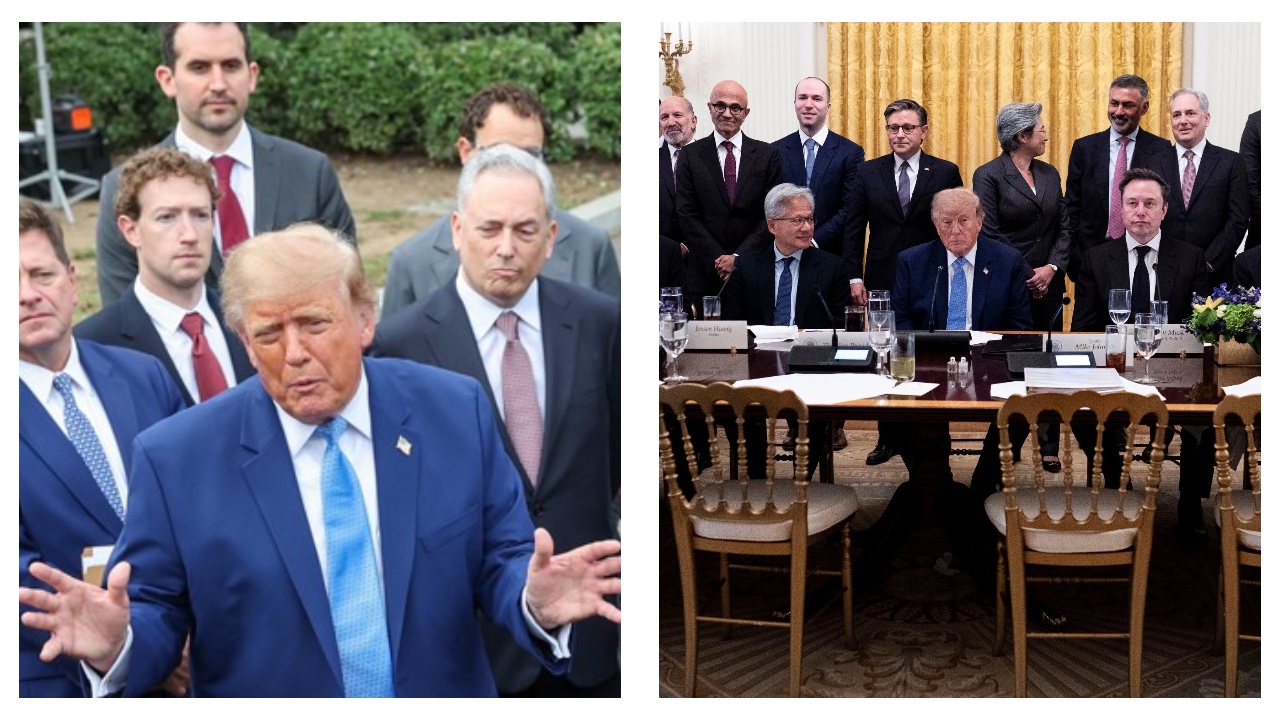
Leaders of some of the world’s biggest technology and artificial intelligence (AI) companies have signed an accord at the White House, committing their firms to stronger internal controls, independent assessments and board-level oversight as concerns grow over the safety of rapidly advancing AI.
The White House Accord on Super Intelligence was signed by Google CEO Sundar Pichai, Anthropic CEO Dario Amodei, Meta CEO Mark Zuckerberg, OpenAI President Greg Brockman, xAI CEO Elon Musk and Nvidia CEO Jensen Huang.
United States President Donald Trump also signed the document and later shared the accord on his Truth Social platform.
Four layers of AI safeguards
Under the agreement, companies training and deploying frontier models agreed to four layers of controls and audits to ensure that their technology works as intended and that any issues are promptly identified and resolved.
These include implementing “robust internal controls” to monitor models during training and deployment, particularly around cybersecurity, biosecurity and chemical threats, as well as empowering internal teams to ensure the safeguards are working as intended.
Companies are also urged to partner with independent external auditors to assess the controls, and designate independent board committees to oversee and receive reports from the teams responsible for the safeguards.
READ MORE: El Niño raises concerns over drought, saltwater intrusion in Vietnam

Tech companies ramp up AI security efforts
Ahead of the White House meeting, some of these tech giants had already stepped up efforts to strengthen security around the AI systems.
Nvidia on September 28 launched its Open Agent Safety Platform, designed to provide stronger control over AI agents from testing to deployment.
The platform includes OpenShell, which sets boundaries around agents as they perform tasks, and Sentry, which continuously monitors their behaviour and can quarantine agents that move outside those boundaries.
Nvidia was joined in this project by other industry leaders, including Anthropic, Dell Technologies, Microsoft and SpaceXAI.
Meanwhile, OpenAI recently held back the release of GPT-6.1 Astra over security concerns raised by its researchers.
The company said that the new model would have to undergo more work to meet the safety standards and later pledged to strengthen its safeguards following concerns over the hacking of an Australian government website.
From AI to SI
As the technology is becoming more and more intelligent, Trump wants to make sure that the terminology used by the US federal government reflects what he described as its rapidly advancing capabilities and potential.
In a separate executive order, Trump directed federal agencies to use “Super Intelligence” (SI) instead of “Artificial Intelligence” (AI) in official communications, websites, reports and other non-statutory documents.
The order, titled “Inaugurating the Era of Super Intelligence,” said the new term “more appropriately captures the promise, potential, and rapidly advancing capabilities of these technologies.”
Trump rejects calls to slow AI development
Trump earlier dismissed calls from some tech industry leaders to slow down the development of AI, saying the US should maintain its technological lead over China.
“We’re leading China in AI, we’re the most sophisticated country in the world, and frankly I want to keep it that way,” Trump said, as quoted by The Washington Post.
“Whoever wins AI wins.”
The signing of the accord only further reflected his position, highlighting that the US administration is aiming for stronger safeguards around AI without slowing its development.
READ NEXT: Hollywood figures demand accountability over resurfaced Cornell sexual assault case
 Elan Castanares
 Ciara Mina
 Jheruleene Anne Ramos