
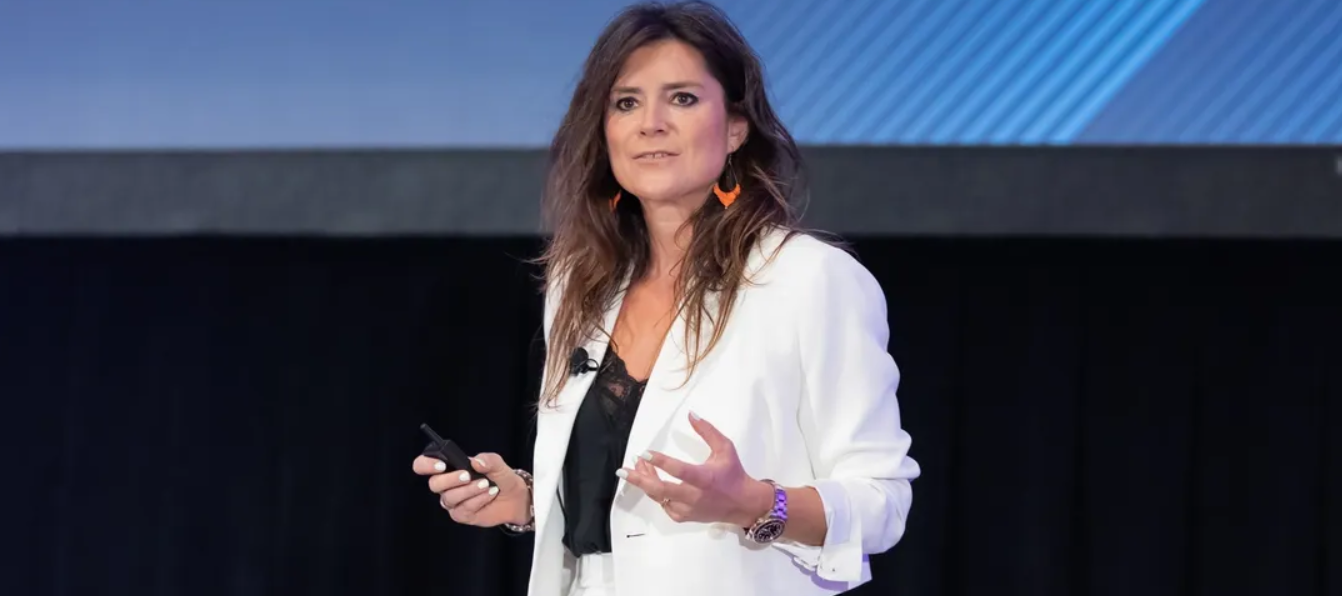
Sarah Furness is a recognised teamwork & teambuilding speaker, drawing on frontline leadership experience to explain how individuals operate under pressure and how teams sustain performance when it matters most.
A former Royal Air Force helicopter pilot, she completed operational tours in Iraq and Afghanistan, leading missions in high-stakes environments where clarity, trust and decision-making were critical.
That background now underpins her work with organisations navigating change, where the same principles of accountability, communication and resilience apply beyond the military.
Her approach focuses on practical leadership. Not theory, but how people actually behave when pressure builds, priorities compete, and outcomes are uncertain. From managing fatigue to maintaining focus and creating a sense of shared ownership, her perspective is grounded in lived experience rather than abstraction.
In this exclusive interview with the Female Motivational Speakers Agency, she breaks down how leadership evolves over time, how teams stay engaged during transformation, and why the strongest cultures are built on collaboration, challenge and contribution.
Q1. How has your leadership style evolved over time, and what has that taught you about leading others well?
Sarah Furness: “Interesting question. I think my leadership style started with probably a dictatorship, where I worked out that people would do what you asked them to do when you were given a leadership role. This was very young, when I was 12 or 13, and I was in the Air Cadets, and I sort of had my train set to play with.
“Then you obviously work out that that’s not really what leadership is. I think you have to, or I certainly had to, work that out by practising it, getting it wrong and realising that people don’t really respond to that.
“So, I think now it’s gone much more into influence and stepping back and creating the conditions. To start with, you feel like you have to have all the answers and be very directive. And I think there’s a time and a place for that.
“But as I’ve matured and learned more about it, I’ve learned that actually sometimes it’s just about creating the space for people to find their own answers and having the confidence that that’s also leadership.”
READ MORE: UK scrambles to contain meningitis outbreak linked to student cluster

Q2. What does it look like for leaders to model wellbeing in a credible, practical way?
Sarah Furness: “I think one of my superpowers, or one of the things I think is a leadership superpower, is un-asking, which is what it sounds like. It’s the opposite of multitasking.
“I think that’s so important in today’s world, where we’re on all the time. We are able to be contacted through a variety of different media sources, so it’s very easy to think that we have to be everywhere at once.
“But actually, the brain still can’t be in more than one place at once. Our conscious thinking brain can only really focus on one thing at a time.
“I discovered this, and it’s a very long, convoluted story which I give a whole speech about. But ultimately I discovered that when you focus on one thing at a time, not only do you do that task quicker, but you reduce overwhelm, and you take back a bit of agency in your life, so it feels good.
“I think giving yourself permission to focus on one thing at a time is a really good strategy for wellbeing. One of the best ways for leaders to encourage that is to do it themselves and to signpost that and say, ‘Actually, I can’t multitask. I’m better at focusing on one thing at a time, so I need to focus on this right now.’
“It’s about creating those boundaries but also socialising the idea so that other people think maybe I could do that too, because they seem so calm and I’m running around doing a million things. Hopefully that’s not true. But I think you’ve got to practise what you preach.”
YOU MAY ALSO LIKE: Philippines tourism: Central Visayas tops foreign arrivals, Calabarzon leads domestic travel

Q3. When organisations are going through change, how can leaders keep people engaged rather than resistant or disconnected?
Sarah Furness: “That’s a great question, and a lot of organisations ask about this. How do we lead through transformation? How do we lead through change?
“I think there are a couple of really important things to think about here. Number one is, if your partner, or someone that you deeply respect, put a cup of tea in your hand and said, ‘We need to talk. Something’s got to change.’ What would your immediate go-to thought be? Because I know what I’d be thinking. I’d be thinking, ‘Oh my goodness, what have I done wrong?’
“So, I think it’s important to recognise that when we’re leading through change, that’s where people’s brains go. They either think ‘I must have done something wrong or I’m being set up to fail.’ So actually, I think a lot of it is about teaching people to have a different mindset about failure, because it’s part of the journey.
“I think the other part is when change is done to people. We don’t really like being told what to do. I did 21 years in the military, where you literally tell people what to do, and I can tell you that they still don’t like it.
“So, I think the key is creating a sense of agency. Where you can, give people the ability to collaborate, to co-create the transformation plan, and if they can’t do that, then the ability to challenge it. If they can’t do that, then at the very least, they should explain why they are an integral part of the plan and articulate what their contribution is.
“So, I put that down to three C’s, which are collaboration, challenge and contribution. Those are the ways I think can really help to increase people’s engagement when they go through transformation.”
MORE FOR YOU: Turkey fires up diplomatic pursuit amid rising Mideast tension
Q4. Where did your confidence to lead come from, and how did you build it early on?
Sarah Furness: “I attribute a lot of this to my upbringing, my childhood. It all started with the movie Top Gun. I’m not ashamed to say, when I watched the film, I thought that was what I’m going to do. And when you’re 12, you don’t question it. But neither did anybody else, actually. My parents, my teachers, they said absolutely, we can kind of see you being a fighter pilot.
“So, I went off and joined the Air Cadets, and that gives you an early exposure to leadership. Then I was a prefect at school.
“I think part of it was just that nobody put the idea in my head that I couldn’t, and actually, when you’re that kind of age, we don’t have those limiting beliefs that we all learn to have when we get older.
“So, I think that helped. And also, just getting out there and doing it. Inevitably, you have to test and adjust. You get some things wrong, but the more you do it the less frightening something is. I think early exposure, and then just keeping learning, really helped.”
ALSO ON NJN: Oscars 2026: Winners, who attended, noteworthy moments

Q5. What have leadership and motherhood taught you about being honest about pressure, limits and support?
Sarah Furness: “With difficulty at times. I think one of the lessons I learned early on when I was in the Air Force was not to try to hide it. When I went back to work after maternity, I was afraid that if I signposted that I was doing childcare, it would be a black mark.
“Actually, I was being deployed to America on an exercise, and I wasn’t able to work out the childcare plan because my husband at the time was also deployed somewhere. He was in the army. I kept trying to come up with these elaborate reasons, as in, ‘Oh, I’ve got to get back because it’s a really important meeting,’ and X, Y, Z, and nobody was buying it.
“Then eventually I said, ‘Look, if I don’t get back, my son won’t have anyone at home.’ And I remember them saying, ‘Why didn’t you just say that in the first place, Sarah?’ And they got me on the next flight.
“So, I think it was learning not to be afraid of just being really transparent because a lot of people are parents too. I think that was a really important lesson.
“But also, dare I say it, sometimes as a mother, we used to say, ‘Oh, well, it always falls to the mum,’ but that’s often also because I always just got on and did it. Actually, when you say he’s got two parents, so maybe dad can help out, and you ask them, they usually find a way.
“So, I think it was also about not being a martyr, whether we realise it or not, and actually letting the other part of the team help out.”
This exclusive interview with Sarah Furness was conducted by Tabish Ali of the Motivational Speakers Agency.
READ NEXT: Randy Orton brutalises Cody Rhodes during contract signing
 Carmela Calling
  James Mario Ajero