

History unfolded before our eyes on Monday as the Artemis II mission of the National Aeronautics and Space Administration (NASA) recorded the farthest distance from Earth traveled by any human, surpassing the record previously set by Apollo 13 in 1970 at 248,655 miles.
Historic lunar flyby
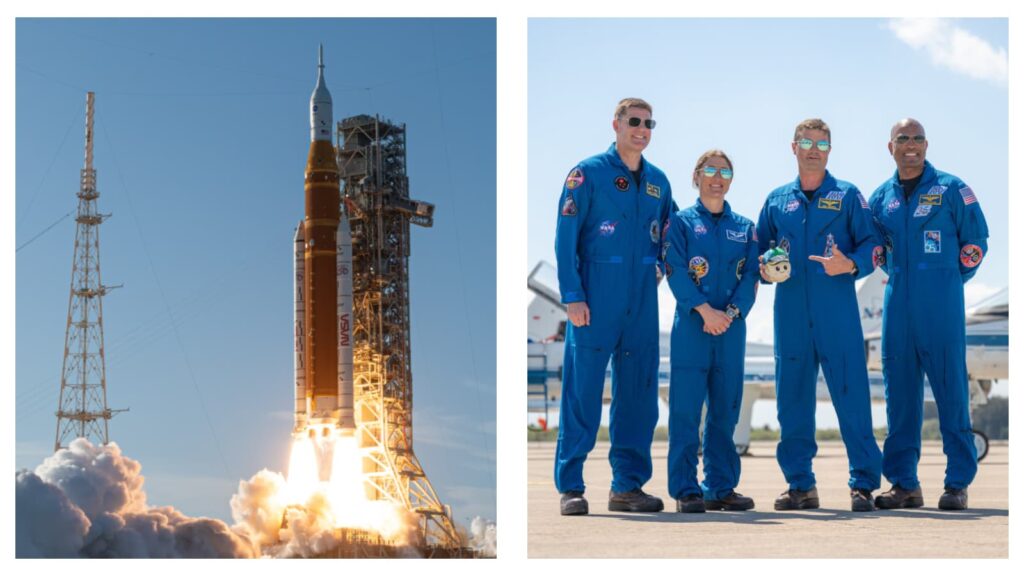
As NASA astronauts Reid Wiseman, Victor Glover, and Christina Koch, along with CSA (Canadian Space Agency) astronaut Jeremy Hansen continued their journey to complete a historic flyby, the crew discovered two small, unnamed craters on the heavily pockmarked lunar surface.
They noted being able to see them with their naked eye.
The crew provisionally named the two craters – the first is Integrity, named after their spacecraft and the historic mission, located northwest of Orientale basin, while the other is named Carroll, in memory of Wiseman’s late wife, Carroll Taylor Wiseman, located just northeast of Integrity.
The Orion spacecraft lost connection with Earth at approximately 6:44pm for about 40 minutes.
At around 7pm, the spacecraft and its crew reached their closest point to the Moon, flying about 4,067 miles above its surface.
Just two minutes later, they hit the mission’s farthest distance from Earth at 252,756 miles.
YOU MAY ALSO LIKE: Artemis II marks NASA’s first crewed mission to the Moon in five decades
What did the crew witness?
NASA reported that the test flight revealed areas never before seen by human eyes.
During the lunar flyby, the crew observed impact craters, ancient lava plains, and surface fractures that could help scientists better understand the Moon’s geological history.
They also noted subtle variations in color, brightness, and texture across the landscape.
As the Orion spacecraft passed behind the Moon, the crew witnessed an “Earth set”, followed by an “Earth rise” as it reappeared from the Moon’s far side.
The crew also had the opportunity to witness a solar eclipse, where they analysed the solar corona, the Sun’s outermost atmosphere, as it appeared around the Moon’s edge.
During the eclipse, the four astronauts reported six light flashes from meteoroids striking the surface.
Crew on their way home
After seven hours of the historic flyby, at 9:35pm on Monday, the Artemis II mission crew completed their lunar observation period, and are now on their way home.
Hailing the crew for their successful journey, acting associate administrator for Exploration Systems Development Mission Directorate at NASA Headquarters in Washington, Lori Glaze, said: “Their dedication is about more than breaking records – it’s fueling our hope for a bold future. Their mission is to carry our promise to return to the Moon’s surface, this time to stay as we establish a Moon Base.”
The Artemis II mission is a big step toward bringing people back to the Moon.
The historic lunar flyby helps NASA prepare for its future missions in deep space exploration and establish a sustained presence on the Moon.
READ NEXT: Drones enter Philippine coffee farms as new approach to cultivation
 Carmela Calling
  James Mario Ajero