
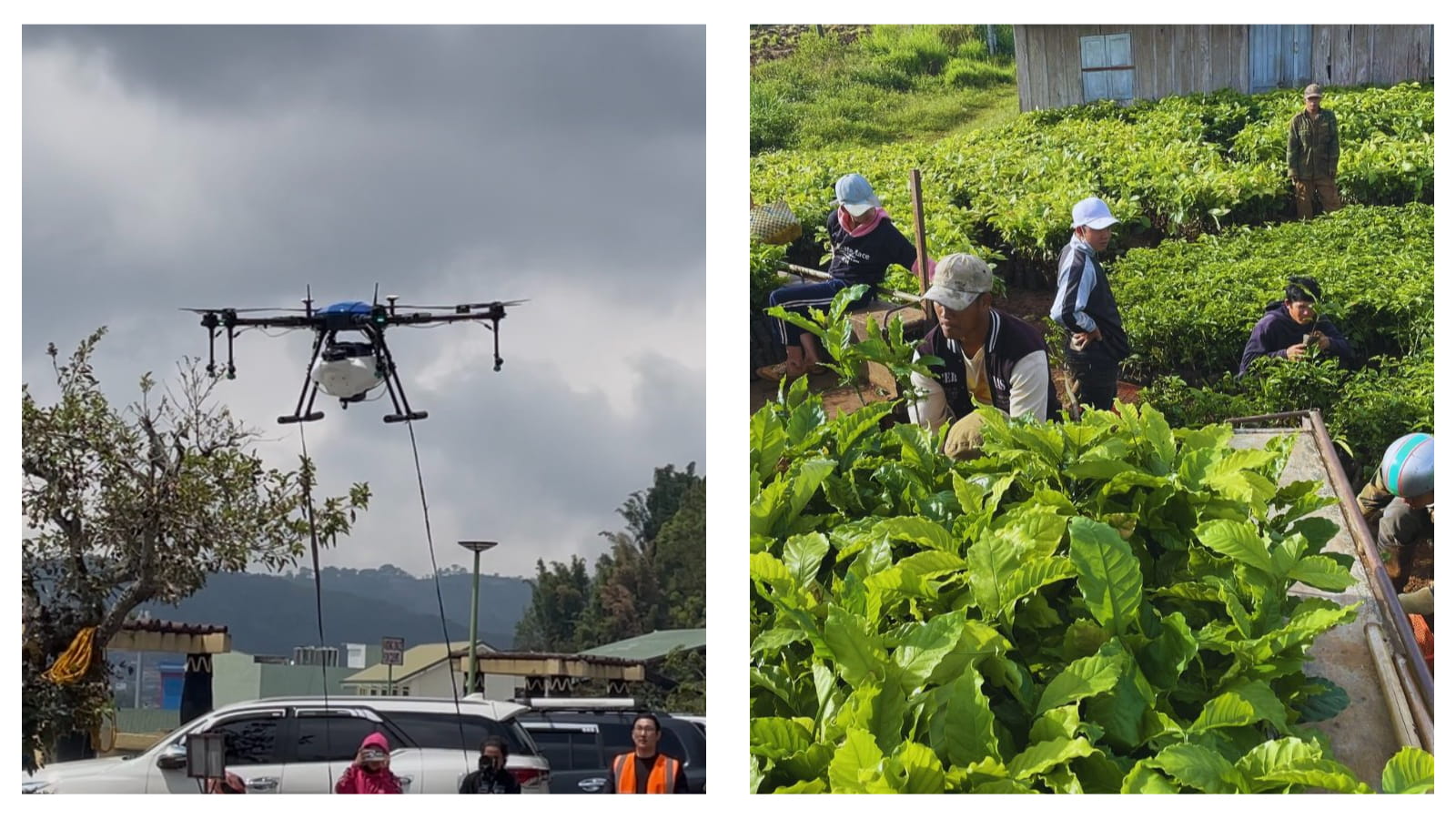
Drone technology is being introduced to coffee farms in the mountainous province of Benguet, offering a potential solution to labour shortages and difficult terrain that have long constrained production in the Philippines.
The technology was showcased during the “Tinapong: Benguet Coffee Festival 2026,” where a live demonstration at the Benguet Provincial Capitol highlighted how agricultural drones can be used to spray water, fertilisers, pesticides, and nutrient solutions across crops.
A solution to terrain and labour challenges
Coffee cultivation in Benguet is largely centred on Arabica varieties grown on steep slopes, where transporting equipment and inputs can be physically demanding. Drones are being explored as a way to ease these constraints.
According to demonstrators, the drones can carry between 10 and 20 litres of liquid and cover up to one hectare in around 15 minutes.
In addition to spraying, the devices are equipped with imaging cameras capable of identifying crop conditions and potential problems, allowing farmers to assess plant health more efficiently.
The technology is seen as particularly relevant in areas where labour shortages have affected farm operations.
Toward a practical programme
The initiative has been linked to an educational programme that combines English language training with practical exposure to coffee production.
JIC Tutorial Language Inc academic director Brian Patrick Pobre said the concept initially aimed to attract international students from countries such as South Korea, Japan, Taiwan, and China to study English in the Philippines while gaining hands-on experience in coffee farming.
The programme later expanded through collaboration with the Korea Coffee Association, allowing participants to pursue both language training and barista certification.
During visits to farms in Benguet, organisers observed that local agricultural processes could be further developed, prompting efforts to introduce new technologies.
READ MORE: Rising tensions, shrinking water: Turkey, UN warn of global water supply crisis
Local farmers consider community use
For local farmers, the potential benefits of the technology are closely tied to scale and shared access.
Coffee farmer Marcial Mano Compala said drones would be most effective if used collectively within farming communities.
“We need to come together as one community. If we plant together, we can avail of this technology so that I will not have to shoulder it alone.
“Many of us can benefit from it since it can cover a wide area, making it ideal for an entire community. It is a good technology, especially for large farms,” he said in an interview with the Philippine Information Agency.
The emphasis on shared use reflects the economic realities faced by many smallholders, for whom the cost of advanced equipment can be prohibitive.
By pooling resources or accessing rental services, farmers may be able to integrate the technology more gradually.
While still in its early stages, the introduction of drones in Benguet signals a shift in how agricultural innovation is being approached in the Philippines.
With its origins in South Korea and potential applications beyond national borders, the technology is being positioned as part of a broader move towards more adaptive and technology-driven farming systems.
READ NEXT: Documentary on Vietnam’s Son Doong Cave featured on CBS’s “60 Minutes”
 Kamille Q. Cabreza
  Diana Mae Y. Cleto
  Hazel Camba