
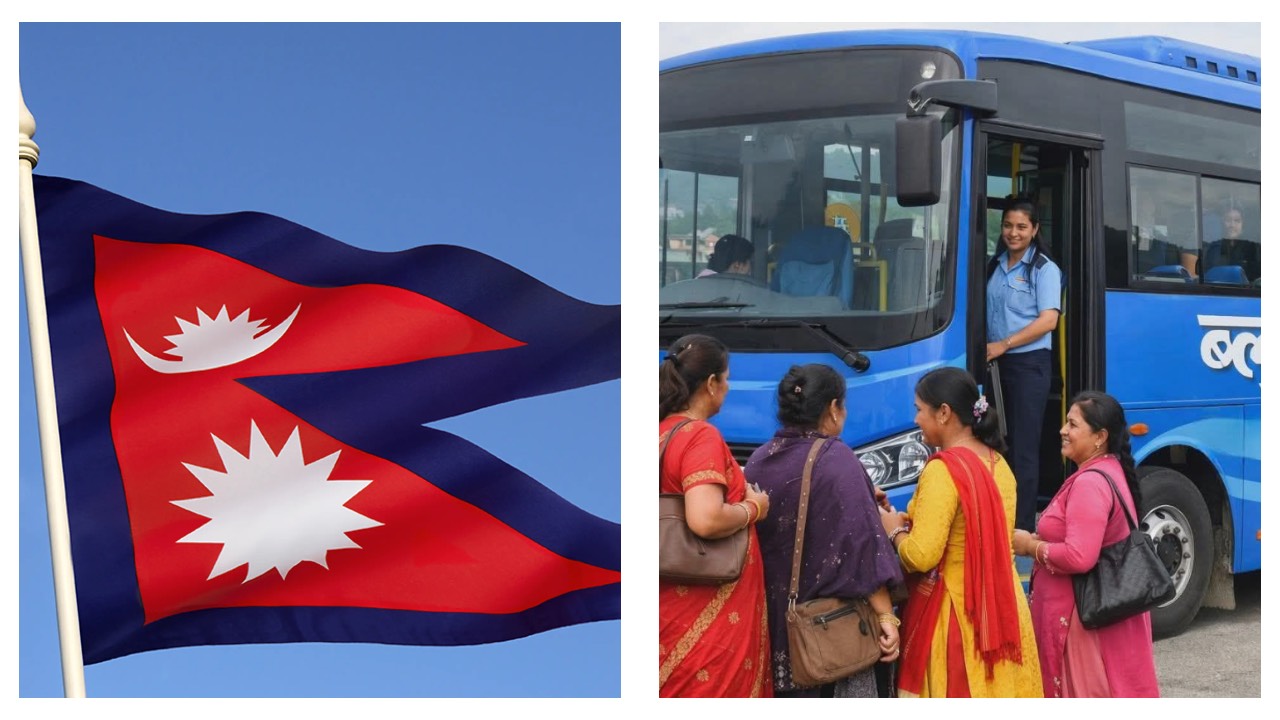
In a bid to curb violence against women in public spaces, the Nepali government is launching a women-only passenger bus line nationwide.
Known as the “Blue Bus”, the passenger bus line will offer a free transportation service to women and girls across all seven provinces in Nepal.
The initiative was first announced in March as part of the government’s 100-point reform agenda.
During its first phase, at least 25 CCTV-equipped Blue Buses will be rolled out nationwide in the next 100 days.
Women commuters’ plight
Despite existing measures to protect women in public spaces, many Nepali women are still experiencing harassment while using public transit.
Police reports for fiscal year 2024-2025 revealed that in the Kathmandu Valley alone, 4133 people were arrested for misconduct on public transport.
Of these, 43 were arrested for obscene acts, 32 for using abusive language, and 16 for physical assault that involves sexual harassment.
Women accounted for the majority of those affected by these incidents.
In an interview with The Kathmandu Post, police spokesperson Prabin Dhital said that the actual figures may be higher, as many incidents go unreported due to fear of stigma and blame.
“When women are made to feel that they are somehow responsible [for the harassment], they become afraid to speak openly or seek help,” said Dhital.
READ MORE: Vietnam announces cash incentives for women with two children by 35

Officials flag sustainability hurdles
The Blue Bus initiative was first implemented in Chitwan in 2023 under the leadership of Rastriya Swantantra Party chief Rabi Lamachhane.
It provided free transportation services for women in Kalika Municipality, Bharatpur, and Narangyat.
However, the service failed to gain traction and was discontinued within six weeks due to low ridership and mounting operational costs.
The national government is facing the same challenge.
“Starting a bus service is easy, but keeping it running is the real challenge,” said Bhupendra Aryal, chief executive officer of state-backed transport co-operative Sajha Yatayat.
“Fuel, drivers, drivers’ assistants, repairs, and administrative overheads all require a steady budget,” he said, adding that the government must clarify the exact procedure for budget sourcing and implementation.
MORE INTERNATIONAL STORIES: Philippines to warmly receive FIFA World Cup despite basketball-driven culture

A band-aid solution?
Another issue that women’s rights activists see is the exclusion of women travelling with their husbands and other family members.
Using the Chitwan implementation as a basis, women’s rights activist Sarita Tiwari said that the national Blue Bus initiative could also experience low patronage from women commuters.
“Women [in Nepal] rarely travel entirely in isolation; they are often accompanied by husbands, brothers, or other family members,” said Tiwari.
These women will have to commute separately from their husbands or other male family members if they are going to ride the Blue Bus.
“It does not work well in practice,” Tiwari told the Post, adding that the Blue Bus initiative might not work in the long run.
Rather than creating a separate transportation line, she urged the government to focus on making inclusive transit spaces that promote co-existence and mutual respect.
“The real solution is to make all public transport safe, responsible, and accessible for women,” she added.
READ NEXT: Germany moves to tackle rising use of date-rape drugs
 Angelica N. Hall
  Kamille Q. Cabreza
  Geoffrey H. Latayan