
Christmas is a time of joy, love and happiness and for families to get together and celebrate.
Every family has their own traditions and customs, but with the holidays being just around the corner, it also offers a good opportunity to see how those might differ around the world.
Many people celebrate the “classic” way as we know it from movies and TV series, but in some countries there are customs that a lot of us might consider uncommon or even eerie.
Folklore and mystical creatures often form a huge part of Christmas for some.
Krampus – The Christmas Devil
Most of us are familiar with Saint Nicholas, a lovely man going from house to house and bringing children presents, sweets and treats – something to look forward to.
However, some children in Austria, other German-speaking regions and Alpine regions in Eastern Europe, like Slovenia and Croatia, also have something to fear: Krampus.
If you have been naughty instead of nice throughout the year, this half goat, half demon will pay you a visit.
He walks around carrying a chain which he rattles and a birch which he uses to whip bad children.
Additionally, he also often brings along a sack in which he sometimes kidnaps bad children.
This tradition has its origins in the pagan celebrations of the winter solstice and then years later became a part of Christmas traditions in addition to celebrating Saint Nick.
Nowadays, during “Krampusnacht” (Krampus night) adults will dress up as Krampus and participate in the “Krampuslauf” (Krampus run).
However, in recent years, the Krampuses have had the tendency to get drunk and go on rampages destroying properties and getting into fights, which has been causing issues.
Frau Perchta – The Christmas witch
Just like Krampus, Frau Perchta also punishes naughty children, but also lazy and evil people.
Traditionally the witch watches over people and makes sure they are following rules and being good.
She rewards good and hard-working people with luck and blessings, however, brings bad luck, pain and suffering to the undeserving ones.
Her followers scare away bad spirits with bells, shouting and other loud noises.
If this wasn’t bad enough, the older lore around Frau Perchta is more gruesome and involves disembowelment and murder.
This tradition is common in Austria, Southern Germany, Switzerland and parts of Slovenia.
Welsh Mari Lwyd
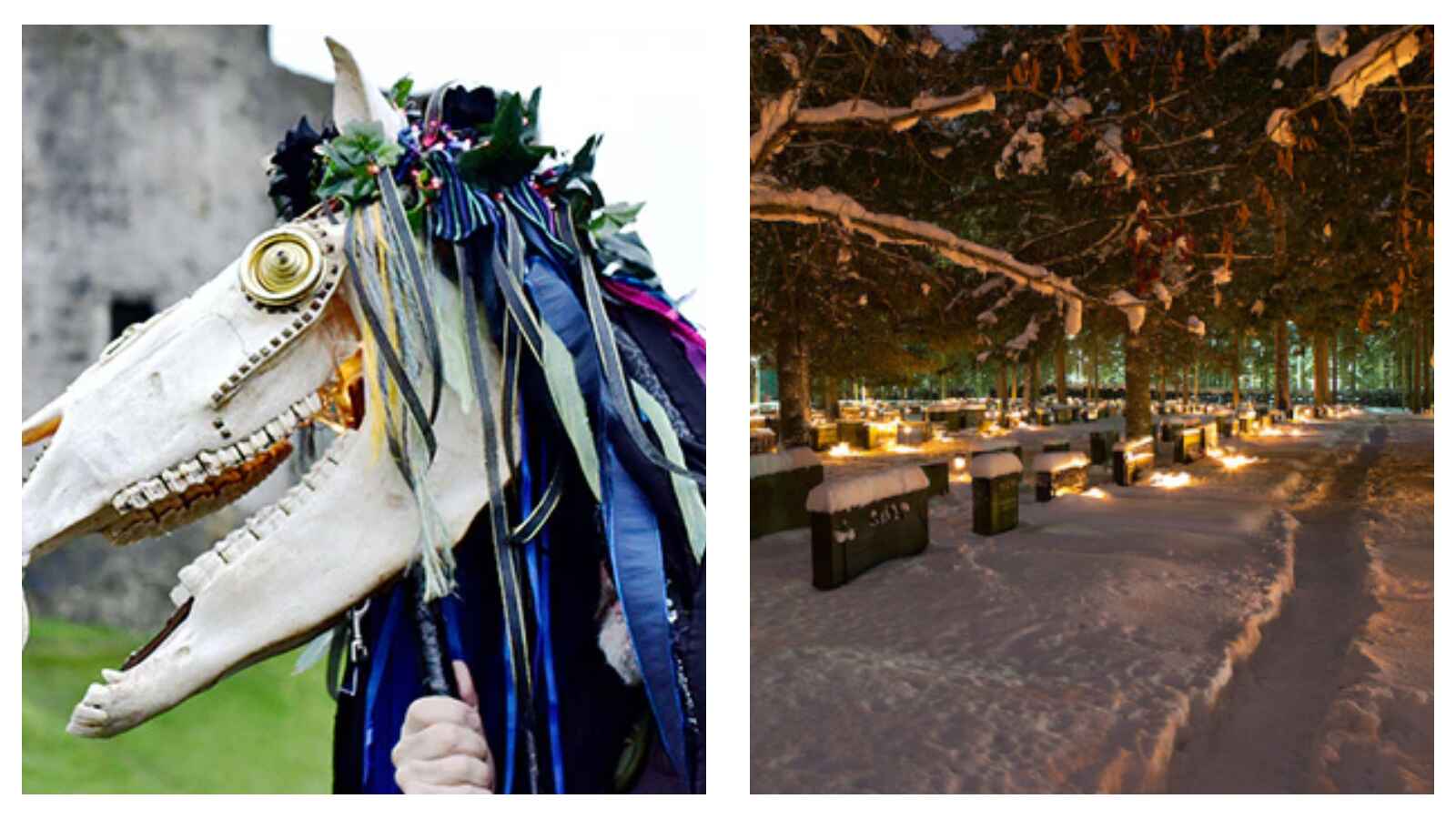
Mari Lwyd (Gray Mare) is a horse figure dressed up and looking like a ghost which is being carried from door-to-door between Christmas and New Year’s Eve.
It is also decorated with colourful ribbons and bells.
The Mari Lwyd is typically carried around Welsh towns by singing people who challenge their neighbours to poetry battles.
Even though this tradition is usually associated with Christmas, it is originally a pre-Christmas tradition, and some people even choose to showcase their horse on other holidays such as Halloween or New Year’s Day.
Nonetheless, the most popular time for Mari Lwyd is the Christmas season as it involves wassailing, drinking of a spiced, alcoholic ale.
Iceland: Gryla, Yule Cat and rotten potatoes
Gryla is a huge ogre who lives in a cave and comes out on Christmas to hunt for children to cook in her stew.
She also has many companions like her 13 mischievous troll children called the “Yule Lads” and the so-called Yule cat (Jólakötturinn).
This cat however is nothing like our beloved, snuggly friends, but rather a cat watching children and looking for ones to eat.
The only way to save themselves is for children to be good throughout the year and get nice clothes for Christmas.
If they don’t get new clothes, they need to make sure to look their best to avoid being devoured.
Another interesting fact is that whilst most commonly bad children are known to get coal instead of presents and treats, in Iceland they receive rotten potatoes which are being brought to them by the Yule lads.
YOU MAY ALSO LIKE: ‘Merii Kurisumasu!’: How Japan celebrates Christmas

Hans Trapp roaming around the Alsace
According to lore in the Alsace region of France, Hans Trapp was a man who was known for his wealth and greed.
After using witchcraft and making deals with the devil he was expelled from the Catholic church which led him to lose his wealth and status.
He started roaming around the countryside disguised as a scarecrow and eventually became obsessed with the idea of eating human flesh and killed a shepherd boy to fulfil this desire.
God punished him by striking him with lightning.
It is said that sometimes on Christmas he returns, going from door to door looking for tasty, little children.
The Kallikantzari – Christmas goblins
In Southern European countries like Greece, Bulgaria, Serbia and Turkey, people are pestered by a type of goblin, the so-called Kallikantzari.
These small creatures spend most of the year underground trying to bring the apocalypse to the world, but during Advent they take a break from that by surfacing onto earth bringing mischief and evil to the humans, playing pranks on them.
They are depicted as usually male, small black furry creatures with tusks and horns.
Candlelit graveyard and Sauna Elf in Finland
Some might think that it is a bit morbid to spend Christmas at the cemetery, but in Finland it is a common and beautiful practice.
Families go to graveyards to visit their loved ones who have passed and honour them by lighting a candle on their final resting place, resulting in a candlelit graveyard.
Another common tradition is “Joulusauna” which translates to Christmas sauna.
Since many Finnish have saunas in their houses, it is a popular practice for families to gather in the sauna together on Christmas Eve which aims to be a calm practice to relax people before the hectic and busy holidays.
Hiding broomsticks in Norway
In Norway people take matters into their own hands, doing everything to prevent supernatural mischief.
The Norwegians hide brooms and mops out of sight, like in cupboards for example so that witches and other evil spirits cannot use them for their midnight flights.
This is a century-old tradition that many people partake in, some even hiding knives to prevent more malevolent spirits from causing harm.
Sweden: Gigantic Christmas goat and Donald Duck
The tradition of the Scandinavian Yule goat originates to the days of the Norse gods – Thor’s chariot was driven by two goats and since then goats have assumed many different and positive roles in their culture.
Today, people make a goat out of rough-hewn wood or straw and place it in the stable of Christmas characters.
In 1966, for the first time, Sweden put up a 43-foot-tall Gävle Goat which since then has been put up every year on the first advent.
Its inauguration ceremony is typically shown on livestream.
Another fun tradition that many Swedish have is to sit down at 3pm on Christmas Eve to watch the 1958 Walt Disney TV special “From All of Us to All of You”.
This show has been airing on one of Sweden’s public TV channels every year at the same time since 1959 and without any interruption from commercials.
It has become one of the three most popular TV events every year.
Mexican night of radishes
Every year on the 23rd of December, the Night of the Radishes takes place in Oaxaca, Mexico.
This annual celebration was implemented hundreds of years ago and is a way of displaying creativity and crafting skills including wood carving traditions.
In 1897, the city held a Christmas radish carving competition which has turned into a tradition that now attracts people from around the world.
People come to admire the artwork and talent of the craftspeople carving them.
Greenland: whale blubber and decomposed auk
The inhabitants of Greenland are flipping around traditional gender roles: whereas women are often traditionally known to prepare the Christmas dinner, here the men are taking charge of that.
The traditional Christmas meal consists of “mattak”, strips of whale blubber and “kiviak” flesh from an arctic bird called auk which has been buried in sealskin for months and then served when it starts to decompose.
The dessert is more “typical” one would say: Christmas porridge with butter, cinnamon and sugar.
Catalonians and their pooping Christmas figurine
The tradition of the pooping Christmas figurine called the “Caganer”, literally meaning the “pooper”, has been around since at least the 18th century even though no one exactly knows where it stems from and what its exact meaning is.
Theories vary, with some saying it brings luck and prosperity, others saying it represents humility and humanity.
The Caganer hides in Spanish and Italian nativity scenes making for a fun tradition which also is keeping up with the times.
Its original representation was a peasant wearing a red barretina cap, but nowadays you can find the figurine resembling celebrities or popular figures in pop culture.
Ukrainian Christmas spider
In Ukrainian Christmas trees one might spot a little spider ornament called Pavuchky which has a lovely story as a background.
The story says that a widow and her small children found a pine cone and planted it into the floor of their home.
They took care and nurtured it but sadly had no ornaments to decorate it with.
On Christmas day they woke up and found the tree covered with cobwebs which transformed into threads of gold and silver.
This has become the origin story of Christmas tinsel.
Venezuela: Roller skating to Christmas mass
Going to Christmas mass is not uncommon: arguably most countries that celebrate this holiday have this tradition.
Venezuela, or specifically its capital Caracas has found a way to make this activity exciting.
They celebrate the holidays with “Las Patinatas Navideñas” which is a skating festival which runs from the 16th to 24th of December and ends with the Christmas morning mass.
Alongside the fun of skating, people can also enjoy themselves listening to music and having good food.
Christmas traditions vary from country to country – whereas some are quite scary, others are rather fun.
Maybe one of these will inspire you to include some new Christmas traditions in your celebrations.
READ NEXT: British man sings Christmas songs for 42 hours in world record bid
 Angelica N. Hall
  Kamille Q. Cabreza
  Geoffrey H. Latayan