
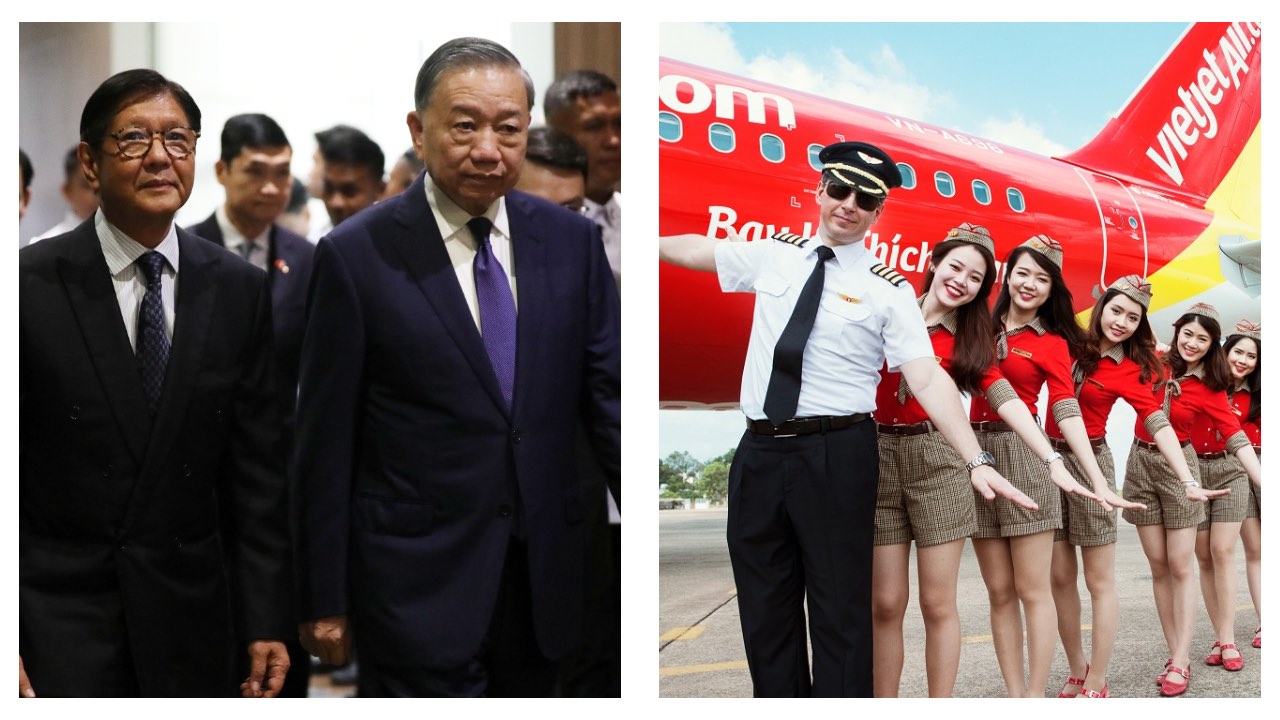
Vietnam is set to expand air links with the Philippines through a new direct service between Ho Chi Minh City and Manila as both governments move to strengthen tourism flows and broader economic ties under an upgraded bilateral framework.
The planned route, set to be operated by low-cost carrier VietJet Air, was announced during the Vietnam–Philippines Business Forum in Manila by Vietnamese President To Lam.
He said the new service is expected to support not only passenger travel but also trade and investment links between the two countries.
Expanding air links between ASEAN neighbours
Air connectivity between Vietnam and the Philippines has been steadily growing in recent years, supported by both budget and full-service carriers.
Data from the Department of Tourism shows Vietnam currently ranks 23rd among source markets for the Philippines, with 33,599 arrivals (equivalent to 0.57% of total inbound visitors last year), as reported by the Philippine News Agency.
The expansion of routes has already begun to reshape travel patterns. In 2025, VietJet introduced a Ho Chi Minh City–Manila service with five round-trip flights each week.
Alongside this, Vietnam Airlines operates multiple direct connections, including daily flights between Hanoi and Manila and Hanoi–Cebu services that operate several times a week.
YOU MAY ALSO LIKE: Film festival news: Hong Kong director Johnnie To to chair Asian jury at DANAFF IV

Tourism framework for broader cooperation
Alongside the airline announcement, both governments have also formalised a wider tourism cooperation programme covering the period from 2026 to 2029.
The agreement sets out plans to increase visitor exchanges and support higher flight frequencies over time.
Under the framework, the two countries intend to develop joint promotional campaigns and explore the packaging of combined tourism products, including so-called “one-package tours” that integrate destinations in both Vietnam and the Philippines.
Toward wider ambitions
Despite the recent expansion in air routes, Vietnam remains a relatively small source market for the Philippines compared to neighbouring countries.
However, officials view the new and planned connections as part of a longer trajectory aimed at increasing regional mobility.
For now, the agreement reflects a broader diplomatic shift towards closer engagement between Manila and Hanoi, where aviation, tourism, and trade are increasingly being treated as interconnected parts of the same economic strategy.
READ NEXT: Envoy recalled, import cuts as Armenia-Russia relations face ‘transformation phase’
 Ciara Mina
  Rosemarie Zamora
  Jacinth Banite