
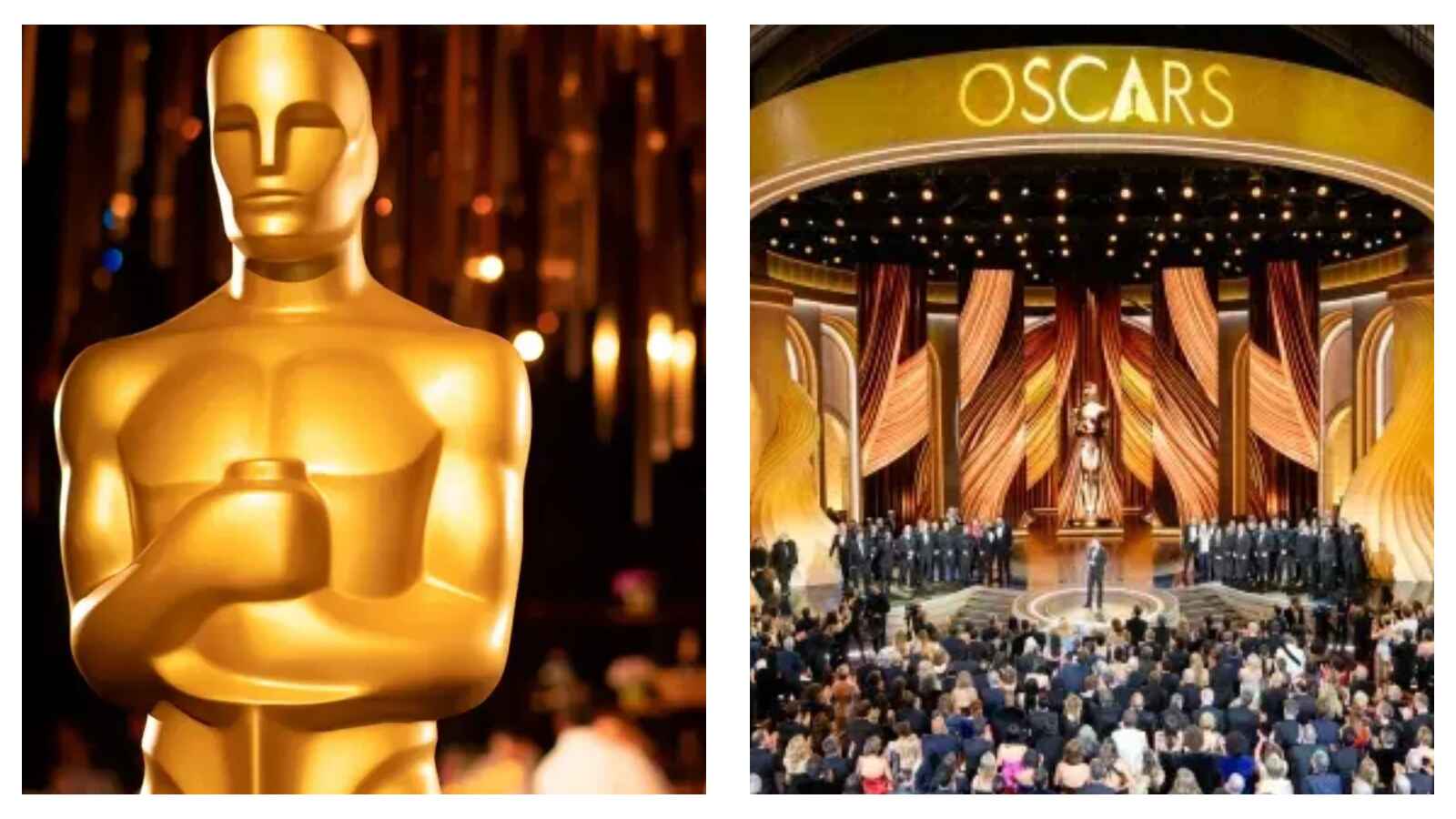
Paul Thomas Anderson’s “One Battle After Another” swept the Academy Awards on Sunday, winning six Oscars out of 13 nominations.
The film, which involves leftist revolutionaries, white supremacists and immigrant detention centres, mirrors the issues of modern-day America.
It blends political satire with high-stakes actions and emotions, including car chases, shootouts, daring escapes, humour, and romance.
But most of all, it explores a father’s unwavering love for his daughter.
Film dominates with major wins
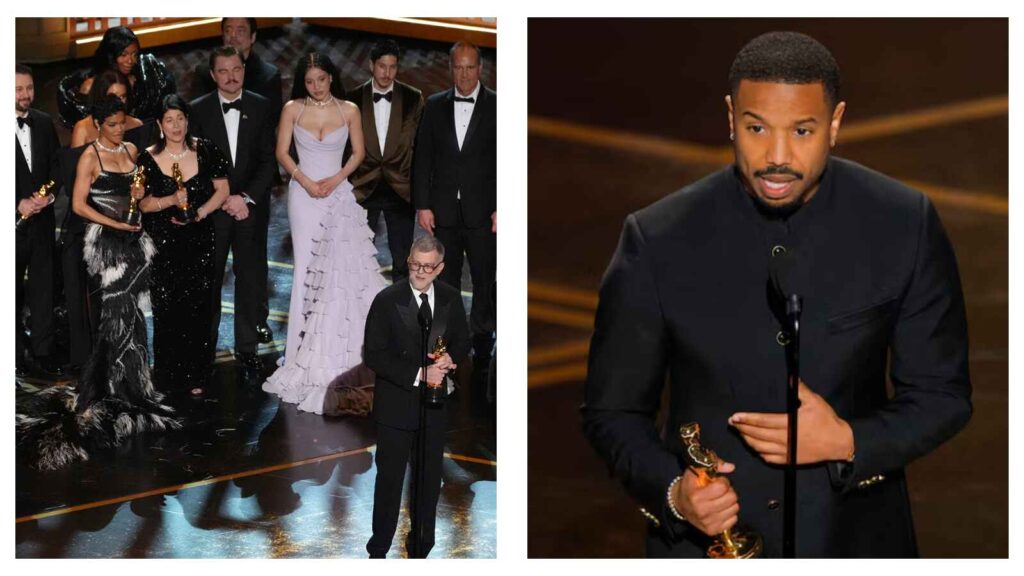
On Sunday, the movie became the big winner at the awards, bagging the Best Picture award, Best Adapted Screenplay, and Best Film Editing.
It also won Best Supporting Actor for Sean Penn, who played Colonel Steve Lockjaw, and its very first Best Casting category.
Meanwhile, Anderson himself won the Best Director category.
The film faced strong competition with Ryan Coogler’s “Sinners,” which was previously leading in the number of nominations.
In a statement reported by Al-Jazeera, Anderson acknowledged that awards can be unpredictable, pointing out the line-up of some Hollywood classics at the Academy Awards in 1975.
“ I just want to say that, in 1975, the Oscar nominees for Best Picture were Dog Day Afternoon, One Flew Over the Cuckoo’s Nest, Jaws, Nashville and Barry Lyndon,” he said.
“There is no best among them. There is just what the mood might be that day.”
YOU MAY ALSO LIKE: Oscars 2026: Winners, who attended, noteworthy moments
A story beyond politics
Although Anderson said the film reflects issues facing the US, he clarified that it was not created solely as a commentary on the present moment.
Speaking to the Los Angeles Times last year, he said that while the film contains political elements, it places greater focus on its characters and their emotional journeys rather than politics itself.
“The biggest mistake I could make in a story like this is to put politics up in the front,” the filmmaker explained.
“You have to care about the characters and take those big swings in terms of the emotional arcs of people… That’s not a thing that ever goes out of fashion. But neither does fascism.”
“I’m not trying to diminish what’s happening right now,” he added, “But I’m also trying to say that what’s worse is that it’s not going away.”
Revolution, pursuit and family
“One Battle After Another” was loosely inspired by Thomas Pynchon’s novel “Vineland.”
It follows the leftist group known as the French 75, a band of revolutionaries carrying out bombings for radical causes.
Their operations begin to unravel after they free a group of immigrants from a detention facility along the US-Mexico border.
The incident puts fiery member Perfidia Beverly Hills, played by Teyana Taylor (also an Oscars nominee), directly in the crosshairs of the relentless Colonel Steve Lockjaw (Sean Penn).
Perfidia soon disappears, forcing her partner Pat, who is an explosives expert played by Leonardo DiCaprio, to go into hiding with their young daughter Willa, played by newcomer Chase Infiniti.
As Lockjaw systematically tracks down members of the French 75, he also forms ties with a white supremacist group known as the Christmas Adventurers.
Sixteen years later, Pat has assumed a new identity as Bob Ferguson and lives off the grid, plagued by paranoia and years of substance abuse.
When Lockjaw finally finds his location and uses a staged immigration raid to flush him out, Bob is forced back into the world he tried to escape.
Meanwhile, teenager Willa suddenly goes missing, making Bob set out to reunite with his former comrades to search for her.
MORE OSCARS NEWS: ‘Golden’ makes Oscars history as first K-pop song to win
 Carmela Calling
  James Mario Ajero