
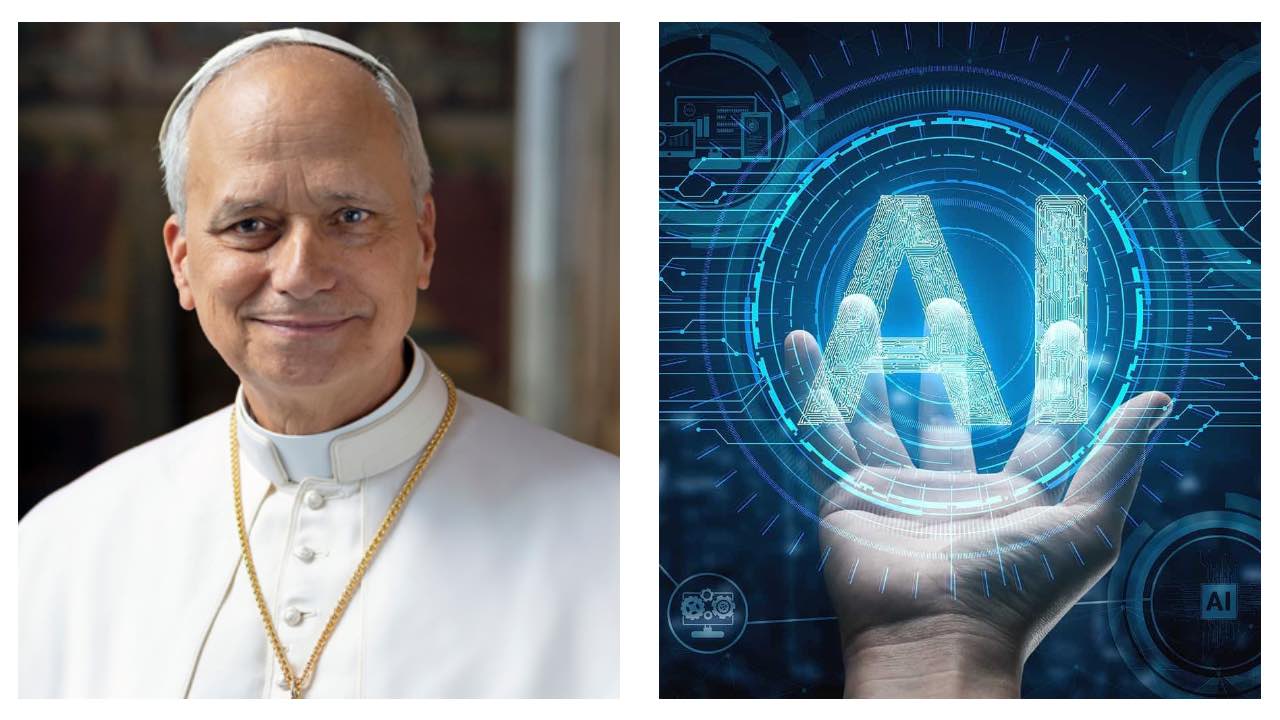
Pope Leo XIV called for the disarmament of artificial intelligence (AI) and for technological progress to be rooted in humanity and the common good in his first encyclical on May 25.
An encyclical is a document released by the pope analyzing current issues in the context of the Gospel and the Church.
In ‘Magnifica Humanitas’ (Magnificent Humanity), Leo mainly highlighted the challenges faced by the world due to rapid technological advancement, particularly with AI — a topic he has been vocal about since the beginning of his papacy.
The full document, signed by the Pope on May 15, can be accessed via the Vatican’s official website, and is available in eight languages.
READ MORE: UN asks nations to find Hormuz alternative, prevent food price crisis

AI must be disarmed
Among Pope Leo’s most crucial calls is the disarmament of AI.
According to the Pope, “to disarm means discrediting the assumption that technical power automatically confers the right to govern.”
Disarming AI is “freeing” it from the military and economic competition that seeks to establish a geopolitical or commercial monopoly.
This move will allow for the discussion and debate of technology, “making it human-friendly and restoring it to the plurality of human cultures and ways of life.”
However, Leo clarified that “to disarm does not mean rejecting technology, but preventing it from dominating humanity.”
He described AI as an environment in which we are already integrated and a force we must engage with.
As such, AI regulation is no longer sufficient. Instead, it “must be disarmed, welcoming and accessible.”
‘No algorithm can make war morally acceptable’
The Pope also warned against AI-powered weapons, noting that the ease of deploying such autonomous systems increases the feasibility of war and lessens human control.
Pointing to the topic of “artificial moral agents”, Leo stressed that “moral judgment cannot be reduced to calculation, for it involves conscience, personal responsibility and the recognition of the other as a person.”
He further cautioned that “no algorithm can make war morally acceptable.”
“AI does not remove the intrinsic inhumanity of conflict,” Leo wrote.
In fact, it only hastens the development of conflict and makes it “more impersonal, lowering the threshold for resorting to violence, transforming defense into threat prediction and thus reducing victims to data.”
This can normalize the idea that violence is “inevitable and needs only to be optimized.”
“Any technology that facilitates attacks without seeing the face of human beings lowers the moral threshold of conflict,” he added.
Leo urged for the “most rigorous ethical constraints” in the development and use of AI in warfare to ensure “respect for human dignity and the sanctity of life” and to prevent a race to develop such arms.
MORE INTERNATIONAL NEWS: Nepal becomes first in South Asia to institutionalise gender minority rights
Equality in the use and advancement of technology
While outlining the principles of the Social Doctrine of the Church, Leo discussed the “universal destination of goods”, wherein he stressed that technologies — their use and regulation — must not fall into the hands of only a privileged few.
“It widens the gap between the included and the excluded, between those who can participate in the digital revolution and those who remain on the margins,” he explained.
The Pope also criticized AI’s impression of objectivity when, in truth, the system’s responses are a reflection of the stereotypes and ideological bias of those who designed and trained them.
This bias can be seen in processes related to rights, opportunities, status and freedom.
Delegating such tasks to automated systems without room for human intervention paves the way for new forms of exclusion, noted Leo.
Therefore, AI cannot be morally neutral.
“Responsibility must be clearly defined at every stage,” the Pope stated. “From those who design and develop these systems to those who use them and rely on them for concrete decisions.”
It is also not enough to merely be satisfied in aligning AI with human values, said Leo, adding that the ethical frameworks involved must also be openly discussed and subjected to shared standards of social justice.
“Otherwise, those who control AI will impose their own moral vision, which will become the invisible infrastructure of these systems.”
“A more moral AI is not enough if that morality is determined by a few,” he stressed.
YOU MAY ALSO LIKE: Mount Everest sets new climbing record in single day

Pursuing progress without sacrificing humanity
Despite his criticisms of AI, it must be made clear that Pope Leo is in no way attempting to stop the world’s pursuit of further technological advancements.
Rather, the Pope is merely highlighting the need to approach AI with vigilance.
Leo echoed Pope Francis’ warning against technocratic paradigm, which the late pope tackled in his 2015 encyclical, ‘Laudato si’ (Praise Be To You).
The technocratic paradigm refers to the tendency to rely heavily on efficiency and profit when making personal, social and economic decisions.
“When [technology] becomes the standard by which everything is judged, it begins to dictate what matters and what can be discarded,” he wrote.
It reduces creation “to an object of exploitation and human beings to mere cogs in a system driven toward ever greater efficiency.”
Cautioning against equating the “intelligence” of such systems with that of human beings, Leo argued, “They may imitate language, behavior and analytical skills, or even simulate empathy and understanding, but they do not understand what they produce.”
“They lack the affective, relational and spiritual perspective through which human beings grow in wisdom.”
The way forward
In determining which direction humanity must take when it comes to AI, Pope Leo said, “The true alternative is not between enthusiasm and fear, but between two paths of a development: a progress that serves individuals and peoples, or a progress that subjects them to the mentality of power.”
He also drew comparisons from the biblical stories of the Tower of Babel and Nehemiah’s reconstruction of Jerusalem.
“We must, then, avoid the ‘Babel syndrome’, namely the idolatry of profit that sacrifices the weak, a uniformity that neutralizes differences, and the pretense that a single language — even a digital one — can translate everything, including the mystery of the person, into data and performance.”
“Instead, let us choose the ‘way of Nehemiah,’ which highlights the importance of working together to make the City of God a safe place for returning exiles,” urged Leo.
READ NEXT: Giro d’Italia enters final week with new race leader Jonas Vingegaard
 Kamille Q. Cabreza
  Jheruleene Anne Ramos
  Wendellyn Mateo