
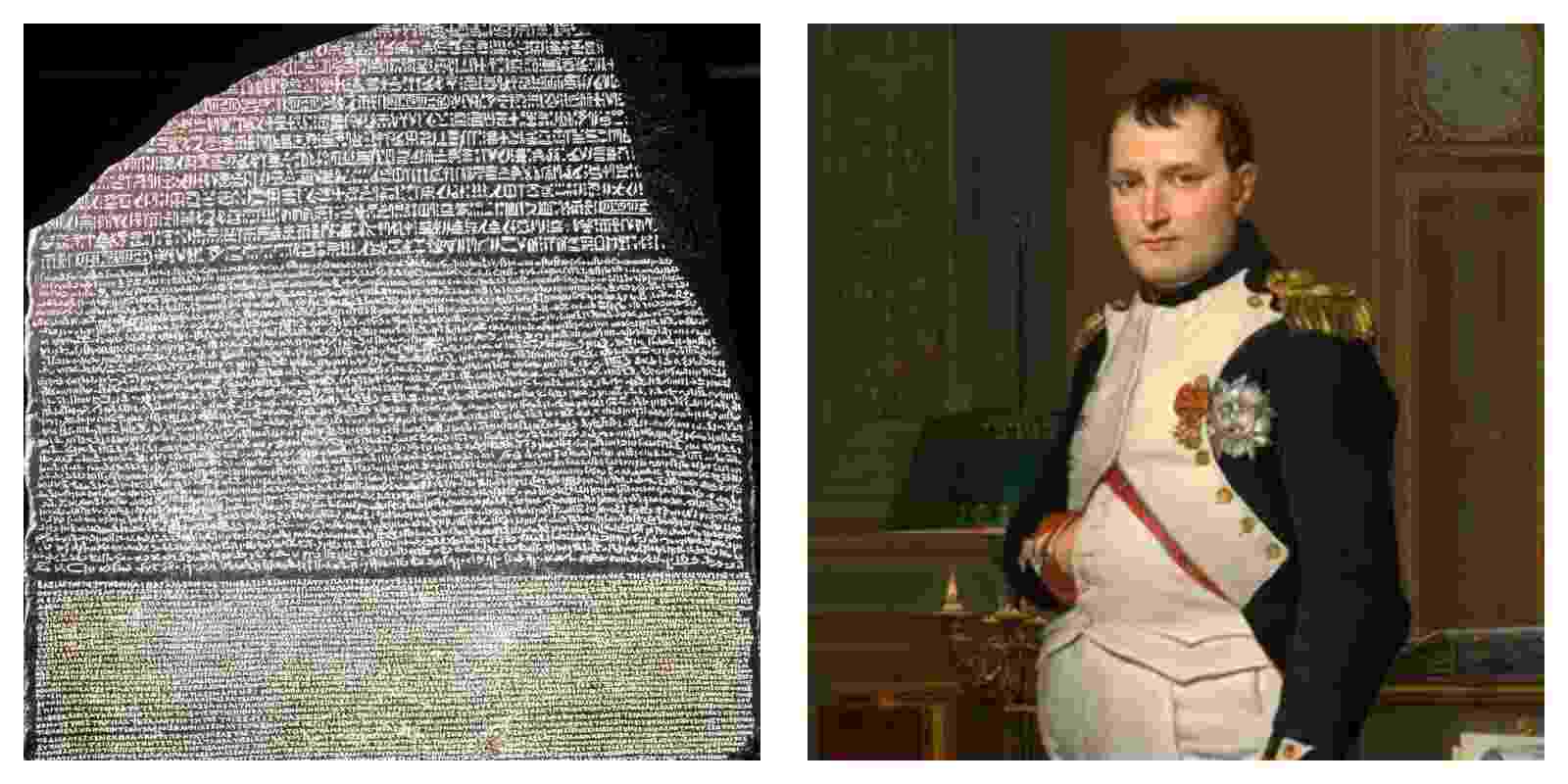
On July 15, 1799, French Emperor Napoleon Bonaparte’s quest to become the master of all Europe crossed paths with one of the most important discoveries in archeology: the Rosetta Stone.
Though scholars are still divided about the exact date of the discovery, July 15, 1799, is the generally accepted date on which the 2,200-year-old slab of stone was found.
Pierre-Francois Bouchard, the officer-in-charge tasked with overseeing a digging activity in the fort of Rosetta in Egypt, did not just unearth a relic of the past, but rather helped uncover a culture that was once shrouded in mystery.
What is the Rosetta Stone?
The Rosetta Stone is a slab of black basalt, about four feet long and two-and-a-half feet wide.
While it could be just another antique item in an ancient town, what made the stone stand out was the markings engraved on the rock itself, dated to 196 BC.
Despite its irregular shape with some of its pieces already broken, the scholars clearly saw that there are at least three different types of writing inscribed on the stone, namely Ancient Greek, Egyptian Demotics, and Egyptian Hieroglyphics.
YOU MAY ALSO LIKE: Record $50m sale of T. rex skeleton ‘Gus’ sparks debate over future of fossil collecting

Translation of the Rosetta Stone
Scholars at that time were still able to understand Ancient Greek. The tricky part is the Egyptian Hieroglyphics, which were still alien to academics at that point.
Through familiar Ancient Greek letters, scholars were able to compare and finally crack the mystery of the Egyptian Hieroglyphics.
This became the first step to finally understanding the history and culture of Ancient Egypt.
French scholar Jean-Francois Champollion made the most crucial observation when studying the Rosetta Stone, with his discovery becoming the basis for interpreting other similar texts about Egypt.
READ MORE: Can you survive Modelland? Tyra Banks ‘cried’ over novel’s viral resurgence

A decree on the stone
Apparently, the writings are about a decree from Ptolemy V, confirming his exceptional status as a divine ruler of the realm.
The pharaoh, being a Macedonian by ancestry, had the decree also written in Ancient Greek.
The Egyptian Hieroglyphics were a writing method exclusively practiced for the kingdom’s nobility, while the Egyptian Demotics was the language used by the masses.
Napoleon Bonaparte
This discovery would not have been possible without the French army commanded by their emperor, Napoleon Bonaparte.
Napoleon, who had proved invincible against the land armies of Prussia, Austria, and Russia, found England untouchable due to her unchallenged supremacy in the seas through the Royal Navy.
Napoleon then arranged an expedition to Egypt to cut off vital British trade routes to India, while also strengthening France’s prestige in the Middle East.
Aside from the lasting geopolitical impacts of Napoleon’s Egyptian campaign in the region, this expedition bolstered scientific and cultural advancements.
The Rosetta Stone is currently housed at the British Museum.
READ MORE: Ichikawa Zoo to celebrate Punch’s first birthday with message exhibit
 Ciara Mina
  Rosemarie Zamora
  Jacinth Banite