
By Sarah Irwin
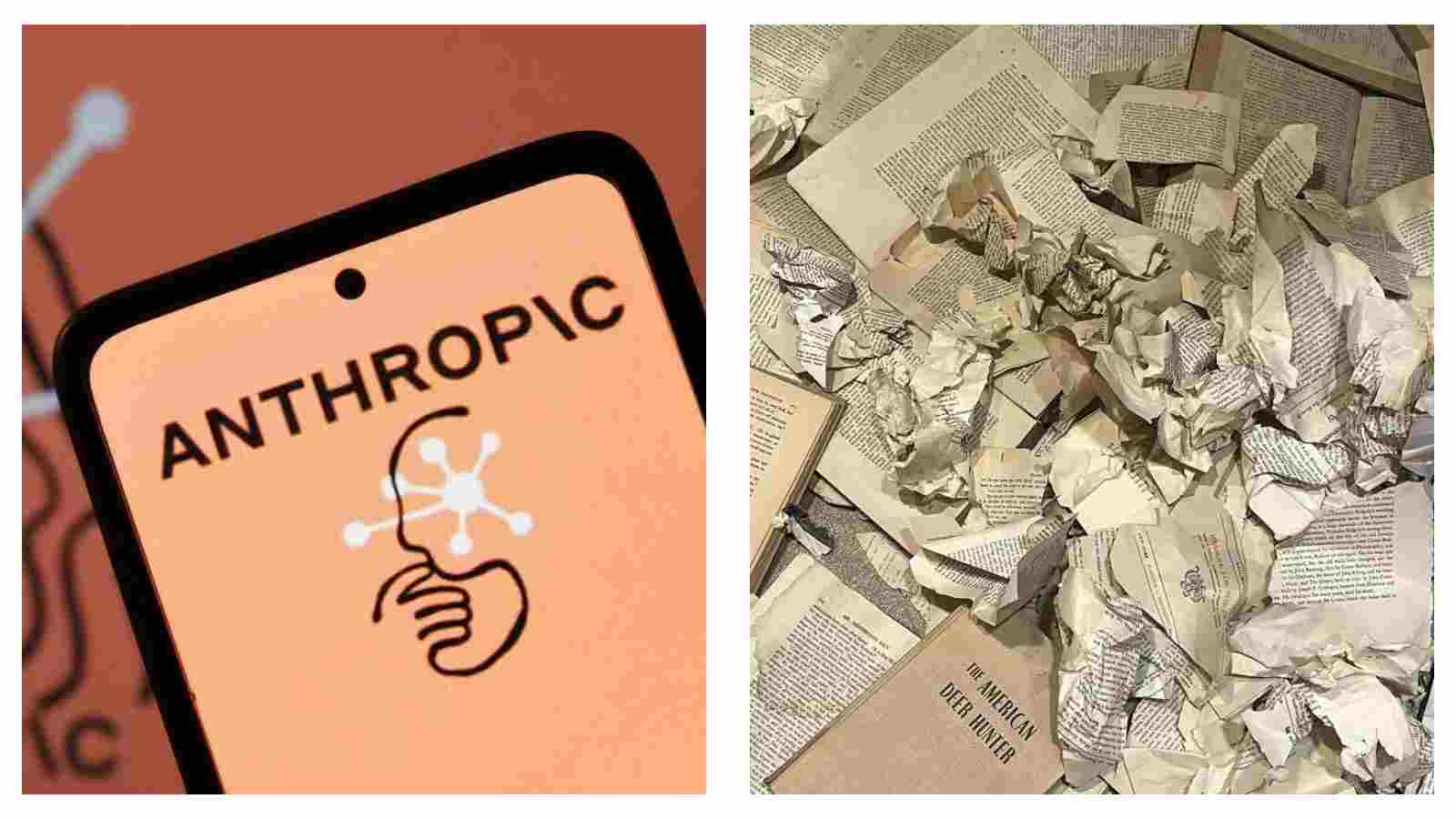
Recent unsealed court documents detail how AI research company, Anthropic, aim to use books and human content disposably, teaching Claude to destroy the content it learns from.
For as long as there have been books, there have also been people who have wished to eradicate them.
From the infamous Nazi Germany book burnings to the increasing prevalence of censoring texts in schools around the world today, these are recognizable political acts.
Now, however, a new threat has emerged.
“Destructively scan all the books in the world”
In recent unsealed court documents of Bartz v Anthropic PBC, details have emerged about how the company has destroyed millions of books to teach its AI chatbot, Claude, “how to write well”.
The story was first reported by the Washington Post in January of this year.
In 2024, Anthropic executives began to seek out mass quantities of books published before 2022.
Dubbed ‘Project Panama,’ the company purchased millions of books, whereby they were “destructively scan[ned]” by Claude.
AI’s growing hunger for data
The problem that Anthropic and other AI companies sit with is that they need large quantities of high-quality language datasets that have not already been corrupted by generative AI tools to improve their large language model’s (LLM) writing output.
The solution Anthropic settled on was to use books as their source of high-quality, long-form text.
Instead of securing copyright permission from authors for existing e-books to use to train Claude, Anthropic executives chose to obtain pirated versions, directly infringing on authors’ copyright rights.
The company then decided to turn to its “destructive scanning” solution.
The process involves slicing the spine off the books in order to scan more easily and then disposing of them.
MORE FROM SARAH IRWIN: BookTok: Why is everyone suddenly obsessed with salt?
Artists sue to protect their work
The case against Anthropic is one of a variety of lawsuits artists are bringing against other tech companies such as Meta, Google, and OpenAI to fight back against their work being used to “train” AI software.
Anthropic agreed to pay $1.5 billion to settle the case in August last year over the initial illegal pirating of authors’ books, but the case has spurred concerns about the way in which AI companies are acquiring and using human-made books, art, music, and other artistic works.
While the judge rules that Anthropic’s destructive scanning of the books is not illegal, an internal memo reveals that the company “[did not] want it to be known that [they] are working on this”.
Is it wrong to destroy books?
Anthropic could have chosen to obtain legal copyright of existing e-books to teach Claude.
Instead, the company has chosen to generate unnecessary waste by buying and destroying physical copies.
The process, while legal, asks us to consider how AI and tech companies respect and view the books in question.
Without regulation, if more AI companies were to adopt this process, critics raise concerns regarding the destruction of rare and antique copies.
Further, the case challenges us to think broadly about how texts that are uninfluenced by AI may move towards no longer serving as cultural objects of our time but are valued against their usefulness for AI advancement.
READ NEXT: Russia, Ukraine exchange fresh strikes as war grinds on
 Wendellyn Mateo
  Maybelene Marcelino