
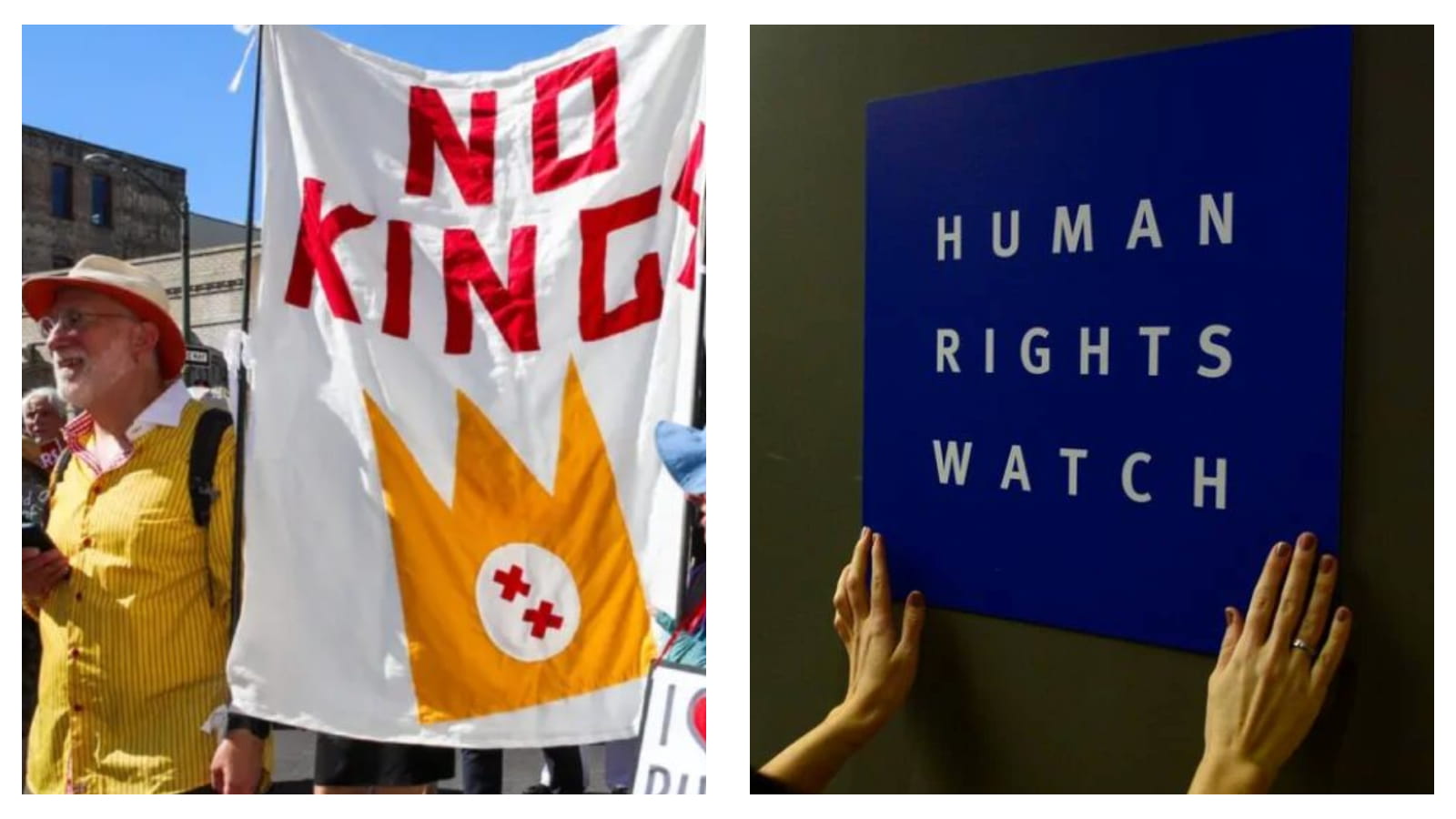
The world’s commitment to democratic governance has plummeted to levels not seen in four decades, according to a new report by the Human Rights Watch (HRW).
In its annual review of human rights around the globe, the New York-based research and advocacy organisation confirmed that 72% of the globe’s population now lives under autocratic systems.
This marks a return to the same levels of non-democratic rule recorded in 1985.
HRW particularly noted that China and Russia are less free today than 20 years ago.
They warned that the United States is also veering towards autocracy under the leadership of President Donald Trump.
Trump’s white nationalist policies raise alarms
The watchdog highlighted how recent developments in Washington, including the “hundreds of unnecessarily violent and abusive raids” carried out by the Immigration and Customs Enforcement (ICE) agency, are dismantling the rules-based international order.
It emphasised that the current US administration has adopted policies and language linked to white supremacist ideology, which dehumanises immigrants and asylum seekers.
According to the group, a total of 32 people died in ICE detention facilities in 2025, with four additional fatalities reported by mid-January.
“Trump has shown blatant disregard for human rights and egregious violations,” HRW said in the report, as quoted by AFP.
Enforcement tactics and power dynamics
Meanwhile, HRW also cited systemic issues that signal a clear move away from democratic principles in America.
These include divisive rhetoric targeting specific groups, deployment of National Guards for political objectives, retaliatory measures against opposition and critics and efforts to concentrate authority in the executive branch while weakening legislative and judicial oversight.
“Every day you see confirmation of this trend, but when you step back, you see an organised, relentless, determined assault on all of the checks and balances that are meant to limit executive power in US democracy – a system designed to limit power and protect rights,” said the organisation.
Migrants abuse documented
On the issue of severe human rights violations by the US involving migrants, HRW reported that 252 Venezuelans were transferred to a high-security correctional facility in El Salvador.
This practice is recognised as unlawful under international standards.
The organisation revealed that accounts from the individuals, who were permitted to return to Venezuela, included claims of severe physical assault and sexual violence while in custody.
Separately, HRW’s report mentioned that illegal attacks on boats in the Caribbean and Pacific regions have led to the extrajudicial killing of over 120 people.
Trump’s administration asserts that they were engaged in drug trafficking.
Undermining global governance through key withdrawals
Beyond domestic or targeted practices, President Trump fuelled the rise of autocracy and eroded democratic values globally by pulling the US out of two major intergovernmental bodies: the United Nations Human Rights Council and the World Health Organisation.
The move, according to HRW, gutted US aid programmes that were a crucial source of support for children, elderly individuals, those requiring medical care, the LGBTQ+ community, women and human rights advocates.
Sanctions targeting rights groups and international bodies
Equally troubling is the administration’s imposition of “unwarranted” sanctions towards prominent Palestinian human rights groups, the International Criminal Court prosecutor and judges, a UN special rapporteur and even a Brazilian Supreme Court Justice and their spouse.
These actions drew condemnation from legal experts, advocacy groups and US allies, who argued that they threaten the independence of institutions tasked with upholding accountability and protecting vulnerable groups.
Emboldening autocrats, straining democratic ties
Another key concern raised is Trump’s deliberate strategic choice to strengthen ties with authoritarian leaders such as Hungary’s Prime Minister Viktor Orbán, Türkiye’s President Recep Tayyip Erdoğan, and El Salvador’s President Nayib Bukele, while creating friction with democratic allies.
The watchdog also pointed out that while criticising some elected Western European leaders, he and his top officials openly praised Europe’s nativist far-right.
HRW said this created a rift within the North Atlantic Treaty Organisation and the European Union, with some members questioning the reliability of the US as a core ally.
A test for global values
With the US being flagged for its autocratic shifts, the pressing challenge is determining how other global powers will address these changes.
Philippe Bolopion, HRW’s executive director, called on nations to forge alliances rooted in human rights respect and collective solidarity, even standing against Trump’s tariff-focused approach.
“Some countries may be tempted to forge ad hoc alliances on specific issues – one day with China, another with Turkey, another with South Africa,” Bolopion told AFP.
“From our perspective, for such an alliance to be strong and lasting, it must be built on principles and values – democracy, international law, human rights.
“It can carry weight and provide a degree of security to its members,” he added.
 Carmela Calling
  James Mario Ajero