
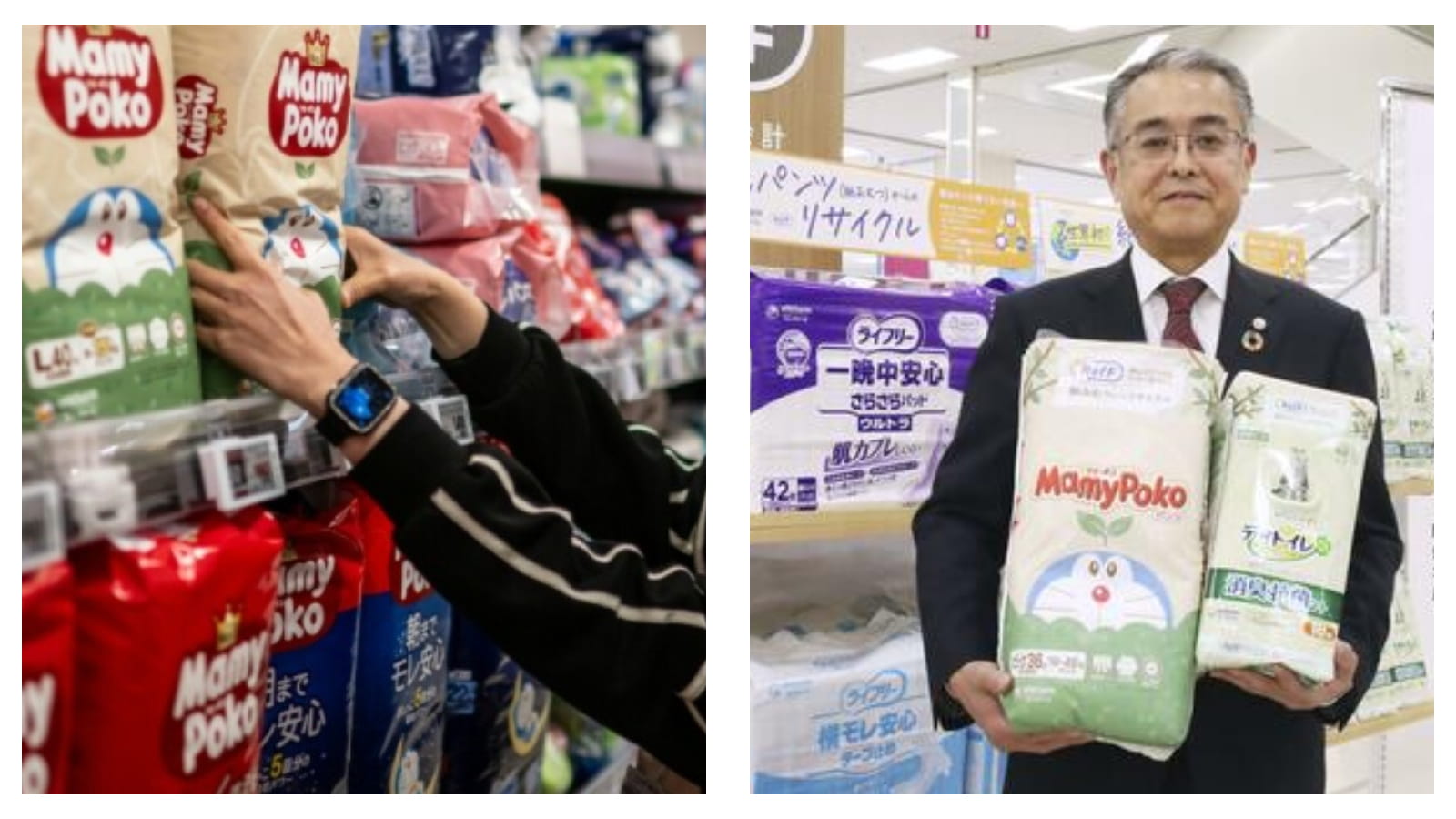
Japan has once again proved that it is living in the future by pioneering a groundbreaking initiative to recycle billions of soiled disposable diapers.
For decades, consumers have considered diapers as a linear commodity that can only be used and discarded, but Japanese hygiene product maker Unicharm is making a critical shift in the circular economy by viewing them as a valuable reservoir of raw materials.
Technical and mechanical principles
The process begins with collecting used diapers from nursing homes and residential areas, then reusing the main ingredient in nappies to make new ones through intensive autoclave and ozone treatments.
Takahisa Takahara, president of Unicharm, explained that the high-pressure steam sterilisation neutralises bacteria and odors while loosening the adhesive bonds between the wood pulp and the plastic backing.
He added that the materials are then separated by centrifugation or washing, yielding plastic, fiber (wood pulp), and a superabsorbent polymer (SAP).
“If we can transform the sense of guilt ordinary consumers may feel about using disposable products into something positive, and make using recycled products the norm in society, it will become economically viable,” he said.
READ MORE: Maritime sector bets big on atomic propulsion

Key environmental benefits
According to Unicharm, the recycling process for dirty diapers emits 30% less greenhouse gas than incineration.
It added that by recycling materials into new, safe products, including new diapers, the technology reduces the consumption of virgin pulp and plastic.
In terms of waste reduction, the company noted that the initiative’s process turns large amounts of used diapers that would otherwise be burned (increasing landfill use) into reusable materials.
Unicharm said it had also developed a technique using microbial fuel cells to generate electricity from the wastewater produced during the recycling process.
Progress, goals, and future outlook
The project, currently operating in the municipalities of Shibushi and Osaki in Kagoshima Prefecture, reported an exceptionally high 80 per cent recycling rate, far surpassing the Japanese average of less than 20%.
Unicharm highlighted that its advanced facilities achieve over 85% material recovery, significantly reducing reliance on imported raw materials.
The company aims to team up with 20 other municipalities to implement this technology in the coming years, focusing on reducing water use in the recycling process.
“By 2028, Unicharm aims to recycle the plastic and absorbent polymer from soiled diapers to make new ones as well,” Tsutomu Kido, senior executive officer of Unicharm’s recycling business, told AFP.
YOU MAY LIKE: Boracay White Beach recognised among world’s top destinations by TripAdvisor

Game-changing innovation for aging populations
Faced with a severe demographic crisis characterised by the world’s oldest population, a shrinking workforce, and a record-low birth rate, Japan’s grappling with a swelling mountain of soiled adult diapers is no surprise.
However, its latest recycling development not only changes the game for manufacturers and consumers but also signals a shift from a traditional “take-make-waste” linear model toward a circular, sustainable approach.
By changing how the lifespan of a product like a diaper is designed, managed, and perceived, Japan is demonstrating that achieving economic growth is possible without generating more waste.
READ NEXT: Vietnam updates energy plan to meet future demand
 Carmela Calling
  James Mario Ajero