

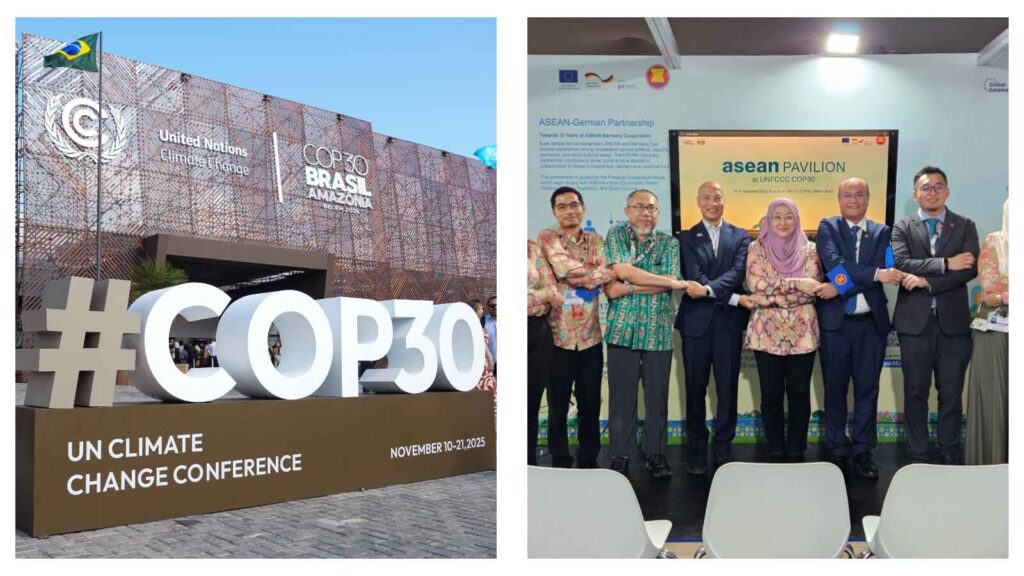
The Brazilian city of Belém is currently the global focus for an important event: the COP30 summit where global leaders discuss the future of our planet, ways and means to protect it and methods to halt global warming or at least keep it to a minimum.
Even though this event should be the main focus, ongoing protests outside the summit are taking some of that attention away.
For the first time in three years the summit is taking place in a country where public protesting is allowed and therefore, people, amongst whom are Brazilian youth groups, indigenous groups and activists from all around the world, have come together and are using the opportunity to publicly voice their opinions, concerns and most importantly, their demands.
Using different tools to send a message
The participants have been using different methods to convey their message.
For example, indigenous groups have brought inflatables of animals with the words “the answer is us” on them.
Other protestors carried around three big coffins, symbolising oil, coal and gas, which were flanked by grim reapers, whilst chanting “free the Amazon”.
Tuga Cíntia from the theatre group Hydra Dance from the Federal University of Pará said: “We are holding a funeral for fossil fuels. I’m here because enough is enough with COP meetings and theory. It’s time for us to actually act.”
Brianna Fruean, a climate activist from Samoa stated: “Fossil fuels are still being burned. We know all too well what it’s like to live on the frontline of climate change.”
“We are here after so many COPs, marching for justice, for the end of fossil fuels,” Ilan, from “350” which is a non-governmental organisation added.
READ MORE: ASEAN debuts climate pavilion at UN’s COP30 summit
Indigenous people are more impacted than others
Experts believe that indigenous groups are the best people to protect the rainforests and also the biodiversity which can be found in them as, to this day, hundreds of different indigenous groups are living in the Amazon.
Exactly for this reason, it could be argued that they are even more impacted by climate change and deforestation than others.
Therefore, it is no surprise that they are so involved and vocal in these protests.
Due to the fact that they are more knowledgeable in the area and more affected by the issue, many of the indigenous people are demanding local ownership of their individual territories in the rainforest and they’re doing so with the help of signs which state “demarcation now”.
Similar protests have taken place all around the globe in solidarity with the cause.
YOU MAY ALSO LIKE: Climate change: Study finds Great Barrier Reef may partially recover from worst predictions

Not all protestors are peaceful
Even though there is a high level of security at the COP30, including police guarding the venue with riot shields, some protestors managed to break through and gain access to the venue this past Tuesday.
Fortunately, damage to the venue was minimal and two security guards walked away with only small injuries.
Representation of indigenous voices has been a flashpoint in these talks, some of whom have set up stalls outside the fenced-off COP30 venue to sell products to passing delegates.
It’s unsurprising that COP30 has been given the unofficial name the “indigenous people’s COP.”
Even so, many of the groups feel that their concerns on topics such as deforestation and land protection are not being taken seriously, a frustration since it impacts their homes and the extraction of resources on their land.
This could certainly be the reason why some took it upon themselves to gain access to the venue, possibly in an attempt to get more attention from the summit’s participants.
Even more so maybe, since up to this point very little progress has been made during the delegates’ talks.
READ NEXT: China issues travel warning amid row with Japan over Sanae Takaichi’s Taiwan remarks

Contradicting messages at the COP30
Brazil’s president Luis Ignacio Lula da Silva is hosting this year’s COP and has specifically selected Belém as its location to put focus on the protection of the Amazon.
However, his words and actions are seemingly conflicting given the fact that merely a short time before the talks began, he gave permission to an oil company to search for oil at the mouth of the Amazon.
This is not the only interesting thing to note at this year’s summit: A coalition by the name of “Kick Big Polluters out” has analysed the list of the COP’s attendees and is claiming that a high number of delegates from fossil fuel companies are part of the talks.
According to their numbers, 1600 lobbyists are attending the summit which would constitute a 12% rise compared to last year.
Very little progress after the first week of the COP30
Progress after the initial week of the COP has been very slow but not fully unfruitful.
The Global Initiative for Information Integrity on Climate change has launched an initiative with the goal to create global commitments addressing climate disinformation and not only provide, but more so promote information on climate issues which are actually based on evidence.
Ten countries have so far signed this initiative.
Nonetheless, there are more issues to be addressed and discussed with one of the most crucial areas being the cause of climate change and how to stop or at least slow down global warming.
The host country has promised to deliver talks on this matter, so one can only hope that by the end of the summit on the 21st of November, the participating delegates will find common ground and solutions to a problem which impacts all of us and will have devastating consequences if not solved in a timely manner.
YOU MAY BE INTERESTED IN: UN Rights Council orders probe in Sudan’s El Fasher, as warnings of mass killings, sexual violence mount
 Carmela Calling
  James Mario Ajero