
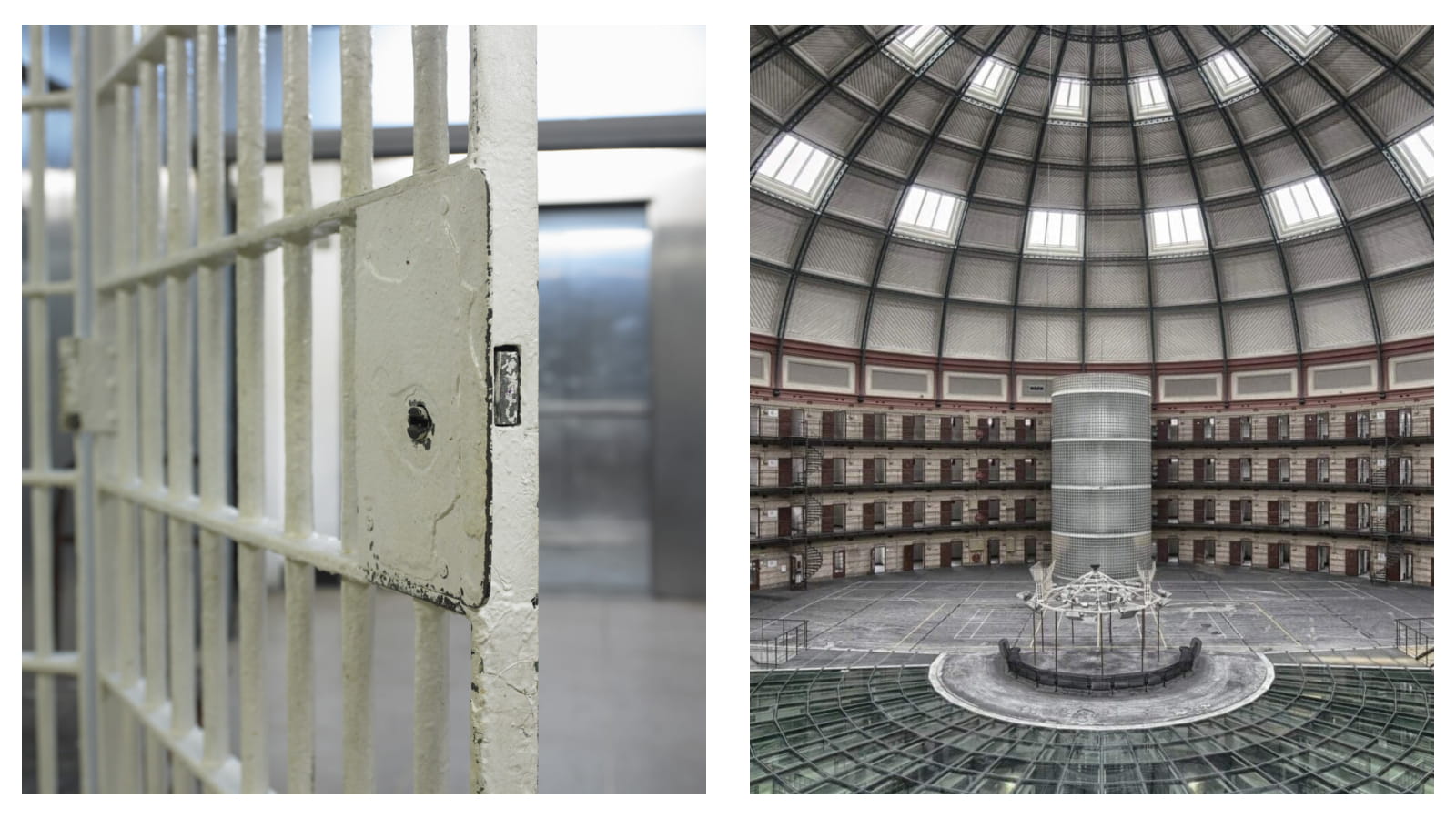
While some countries in Europe are struggling for prison space, the Netherlands is facing an increased number of empty prison cells due to low crime rates.
A study from the Universities of Leiden (Netherlands) and Portsmouth (UK) concluded that between 2005 and 2016, the incarcerated population in the Netherlands nearly halved – going from 94 per 100,000 citizens to 51 per 100,000.
According to the European Journal of Criminology, this has led to the closure of over 23 jails since 2014.
Data from Eurostat suggest that the prison population is now stable – in 2021 and 2022 it was at 54 per 100,000.
Closed and repurposed
Some of these empty prisons have been leased to Belgium or Norway – countries that have a higher prison population -, others have been repurposed into schools, cultural centres, refugee housing, temporary asylum centres and hotels.
But the Netherlands is not the only country closing jails because of a decreased number of inmates.
In 2013, Sweden closed four prisons and one correctional facility after its prison population fell around 1% per year from 2004 to 2011 and between 2011 and 2013, it declined a further 6%.
In the Swedish case, this was the result of a decision from its supreme court in 2011 to give lighter sentences for drug offenses, leading to inmates spending less time incarcerated.
Decline in serious crime
In the Netherlands, judges are not only granting shorter sentences, but there has also been a decline in more serious crimes.
While the UK gives the most life sentences in Europe, the Netherlands is practicing a less punitive approach – in 2013, there were only around 30 inmates serving life sentences.
With the memory of the Nazi occupation during World War II, the Dutch had “a strong sense of the dangers of an overbearing state and the horrors of imprisonment”, explains Francis Pakes, a Dutch professor of criminology at the University of Portsmouth.
This led to a more humane treatment of inmates and a lighter use of prison sentences than before the war.
READ MORE: Latest revelations from Epstein files rock European politics, royal families

While in some countries prison time is a response to a threat of disorder, “in the Netherlands (historically), crime was just something the system had to respond to,” says Pakes.
Rehabilitation and reduced sentences backed by the funding of youth intervention schemes, electronic tagging and residential care for offenders with addictions and mental health problems, as well as the decriminalisation of soft drug use and sex work (in 1976 and 2000), reflect this approach.
Wider approach needed
The Dutch believe that the judicial system can’t be used as a single tool to fix criminality but a wider approach is needed.
“In the Netherlands (compared to the UK), the prisons are − by and large − better maintained, better staffed, more spacious and more decent places,” explains Pakes.
Various studies have shown that this contributes to a more successful reintegration into society.
Other strengths the country has that contribute to lower crime rates are low poverty rates, a strong emphasis on the social welfare system and rehabilitation, as well as community policing initiatives.
Adding to these factors, the very Dutch cultural value of an unshowy lifestyle also reduces social tensions and pressures.
Overall, this attitude towards prison sentencing can be seen as a positive example.
YOU MAY BE INTERESTED IN: Property co-ownership among same-sex couples allowed under Philippine law

Imprisonment ‘doesn’t have the desired outcome’
According to Pakes, the Dutch judicial system is aware that most of the time, imprisonment doesn’t have the desired outcome.
“What you find in the Netherlands when you talk to senior police officers, prosecutors or judges, is that very few people have anything positive to say about the effect of imprisonment,” Pake says. “Nobody really believes it works.”
A criminal can be out of the streets for a while, but in most cases, they will resume their criminal activities when they get out of prison, sometimes with a wider criminal network as a result of criminal relationships they built while behind bars.
Adding to that factor, they might become more ruthless because of the violent environment they had to endure while in prison.
“We now know better that if you want to turn those lives around, simply being punitive is not going to cut it,” Pakes adds. “It needs something much more wholesome than that.”
 Ciara Mina
  Rosemarie Zamora
  Jacinth Banite