
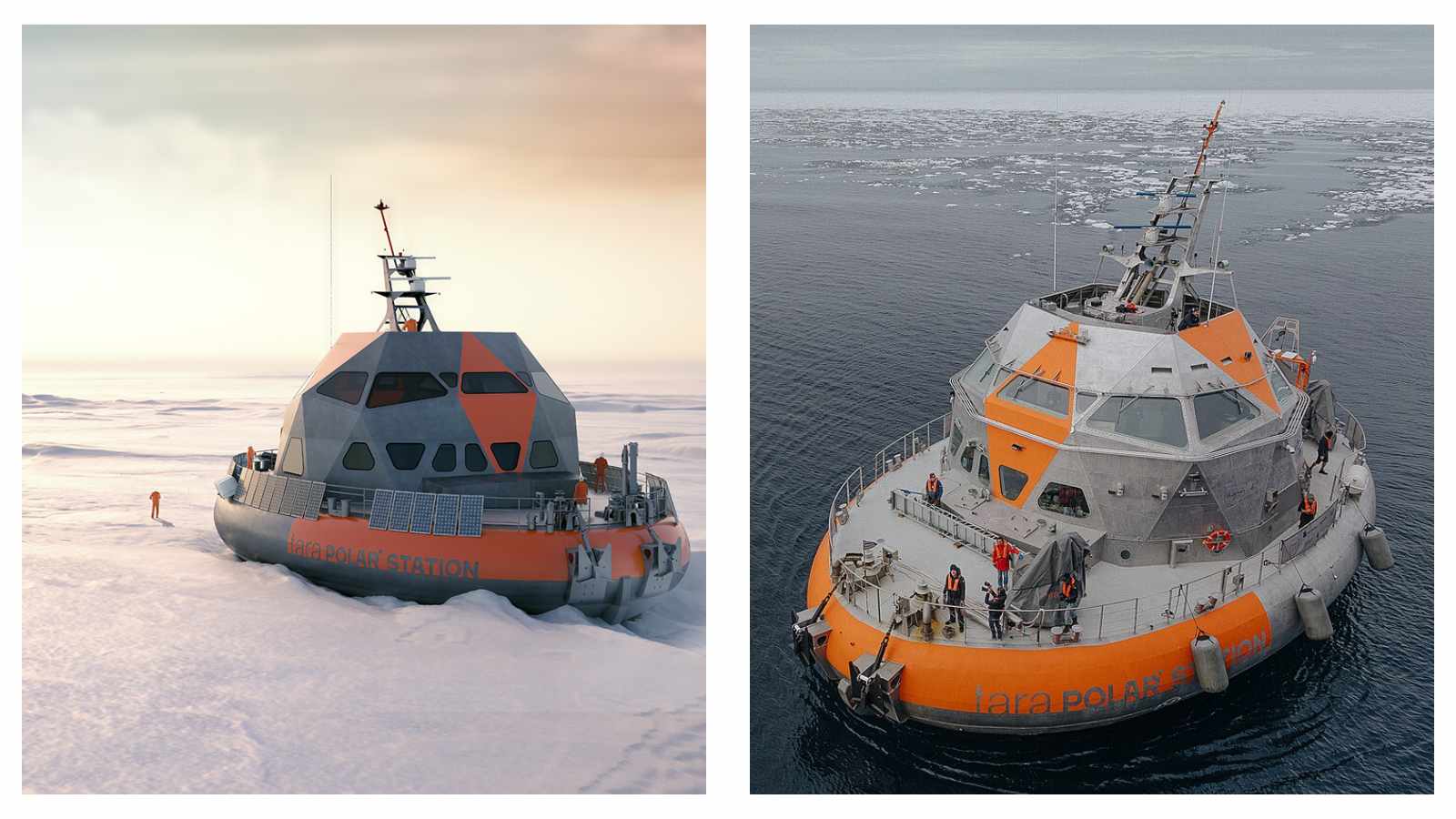
A unique aluminium research station shaped like an igloo has departed France to begin a long‑term study of the rapidly changing Arctic environment.
The Tara Polar Station is designed to become trapped in sea ice and drift along with it for months at a time.
Scientists highlighted that its distinctive shape could resist heavy ice pressure and extreme cold that can drop as low as ‑52°C.
Experts will use the floating laboratory to study biodiversity and the impacts of climate change across every season – work that short‑term visits simply cannot deliver.
“The Arctic is an ocean that has been little studied and is already changing significantly. It is undergoing a major transformation,” said Romain Troublé, executive director of the Tara Ocean Foundation, as cited by AFP.
“You cannot understand the environment if you only spend two months a year there.”
Though built in France, the project brings together 30 research centres from 12 nations, including Germany, Canada, Spain, the United States, Switzerland, and Japan, all taking part in the shared expedition.
The vessel set sail from France’s western port of Lorient, where French Minister for the Sea Catherine Chabaud joined hundreds of well‑wishers to see it off from the quayside.
YOU MAY ALSO LIKE: Panama Canal prepares for dry season as strong El Niño threat looms
A journey spanning years and ice
According to authorities, the station will travel eastward along the Russian coast starting in mid‑August, guided and cleared a path by an escorting icebreaker.
By early September, it will settle into the pack ice and begin drifting on its own at an average pace of roughly 10 kilometres each day.
It is projected to reach the Fram Strait, the passage lying between Greenland and Svalbard, by the end of 2027.
This voyage marks only the start of a far greater effort as 10 separate expeditions are planned between 2026 and 2045, running on a schedule of one mission every two years.
The station will carry 12 people through the long Arctic winter, six of whom are scientists, and increase to 18 crew members during the brighter summer months.
Resilience over adventure
Selection for the international crew follows thorough medical checks, psychological assessments, and team‑building exercises.
“We weren’t looking for adventurers who want to head to the North Pole alone. The idea is rather to have people who get along well to experience this confined human environment together,” explained expedition director Clémentine Moulin.
For those who remain through the winter, the challenges go far beyond freezing temperatures.
They will contend with five months of near‑total darkness, limited space, and the constant presence of polar bears.
“Bears are a serious matter – the bear is on its home turf and it’s used to hunting and hides behind blocks of ice,” said Eric Pelletier, a 58‑year‑old genomics researcher and member of the crew.
Every person on board completes firearms training to respond to potential wildlife encounters, while a specially trained working dog will also travel with the team to help spot approaching animals.
READ NEXT: An AI hub on Philippine soil? Govt says framework deal in progress despite protests

Racing to document a changing world
Using an opening through the station’s hull and a full set of advanced instruments, researchers aim to collect more than 10,000 samples taken from the water, ice, atmosphere, and seabed throughout the journey.
“There is biodiversity at the North Pole that is uniquely adapted to this environment. If the environment changes, that biodiversity might disappear,” Troublé said.
“We could potentially lose an entire chapter of the evolution of life on this planet without even having had time to document it.”
READ NEXT: Venezuela twin quake toll hits 5,119
 Diana Mae Y. Cleto
  Levi Mora
  Rosemarie Zamora