
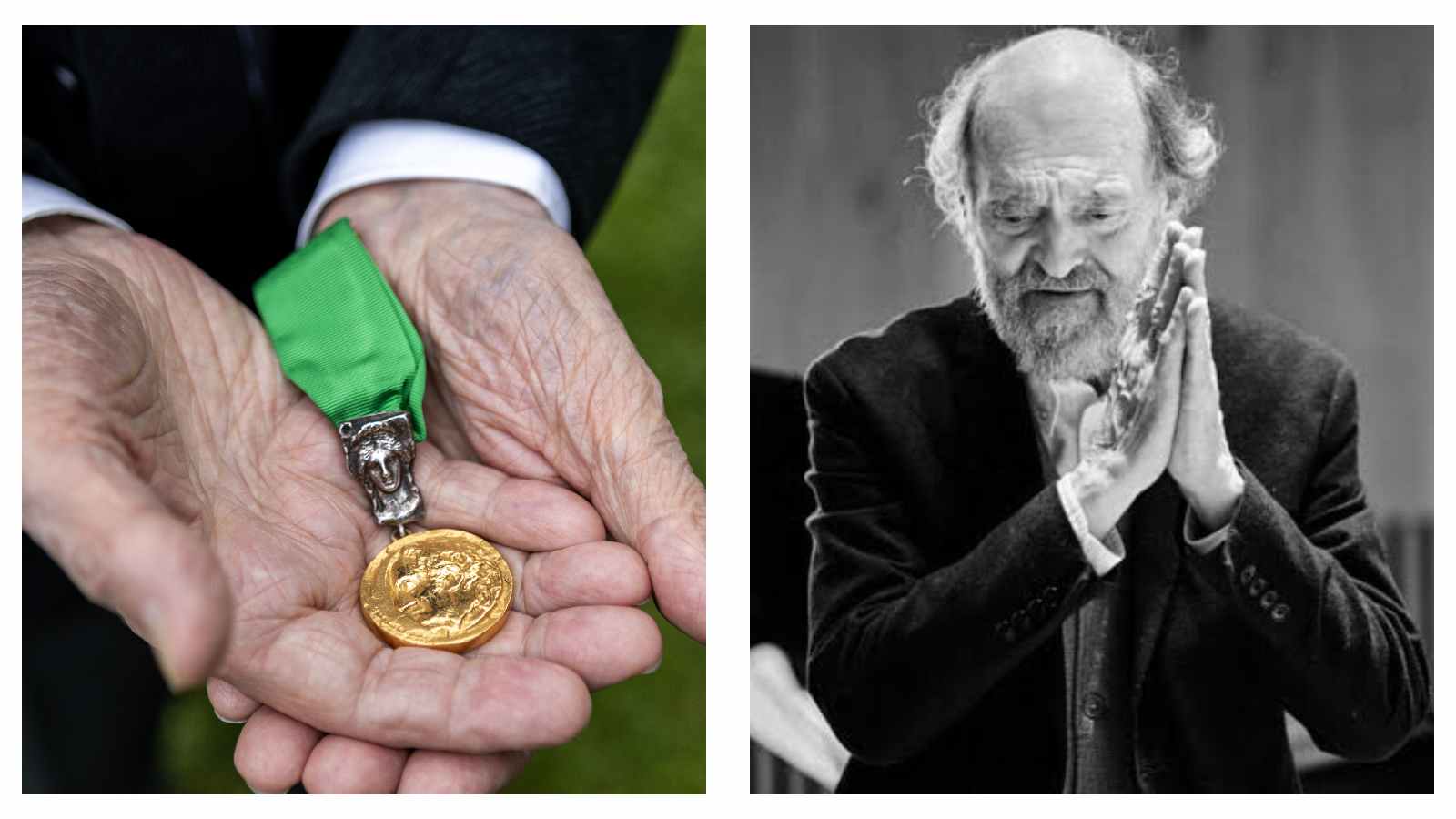
The Goethe-Institut officially conferred the 2026 Goethe Medal upon three distinguished international figures during an official ceremony in Weimar, Germany on Friday, August 28.
Presented by Goethe-Institut President Gesche Joost, the official decoration of the Federal Republic of Germany honoured individuals who have rendered outstanding service to international cultural exchange and the promotion of the German language.
According to the official Goethe-Institut platform, this year’s recipients represent music, translation and theatre, reflecting a commitment to open dialogue across European borders.
Arvo Pärt
Estonian composer Arvo Pärt was awarded the medal in recognition of his transformative contributions to contemporary classical music and his role in bridging global audiences through spiritual composition.
Pärt developed his signature “tintinnabuli” compositional technique – a minimalist, bell-like harmonic style – after emigrating from Soviet-occupied Estonia and living in Berlin for nearly three decades.
The Goethe-Institut noted that his iconic works, such as “Für Alina” and “Spiegel im Spiegel”, continue to serve as an enduring expression of the European spirit and cross-cultural connection.
YOU MAY ALSO LIKE: National Museum display of Philippines’ lone captive elephant sparks animal welfare concerns

Anita Raja
Italian translator and publicist Anita Raja received the medal for her exceptional efforts in introducing modern German literature to Italian readers.
Raja was recognised for her translations of landmark German-language authors, including Christa Wolf and Franz Kafka.
The Goethe-Institut emphasised her extensive career as a literary scout, noting that her work has significantly enriched German-Italian cultural exchange and established vital publishing bridges between the two nations over several decades.
Prodromos Tsinikoris
Greek theatre director, dramaturge and actor Prodromos Tsinikoris was honoured for his pioneering work in documentary theatre.
Born in Wuppertal to Greek migrant workers, Tsinikoris was recognised for using performance art to explore themes of migration, socio-economic issues and historical perspectives.
The Goethe-Institut described Tsinikoris as a key figure in Greek and European theatre, highlighting his politically engaged work and his ability to connect his two cultural homes, Germany and Greece, through theatre.
READ NEXT: Asian Games: How Nagoya is housing 17,000 people without an athletes’ village
 Ciara Mina
  Rosemarie Zamora
  Jacinth Banite