
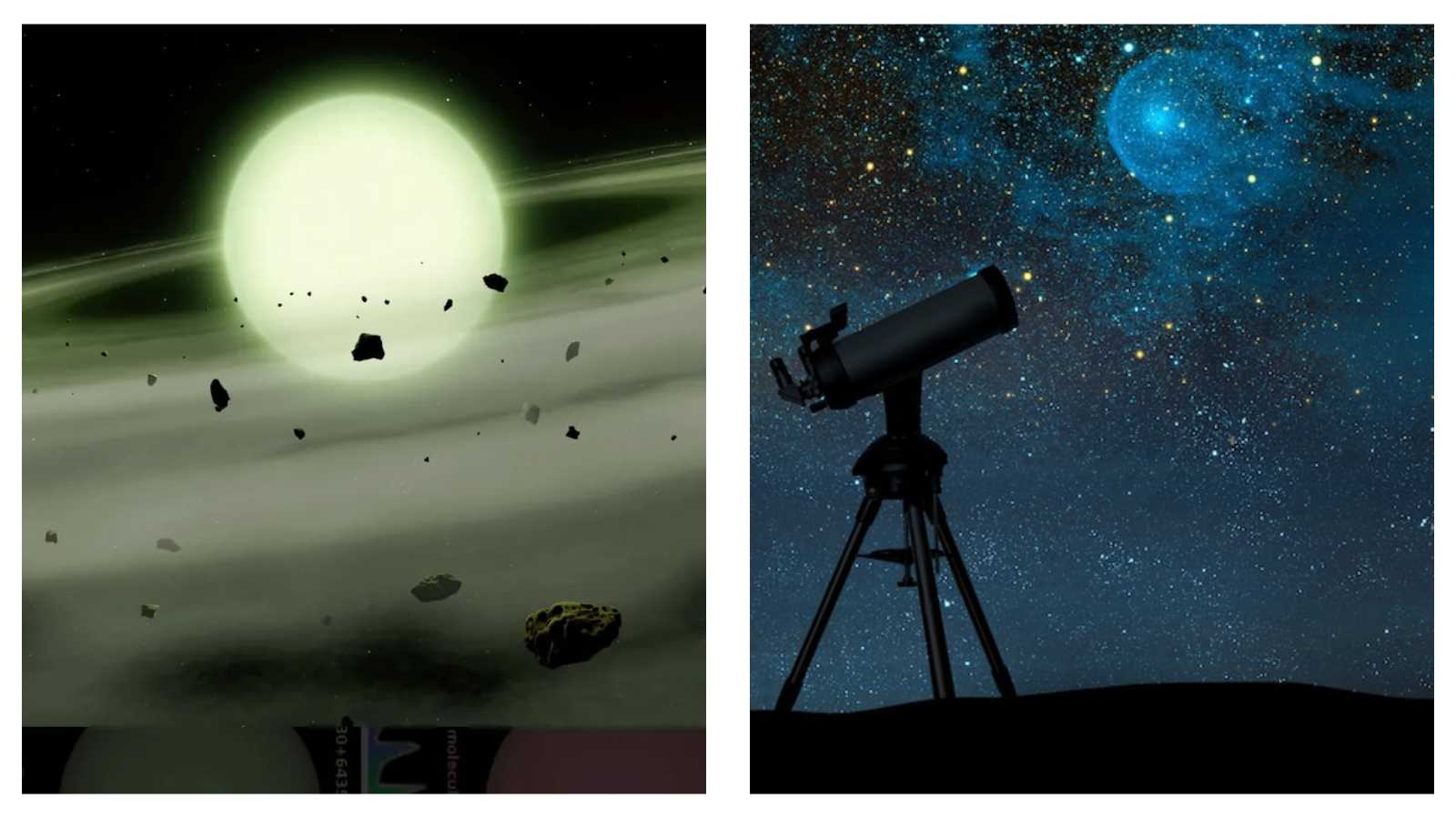
Astronomers have discovered the first green star, WD J1330+6435, which is located about 280 light-years from Earth. It is a white dwarf in the Milky Way galaxy and can be found in the constellation Draco.
White dwarfs can be green, pink, or purple
While stars can typically only be white, orange, or blue, a new study found that it can also be green – and pink, cyan, yellow, and purple.
According to Mark Hollands, the study’s lead author and an astrophysicist at the University of Warwick, the green star would appear chartreuse green to the human eye due to additional elements of calcium, lithium and sodium in its atmosphere.
White dwarf stars are “dense stellar remnants left behind by the majority of main-sequence stars at the end of their lives,” and are typically white or pale blue, hence its name.
“In this particular white dwarf, however, the density is so high that the sodium atoms are constantly being bombarded by surrounding helium atoms, which alters the sodium atomic energy levels,” Hollands said.
“The end result is that the sodium atoms no longer absorb one very narrow wavelength of orange – they absorb the yellows, oranges and some of the red wavelengths. And what you’re left with is a star that has a beautiful chartreuse green glow, something that wouldn’t be possible for a sun-like star.”
TRY THIS: Elon Musk unveils Tesla’s new ‘flying’ car

1 in 30 white dwarfs emit an unusual colour
The study suggested that around 1 in 30 of white dwarfs glow an unusual colour.
Hollands stated that stars are usually only orange, white, or blue.
And while it is also majorly the same for white dwarfs, “there are some special cases where the physics in the outer layers of these stars are sufficiently strange that it causes actually quite big deviations in terms of their spectrum.”
The study observed 151 white dwarfs within about 65 light-years from Earth. Two of the stars were yellow and three were pink.
“One in thirty might not sound like a huge fraction, but across the entire population of white dwarfs in the Universe, that is still a lot of oddly coloured stars out there,” said Boris Gänsicke, the study co-author and an astronomer from the University of Warwick.
“Yet if we take the median across a representative population of white dwarfs, we found that the average white dwarf really is white.”
READ NEXT: Economics Nobel honors two researchers behind today’s inflation, recession playbook
 Rosemarie Zamora
  Jacinth Banite
  Hazel Camba