
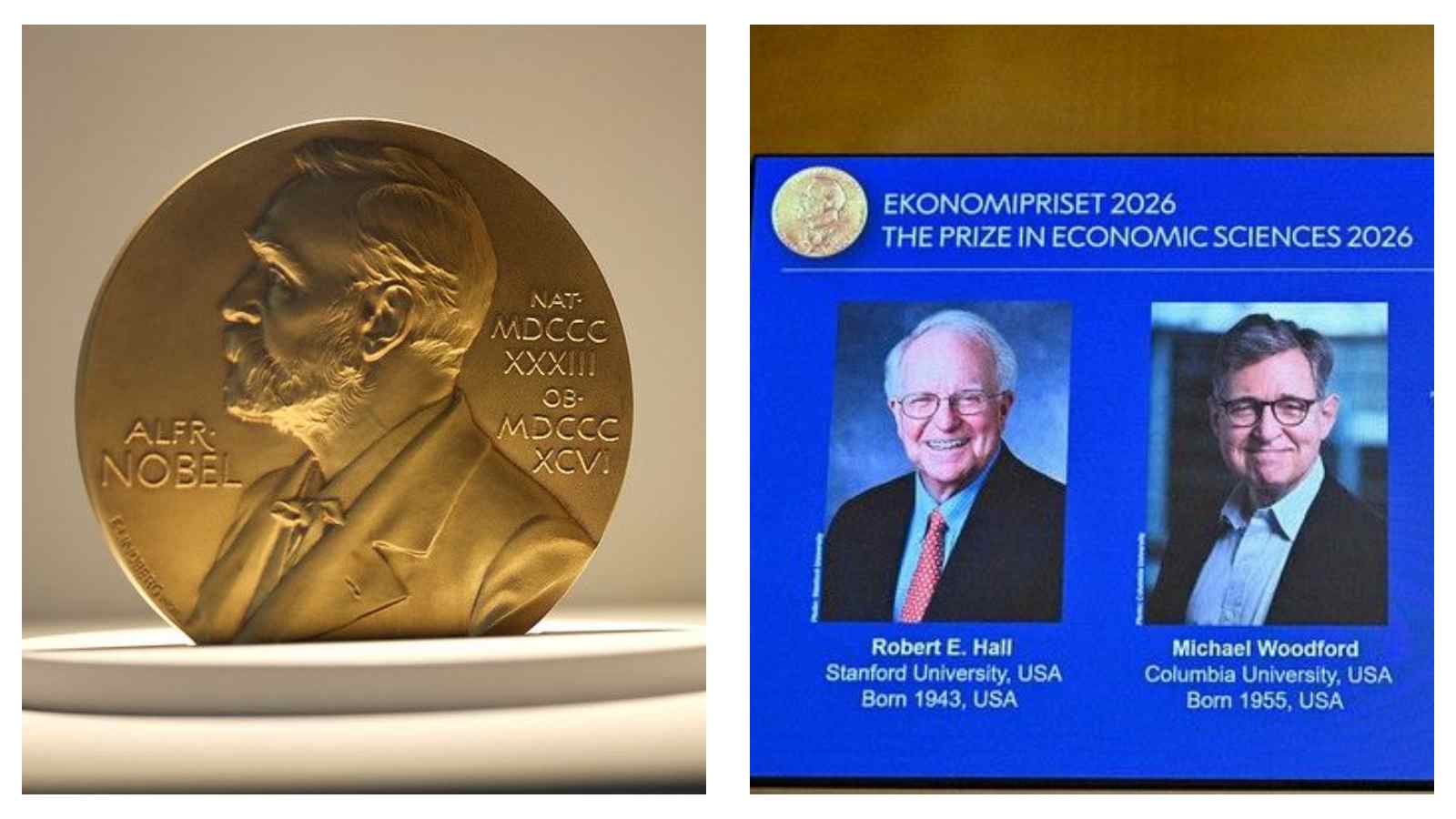
The 2026 Nobel Prize in Economic Sciences has been awarded to Robert E. Hall of Stanford University and Michael Woodford of Columbia University for research that helped economists better understand how governments and central banks can respond to recessions, inflation, and other economic shocks.
The Royal Swedish Academy of Sciences cited the pair’s work on the “microeconomic foundations of macroeconomic stabilization.”
According to the Nobel Committee, their work provided the theoretical foundation for many of the economic models now used by central banks and governments around the world when making decisions about interest rates, spending, and other policy measures.
Building the economy from the ground up
For decades, economists have tried to understand why economies experience periods of growth, recession, rising prices, and unemployment.
Hall and Woodford approached those questions by focusing on the decisions made by individual households and businesses.
Rather than relying primarily on broad economic relationships, their models examined how people make choices about spending, saving, investing, and setting prices.
The Nobel Committee said this approach helped create stronger foundations for studying the economy as a whole.
Lessons from the 1970s
The Academy noted that confidence in traditional economic models weakened during the oil crises of the 1970s. At the time, many economies experienced both high inflation and high unemployment, a combination that existing models struggled to explain.
Hall and Woodford were recognized for helping rebuild macroeconomic models using insights from individual economic behavior.
According to the Nobel Committee, this helped revitalize the study of stabilization policy, or the measures governments and central banks use to smooth economic fluctuations.
YOU MAY ALSO LIKE: US-ICC dispute erupts after Nobel Peace Prize winner named
Why expectations matter
A central idea in their work is that people make decisions based not only on current conditions but also on what they expect will happen in the future.
Households may adjust spending based on future income expectations, while businesses may set prices based on what they believe demand and inflation will look like later on.
The Nobel Committee said this means that government and central bank communication can influence economic behavior. When policymakers signal future plans, those signals can affect decisions across the economy even before a policy takes effect.
Models used around the world
According to the Academy, the frameworks developed by Hall and Woodford are now widely used in economic policymaking.
The committee said their work has helped policymakers respond to economic downturns and other disruptions over the past several decades.
Committee chair John Hassler said the research has made governments and central banks better equipped to deal with shocks such as energy crises and sudden changes in consumer spending.
READ NEXT: UNDP warns of ‘wake-up call’ as global poverty rises
 Ciara Mina
  Rosemarie Zamora
  Jacinth Banite