
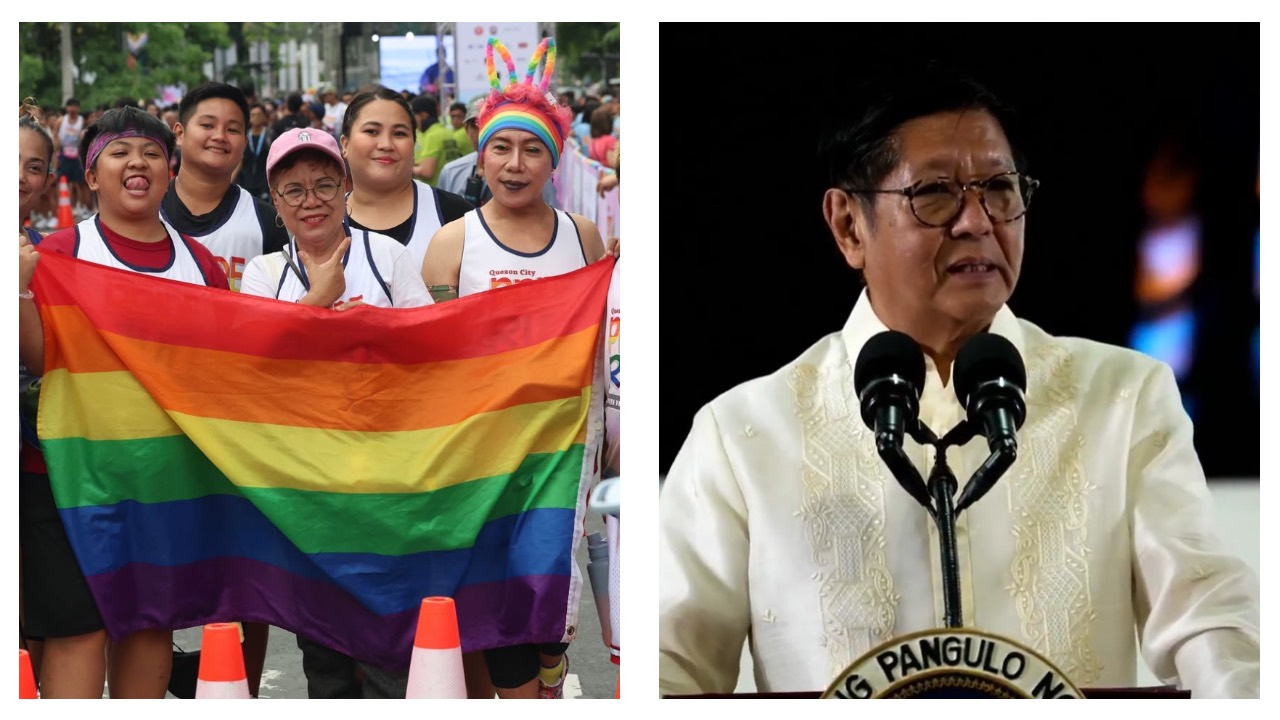
On June 3, Philippine President Ferdinand R. Marcos Jr. released an official statement to mark the beginning of Pride Month, supposedly reaffirming the government’s commitment to equality for every Filipino.
“As we celebrate Pride Month, the government reaffirms a principle that must never waver: every Filipino is entitled to equal protection, equal opportunity, and equal respect under the law,” he said.
It is unheard of for a sitting Philippine president to officially acknowledge the Lesbian, Gay, Bisexual, Transgender, Queer, Intersex, and Asexual+ (LGBTQIA+) community in such a positive light, and so, it is no surprise that some in the community welcomed the message.
A sign of progress, maybe
However, many dismissed it as nothing but lip service and an effort to appeal to a community composed mostly of young individuals and current and future voters, or a distraction amid the ongoing circus show in the Senate.
Those who refused to bite the bait cannot really be blamed when perhaps the most crucial part of his statement is this:
“Inclusion cannot remain only in words; it must be reflected in our policies, strengthened by our institutions, and practiced in our everyday actions as a people.”
That then begs the question — what has the Philippine government done for the Filipino LGBTQIA+ community beyond words and the once-a-year Pride-related events decked out in rainbows?
Has the law been made inclusive and equal for every bakla and tomboy from all walks of life?
READ MORE: Vietnam orders review of price adjustments to control inflation
The SOGIE Equality Bill
The short and simple answers to both queries are “nothing much” and “not really”.
Diving into the supporting evidence behind those answers would take far too long, but there is one thing that could perfectly describe the current state of LGBTQIA+ rights in the Philippines — the SOGIE Equality Bill.
Formerly known as the ‘Anti-Discrimination Bill’, the Sexual Orientation and Gender Identity Expression (SOGIE) Equality Bill was first proposed in Congress in 2000 by late lawyer and politician Miriam Defensor-Santiago and former Akbayan Partylist Representative Etta Rosales.
It seeks to legally punish gender-based discrimination and penalize those who discriminate against individuals because of their sexual orientation, gender identity, or gender expression.
The bill recommends a fine of PHP100,000 but no more than PHP500,000 or jail time of at least one year but not more than six years, or both for persons convicted under the proposed law.
For nearly three decades, the bill has been revised to mirror the current situation of the LGBTQIA+ community and repeatedly refiled in hopes of it finally being legislated nationally.
The proposed law passed its third reading in the 17th Congress in 2017, but it has since languished in the Senate despite the backing of Senator Risa Hontiveros.
It became the Senate’s longest-running bill in 2019, with then-senate president Tito Sotto saying that the bill would not pass the Senate even with former president Rodrigo Duterte’s certification.
MORE INTERNATIONAL STORIES: 7.8-magnitude earthquake rocks Mindanao, Philippines leaving 32 dead and hundreds injured

Debunking misconceptions
In defence of his statement, Sotto echoed the common arguments listed by the bill’s dissenters, misconceptions that have since been debunked by its supporters.
First, only members of the LGBTQIA+ community will benefit from the bill’s passing.
Everyone has SOGIE, whether they are an adult or a child, and even those not part of the community.
That means that a cis (gender identity) heterosexual (sexual orientation) masculine (gender expression) man or a cis heterosexual feminine woman will be granted the same rights under the bill.
Furthermore, the Philippines does not have a comprehensive national anti-discrimination law. Instead, what the country has is a list of laws aiming to prevent discrimination rooted in different factors, including gender (women, specifically), age, disability, and mental health.
The SOGIE Equality Bill merely wishes to also provide legal protection to LGBTQIA+ Filipinos.
Second, the bill will pave the way for same-sex marriage.
Sotto cited a section in the proposed legislation that said no person must experience discrimination when acquiring government licenses. He said this includes marriage licenses.
However, former Bataan 1st District Representative Geraldine Roman — one of the bill’s supporters in Congress — said the proposed law is not meant to carve out a path for the passing of same-sex marriage.
“There is nothing in this bill that will actually allow, like what I’ve said, same-sex marriage,” Roman said in 2023 during a hearing by the House Committee on Women and Gender Equality, as quoted by Manila Bulletin.
“In fact, in the granting of licenses, we are very specific (that) this doesn’t pertain to marriage licenses,” added Roman, who is also the first transwoman elected to Congress.
The final misconception is that it is a transgression against religion and religious freedom.
There is nothing in the bill that violates religion or seeks to harm one’s religious freedom.
Moreover, several religious groups have voiced their support for the bill.
Among them is Bishop Solito Toquiero from the National Council of the Churches in the Philippines, who said, as quoted by Tatler Asia: “The LGBTQIA+ have long been discriminated [against], that is why this bill has to be passed. The bill gives freedom and importance to the community.”
YOU MAY ALSO LIKE: EU eyes further membership expansion
The fight continues, nonetheless
Despite countless drawbacks, Senator Hontiveros repeatedly expressed her desire to have the bill passed in the Senate, with her latest effort in 2025 when she refiled the SOGIESC Equality Bill, now renamed to include ‘Sex Characteristics’.
Furthermore, in February 2026, Mamamayang Liberal Representative Leila de Lima also refiled the same bill in the House of Representatives.
In an episode of Manila Bulletin’s ‘The Sit Down podcast’ released on June 3, Hontiveros acknowledged that progress has been stagnant for nearly three decades.
However, she pointed to a survey saying that most Filipinos are in support of the bill, while several local government units (LGUs) have been implementing their own anti-discrimination laws.
She also mentioned the Right-to-Care Ordinance — an initiative allowing individuals in same-sex relationships to make legal and medical decisions for their partners.
It was first introduced by Quezon City in 2024 and was later adopted by other LGUs, including the cities of San Juan, Iloilo, and Mandaluyong, and the province of Cavite.
Hontiveros described the following developments as a “sign of hope” for community members and allies tirelessly lobbying the bill in Congress and the Senate.
The senator urged continued efforts to carry the bill past parliamentary hurdles to a vote, as Hontiveros said she is “willing to bet” that they have the numbers to finally pass the proposed law.
READ MORE: Vladimir Putin rejects Volodymyr Zelensky meeting, accuses Kyiv of stalling military progress

‘No Filipino should ever be made to feel invisible’
There are LGBTQIA+ individuals in every corner of the Philippines — from the butch lesbian manning the neighborhood store to the femme gay celebrity bringing laughter across the country as soon as the clock strikes 12 noon.
They are expected to function in society as every Filipino does, yet their rights are not equally protected in the Constitution that supposedly governs all Filipinos.
“No Filipino should ever be made to feel invisible in the country they help build,” the president said.
But with the current state of the LGBTQIA+ rights in the Philippines, as evident in the nearly three-decade fight for the passing of the SOGIESC Equality Bill, can the eyes of the law still recognize queer Filipinos?
Or, have they fallen so far between the cracks that Lady Justice only acknowledges them when convenient?
READ NEXT: PBA news: Ginebra rises to 2-1 series lead
 Carmela Calling
  James Mario Ajero