
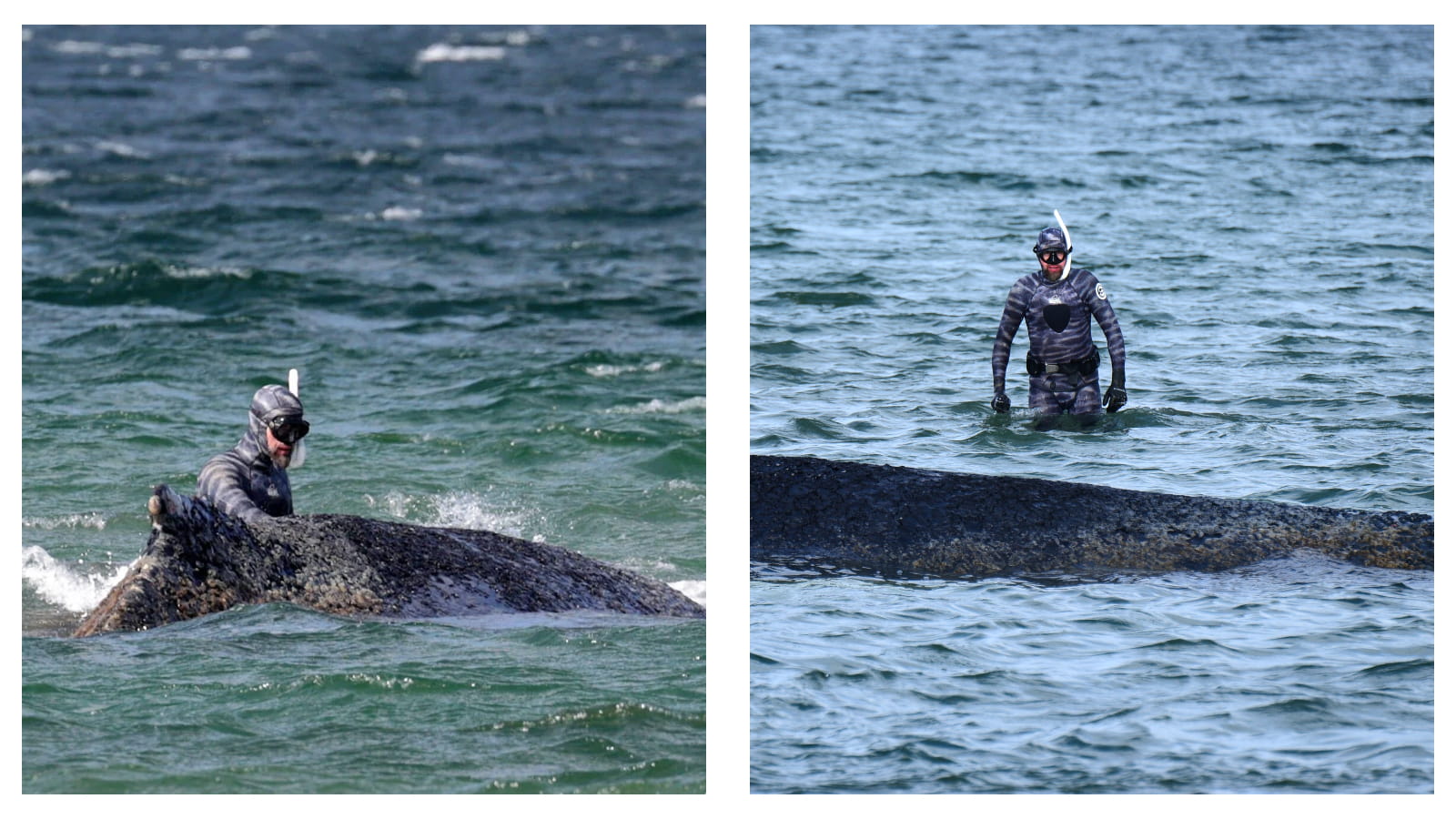
A humpback whale nicknamed “Timmy” has captured international attention after a long struggle in the Baltic Sea.
Despite determined rescue efforts and constant monitoring by authorities and volunteers, experts have now confirmed that the whale’s journey will end in heartbreak.
Perilous journey into unfamiliar waters
The journey began on March 3, when the 12-15 metre whale was first spotted in the Baltic Sea, far from its natural Atlantic habitat.
Experts quickly noted the unusual and dangerous nature of its presence in the shallow, low-salinity waters.
By March 23, the whale was seen near Luebeck before becoming stranded on a sandbank at Timmendorfer Strand.
Early rescue efforts, which included using boats to create waves and heavy machinery to dig a channel, initially succeeded when the whale freed itself on March 27.
However, the relief proved short-lived.
Repeated strandings, physical decline
Between March 28 and 31, the animal became stranded multiple times near Wismar Bay and the island of Poel in Germany.
According to Greenpeace expert Thilo Maack, these repeated incidents demonstrated how weakened the animal had become.
Reports from Deutsche Welle noted that the whale’s breathing rate had slowed, while the Baltic’s low salinity caused severe damage to its skin.
Marine researcher Burkard Baschek, scientific director of the German Oceanographic Museum, explained via Agence France-Presse (AFP) that this situation is unique.
It is believed to be the first time a humpback whale has stranded four separate times.
Baschek noted that even if water levels were to rise, the whale no longer possesses the strength to free itself.
READ MORE: Drones enter Philippine coffee farms as new approach to cultivation

Experts rule out final rescue attempts
On April 7, 2026, officials and scientists definitively ruled out any remaining hope of a live rescue.
Stephanie Gross from the Institute for Terrestrial and Aquatic Wildlife Research in Hannover stated that the animal is “not fit for transport.”
According to AFP, Gross warned that attempting to lift the whale would cause its diseased skin to peel off and likely result in death from sheer stress or existing organ damage.
By Tuesday, the whale had stopped responding to approaching boats, signaling a final, terminal decline.
Mecklenburg-Western Pomerania’s Environment Minister Till Backhaus confirmed that after considering all options, the only remaining humane choice is to leave the animal in peace.
Continued care and security measures
Despite the grim outlook, authorities are maintaining a “whale watch” around the clock.
Police, volunteer fire departments and ministry staff are continuing to use sprinkler systems to keep the whale’s skin moist.
Call for future coastal co-operation
Looking beyond this tragedy, Minister Backhaus has proposed a new “co-ordination function” between the German coastal states of Lower Saxony, Schleswig-Holstein and Mecklenburg-Vorpommern.
Backhaus suggested that climate change will likely lead to more frequent sightings of large marine mammals in the Baltic.
“The next whale will come,” he cautioned, emphasising the need for a unified strategy to “take better care of these wonderful animals.”
READ NEXT: Rising tensions, shrinking water: Turkey, UN warn of global water supply crisis
 Carmela Calling
  James Mario Ajero