
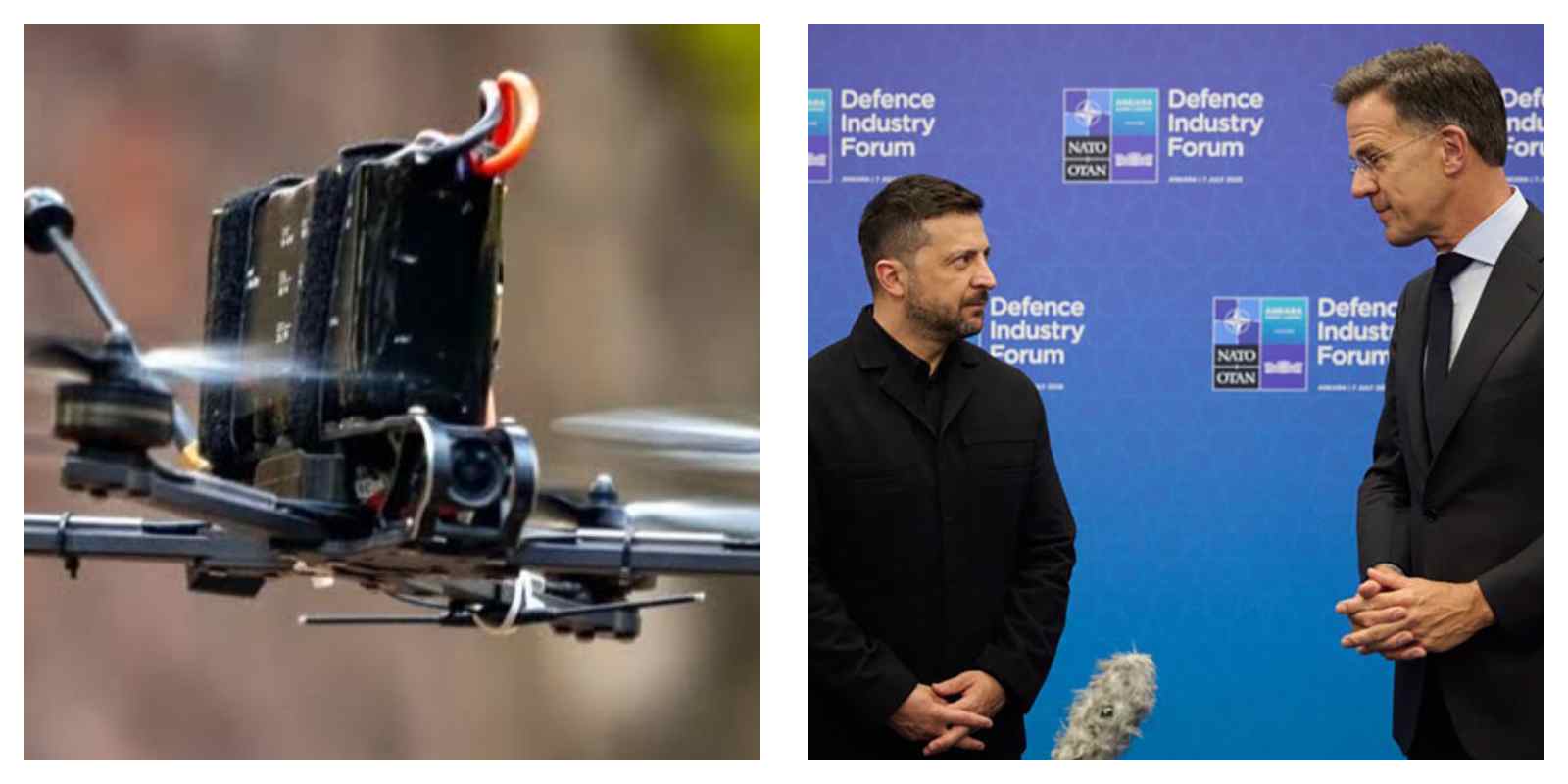
Estonia and Ukraine are set to jointly develop drones in a bid to ramp up their air defences.
Kyiv has been facing the brunt of a Russian barrage on a near daily basis since the start of the war with Moscow more than four years ago.
As a result, defence has become an elevated point of interest for nations located near the conflict, including Estonia, which is now strengthening its military technology.
Defence remains priority
The agreement, signed between Estonian Prime Minister Kristen Michal and Ukrainian President Volodymyr Zelenskyy on the sidelines of the North Atlantic Treaty Organisation (NATO) summit in Turkey this week.
Both nations will expand their co-operation on drones and the defence industry.
Estonia and Ukraine will particularly share expertise in drone technology, cybersecurity, information technology and military innovation.
Ukraine will also be able to export selected defence products to Estonia.
Joint ventures
Moreover, joint ventures will be allowed to begin production in both nations, according to Estonian Defence Minister Hanno Pevkur.
Michal praised Ukraine for being among the world’s “most competitive” defence industries, shaped by its ongoing fight against Russia.
“It is important for Estonia to create as much combat capability as possible from every euro, and if possible, we also prefer local production,” he was quoted as stated in Euro News.
YOU MAY ALSO LIKE: MPA Singapore, WMU partner up to bolster global maritime education, manpower development

Air defence undergoes change in Baltic states
This also comes as NATO transitions its air policing mission in the Baltic states to an air defence mission, which Lithuania President Gitanas Nauseda said would enhance the nation’s air defence capabilities.
The decades-old air policing mission in Lithuania, Latvia and Estonia was unveiled in 2004 shortly after they joined NATO.
The mission had been utilised to identify and escort Russian military planes flying close to the states.
But this year, aircraft gunned down suspected stray Ukrainian drones over Estonia and Latvia, marking the first time the mission opened fire.
“(The current) air policing mission is meant for peacetime, when fighters react to incidents by escorting. This way, we show that we take note of the incidents. It’s a kind of deterrence”, Nauseda told reporters cited by Reuters.
“But what is happening today is not a totally peaceful environment.”
The move is expected to provide pilots with a wider mandate, allowing for a “greater flexibility and faster response to air threats,” Estonian Foreign Minister Margus Tsahkna said.
Latvia looks to enhanced eastern border
Meanwhile in Latvia, authorities are ramping up the nation’s defence along the eastern border.
Its Ministry of Defence recently announced the deployment of additional air defence systems in bid to reinforce the border.
No specific details about the kind of systems that will be deployed were revealed, however, citing operational security reasons.
Defence Minister Raivis Melnis said that alongside drones, radars and bolstered training, Latvia needed the integration of defence systems, especially as the Russia-Ukraine war continues.
The Latvian National Armed Forces has been fortifying the nation’s eastern border since 2024, aimed at deterring, halting, and even eliminating a potential aggressor if deemed necessary, the Baltic News Network reported.
About EUR45 million was set aside to strengthen the eastern border in 2025, and was increased to EUR55 million just this year.
Latvia has also been reporting crashes of several unmanned aerial vehicles in its territory, with one in particular neutralised by NATO fighter jets.
READ MORE: German university establishes independent Islamic theology faculty
 Kamille Q. Cabreza
  Jheruleene Anne Ramos