
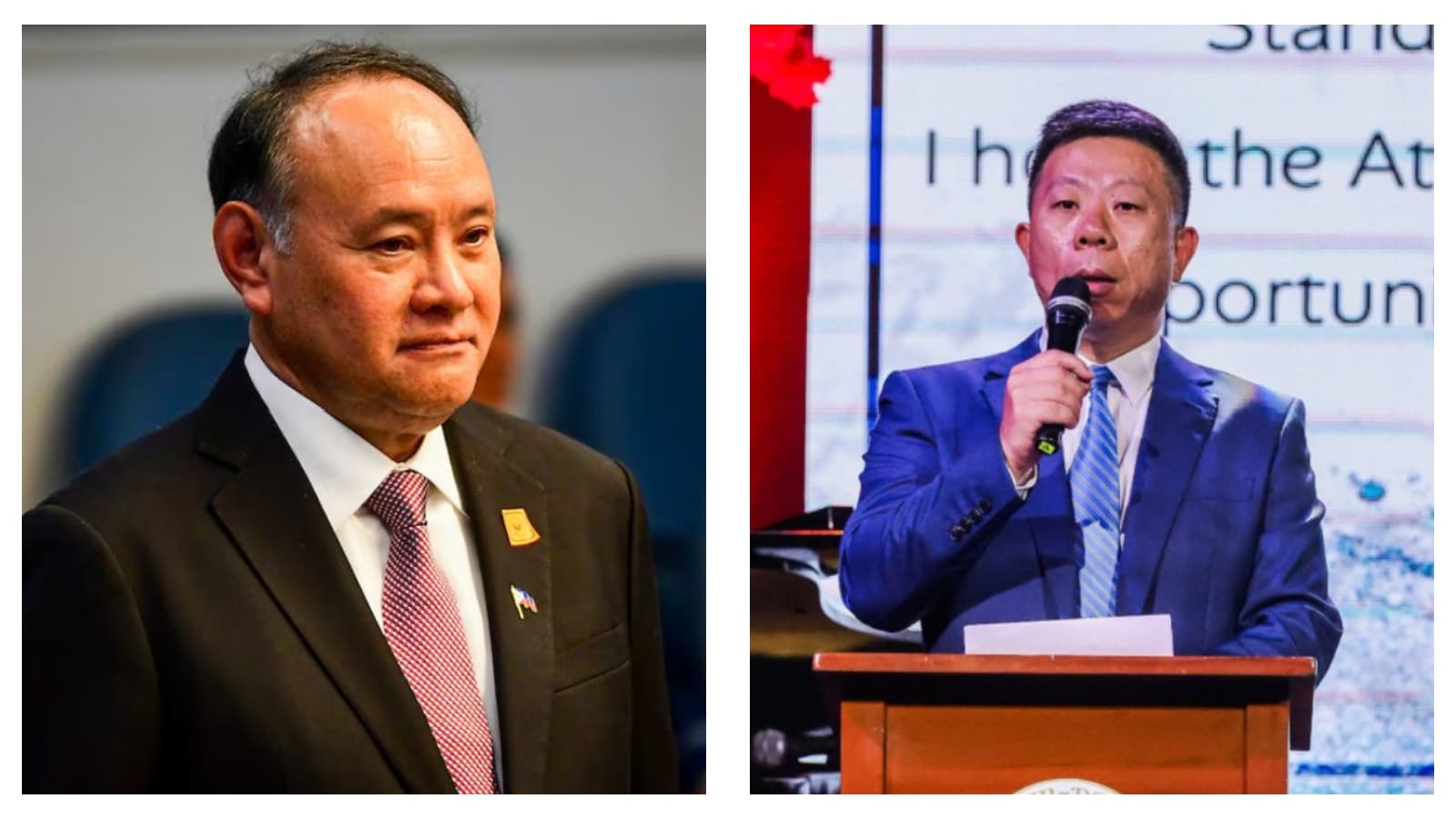
The Philippine government has denounced Chinese ambassador Jing Quan’s statement on the West Philippine Sea conflict, calling it a “thinly veiled threat” meant to intimidate the archipelagic nation.
In an interview on Thursday, Jing said that China could “easily win” a military conflict against the Philippines should a confrontation happen between the two countries.
“We should feel fortunate enough that you have a neighbour like China in this region,” Jing told reporters on the sidelines of a Philippine-China forum in Quezon City.
“If we want to use force, we may easily win – but no, we’ll not use force,” he added, stressing that Beijing prefers to tackle the conflict peacefully.
DFA decries intimidation
The Department of Foreign Affairs, in a statement on Thursday, called out the Chinese ambassador for his “poor choice of words” that could be easily interpreted as an act of intimidation.
“It is regrettable that Chinese ambassador Jing Quan today had a poor choice of words that would seem to convey a thinly veiled threat of the use of force,” it said.
DFA deemed Jing’s statement “hardly helpful in the context of the complicated bilateral ties” between Manila and Beijing.
It also warned other diplomats to exercise caution when making public statements about the Philippines.
READ MORE: US mulls easing sanctions on Russia’s shadow fleet to curb freight costs
Teodoro slams threat
Likewise, defence secretary Gilberto Teodoro Jr. lambasted the Chinese ambassador for seemingly making public a warning that China had previously conveyed privately about crossing its perceived red lines.
“We are really studying this statement because that was not a slip of the tongue,” Teodoro explained to journalists in a radio interview on Friday.
“This is a threat. That is what the statement really contains. They are intimidating us.”
Jing earlier called on the Philippine government to resume its military-to-military communications with China, saying that the country faces “a greater risk of confrontation” if it maintains its non-communicative stance with the military giant.
In 2023, Teodoro suspended direct defence communications with China over alleged abuse of communication channels.
However, the DFA and the Philippine Coast Guard continued to maintain open lines of communication with the country.
YOU MAY ALSO LIKE: Steven Soderbergh steps in to finish ‘The Batman Part II’ filming

Marcos seeks explanation
Philippine president Ferdinand Marcos Jr., in an ambush interview with media on Friday, said that he will be summoning the Chinese ambassador over a statement that seemed like a “threat”.
“I think that deserves a discussion between the ambassador and myself,” said the president.
“It sounds very much to me like a threat, and it is not a very diplomatic statement to make. So, we perhaps would like to understand what exactly it is that he means.”
Marcos had previously lamented how China’s aggression is felt mostly by the Philippines when compared to other countries contesting their claims on the South China Sea.
On separate occasions, the Chinese Coast Guard and the People’s Liberation Army Navy have reportedly subjected Philippine maritime vessels and Filipino fishermen to multiple threats, harassment, dangerous manoeuvres and water-cannon use.
READ NEXT: Time’s up for the “leap second”

Nine-dash line claim
China’s nine-dash line forms the basis of its maritime claims in the South China Sea, including areas that overlap with the Philippines’ exclusive economic zone in the West Philippine Sea.
Beijing cites historical maps and records to support its claims to maritime rights in the region.
In 2016, an arbitral tribunal ruled that China had no legal basis under the United Nations Convention on the Law of the Sea (UNCLOS) to claim historic rights to resources beyond those permitted by the convention.
The ruling is final and binding on the parties involved in the arbitration process as per Article 296 of the UNCLOS and Article 11 of Annex VII of the convention.
However, Beijing rejected the ruling and continues to assert its claims in disputed areas, overlapping with those of the Philippines, Vietnam, Malaysia, Brunei and Taiwan.
YOU MAY BE INTERESTED IN: NCT announces comeback in November
 Ciara Mina
  Rosemarie Zamora
  Jacinth Banite